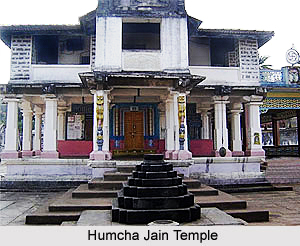
 Humcha or Hombucha is one of the famous Jain pilgrimage centres. It is located in Karnataka. According to the inscriptions it is also known as Pomrchcha and Pombucha. The temple was constructed by Jinadattacharya, the founder of the Santhara Dynasty in the 7th century.
Hombucha is also popular for its Jaina Math that was long back constructed by the monks. These monks belonged to Nandi Sanga of Kunda Kundanavaya. The Math houses temples like the Parshvanatha temple, Padmavati temple, Marthanda Basadi, Bogara Basadi and Jattigaraya Basadi. The Math is adorned with evergreen Lakki trees which are believed to be more than 1300 year old.
In the vicinity of the village a hill is located. On top of this hill an old basadi is situated that is dedicated to Bahubali. According to an inscription the basadi was built in 898 AD by Vikramaditya Santara. Many Sculptures and monuments have been unearthed from this place. A Pancha Matrika sculpture had been discovered in front of the Kalleshwara temple that dates back to 17th century.
History of Humcha Jain Temple
According to history Prince Jinadattaraya came from Mathura. He had established a kingdom in the south and made Hombucha his capital. Once the prince, Jinadattaraya was travelling on his horseback from Mathura. He was carrying with him the image of Padmavati Devi. After travelling a long distance he reached Hombucha, near the hillock called Bahubali Gudda. Upon reaching he was extremely exhausted and hence he went off to sleep under the shade of Lakki tree. It is said that while sleeping he saw a dream wherein he was instructed to build his capital at the place with the help of the people living in the jungle.
Temples of Humcha
There are many temples located in Humcha. An old Jain temple, Panchkuta Basadi belonging to 10th century is located here. It has been built in the Chaukyan style. It is adorned with a common navaranga and an open mukhamantapa. It consists of five cells that have been constructed in a row and has a verandah enclosing the temple.
In front of the basadi is a manastambha which is a magnificent monolithic pillar. It has been intricately carved with artistic designs and stands as an interesting piece of work. The pillar stands on a three tier high platform. Carved elephants adorn the four corners and the cardinal points. Lions in different postures are carved in-between these elephants.
Festivals are also organised with much pomp and show. The car festival of Padmavati Devi is held every year on the Moola Nakshatra day. It falls in the month of March. The Navaratri festival also attracts a large number of devotees from different places.