
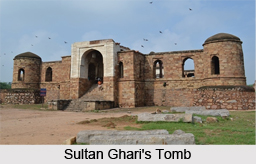
 Sultan Ghari Tomb was the oldest Islamic mausoleum which was established during 1231 AD for Prince Nasiru`d-Din-Mahmud who was the eldest son of Iltutmish near Malakapur village in Delhi. Currently, this region corresponds to Vasant Kunj locality of the national capital of the country. Iltutmish belonged to the Slave Dynasty and he was its third Sultan who reigned Delhi from 1210 till 1236 AD. The region wherein the Sultan Ghari Tomb is existent was once a portion of the first Indian city of medieval Delhi and was a crucial place for the Slave Dynasty which remained in power from 1206 to 1290 and presently, it is within the Qutb complex. This tomb is based inside a `Ghari` or cave which can be accessed by a winding stone series which is supported by flooring and strong pillars. An octagonal terrace slab covers the cave. A combination of sandstone and marble embellishes the outer parts of the tomb structure which is equipped with towers or `bastions` on corners, which makes the Sultan Ghari tomb resemble a beautiful fortress following the oriental and Persian style of architecture. The other tombs which are present in the premises of Sultan Ghari tomb are yet to be identified.
Sultan Ghari Tomb
Sultan Ghari Tomb, Delhi was built by Iltutmish for his favourite eldest son, Prince Nasiru’d-Din-Mahmud during 1231 AD who helped him conquer eastern India comprising Bihar and Bengal by defeating their ruler Iwaz in a battle.
Introduction
Sultan Ghari Tomb was the oldest Islamic mausoleum which was established during 1231 AD for Prince Nasiru`d-Din-Mahmud who was the eldest son of Iltutmish near Malakapur village in Delhi. Currently, this region corresponds to Vasant Kunj locality of the national capital of the country. Iltutmish belonged to the Slave Dynasty and he was its third Sultan who reigned Delhi from 1210 till 1236 AD. The region wherein the Sultan Ghari Tomb is existent was once a portion of the first Indian city of medieval Delhi and was a crucial place for the Slave Dynasty which remained in power from 1206 to 1290 and presently, it is within the Qutb complex. This tomb is based inside a `Ghari` or cave which can be accessed by a winding stone series which is supported by flooring and strong pillars. An octagonal terrace slab covers the cave. A combination of sandstone and marble embellishes the outer parts of the tomb structure which is equipped with towers or `bastions` on corners, which makes the Sultan Ghari tomb resemble a beautiful fortress following the oriental and Persian style of architecture. The other tombs which are present in the premises of Sultan Ghari tomb are yet to be identified.History of Sultan Ghari Tomb
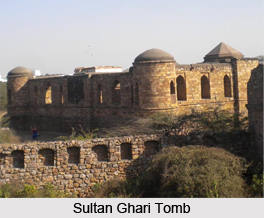 History of Sultan Ghari dates back to the period around 1231 AD, when it was constructed for the Islamic prince named Nasiru`d-Din Mahmud who was the eldest son of Iltutmish, one of the rulers of the Slave Dynasty. Sultan Ghari is the oldest mausoleum in the country and is located in Malakapur village close to Vasant Kunj in Delhi. Iltutmish had conquered the eastern portion of India during 1225 AD in order to gain administrative control of the area of Lakhnauti which presently constitutes a ruined city in the state of West Bengal that is Gaur. The battle which ensued consequently made the then king of Bihar and Bengal lose to Iltutmish which led to the signing of a peace treaty between the ruler Izaz and Iltutmish. Izaz was compelled to pay a hefty amount of 80 lakh `tankas` or silver currency, along with 38 elephants, several coins issued by the name of Iltutmish, mint and eventually acknowledging Sultan Iltutmish`s monarchy over the area. Prior to his return to Delhi, Iltutmish subdivided the eastern India into Lakhnauti and Bihar, establishing Alauddin Masud Jani as his general in Lakhnauti. However, Lakhnauti`s rule was temporary as he was overpowered by Iwaz after Iltutmish`s departure.
Therefore, Prince Nasiru`d-Din Mahmud was asked to put up a bold fight against Iwaz, wherein Iwaz was conquered and killed in 1227 AD along with all his noblemen. The then Governor of the province of Lakhnauti then joined the Oudh region with Bihar and Bengal, after making Lakhnauti his official capital. Iltutmish was quite impressed by the prince`s valour and granted him the title of `Malik-us-Sharq` or King of the East. His reign was short but just after 18 months, Nasuru`d-Din Mahmud was executed. Iltutmish had built the Sultan Ghari tomb in the memory of the young prince during 1231 AD, which is located near the complex of the Qutub Minar. Iltutmish died in the year 1236 and his own tomb is situated near Qutab Minar.
Near Sultan Ghari is existent two tombs of the two other sons of Iltutmish named Muizzudin Bahram Shah who was killed during 1241 AD and Ruknuddin Feroze Shah who died in 1237 AD. Their regime was short-lived and they had reigned before and after the rule of their renowned sister Razia Sultan and were buried in different cenotaphs or `Chhatris`. While one of the Chhatris is completely in ruins the other had been conserved. Excavations conducted by the Archaeological Survey of India has revealed a stone lingam, an isolated mosque belonging to the era of the rule of Firoz Shah Tughlaq and also an inscription dating back to 1361 over the surface of a tank which had been dug out during a marriage. Certain scattered remnants of the Mughal Dynasty have also been discovered.
Architecture of Sultan Ghari Tomb
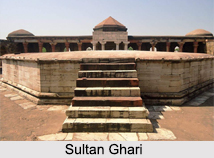 The architecture of Sultan Ghari is slightly unique as it has been constructed in a manner similar to a fortress equipped with a courtyard which is generally not observed inside tombs. Sultan Ghari is erected over a raised platform of a particular height composed of rubble masonry structure. This Indian tomb has been constructed in a beautiful octagonal shape inside a fortress chamber which possesses four corner towers on top of a cave or `Ghari` based in front of the western Qibla, wall of the mosque. The architectural plan of Sultan Ghari involves the combination of an underground room for the crypt and also an over ground tomb along with towers.
The octagonal grave chamber with the tomb in an underground opening is supported on four columns raised with two pillars. Each of the pillars supports beams, and depicts ancient Indian temple relics both on the columns and on the floor. The roof of the chamber is built in thick lime concrete. The western Qibla or the prayer wall which has the Mihrab is made of marble in exquisite Turkish and Afghan design. The Mihrab also has inscriptions from the Quran on it. The prayer chamber in front of the Qibla depicts a yoni-patta or the base slab of the Lingam.
The entire design of the tomb of Sultan Ghari represents the style of corbel arch construction which was quite common in the nation much prior to the real arch design introduced by the Romans. Such architectural styles were observed in the Islamic monuments. It is believed that the tomb had been restored by Firoz Shah Tughlaq. The structure of the Chhatri which is located close to the Sultan Ghari was also preserved by Firoz Shah Tughlaq. The tomb is surrounded by the ruins of old villages. Towards the southern end of the tomb, there are situated the ancient ruins of "khanqah" or a space of spiritual retreat, Tugluq mosque and Jami Masjid.
Worship at Sultan Ghari Tomb
Sultan Ghari is an important pilgrimage spot for Muslims as well as Hindus and devotees from Rangpuri and Mahipalpur villages regularly visit this place as they believe it is the holy abode or `dargah` or a `peer` or saint. Newly wedded people visit the tomb for obtaining his divine blessings and it is much better conserved by the regional inhabitants than the Archaeological Survey of India or ASI. During Thursdays, Muslims and Hindus arrive at Sultan Ghari. The tomb is thronged by innumerable pilgrims from various portions of Delhi during the 17th day of the Islamic month of `Ziqad` and even during `Urs`, which means the death anniversary of Nasiruddin Shah.
Recently updated articles in Indian Monuments
Badshahpur Fort
Badshahpur Fort is a historic defensive structure reflecting the architectural traditions of its era. Built with granite and red sandstone, the fort w...
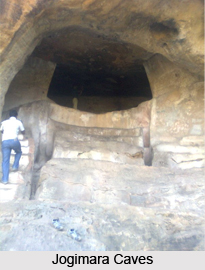
Sitabenga and Jogimara Caves
Sitabenga and Jogimara Caves in Chhattisgarh are ancient rock-cut monuments dating to the early historic period. Known for their Brahmi inscriptions,...
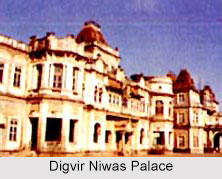
Digvir Niwas Palace
Digvir Niwas Palace in Vansda, Gujarat is one of the popular heritage buildings that reflect the majestic architecture of the early 20th century.
Historical Monuments of Satara
Among the historical monuments of Satara the fort at Satara is the most famous. Most of the constructions here belong to the Marathas.
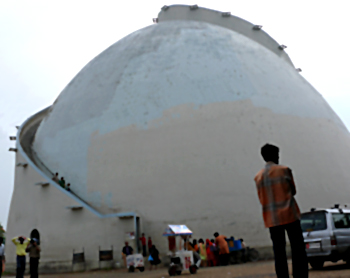
Architecture Of Bihar
Architecture of Bihar consists of Buddhist and Mughal style of architecture.
Related articles in Indian Monuments

Monuments of Lakshwadeep
Monuments of Lakshwadeep are famous for their ancient religious feel and historical value.

Monuments of West Bengal
Monuments of West Bengal, mainly from the British era, are considered as priceless heritage of the state and attracts many tourists to the state.
Monuments of Telangana
Monuments of Telangana covers the ancient, medieval and modern historical structures illustrating the architectural grandeur and attracting thousands...
Architecture Of Andhra Pradesh
Architecture of Andhra Pradesh is an illustration of diverse types of Hindu, Buddhist and Islamic architectural styles.
Architecture of Lucknow
Architecture of Lucknow is mostly Islamic in nature. It is representative of 18th and 19th century Indian architecture. The architecture is broadly di...