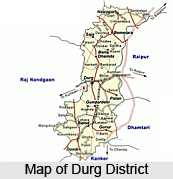
 In the year 1973 Durg was divided and separate Rajnandgaon District came into existence. Since then present Durg District is existing with its headquarters at Durg. District headquarters are located at Durg. This district of Chhattisgarh occupies the south-western part of Chhattisgarh plain and possesses belts of hilly country in the south, southwest and northwest, bestowed with mineral resources and forests. Durg District is located between latitude 20 degree 23 minutes and 22 degree 2 minutes north and longitude 80 degree 46 minutes and 81 degree 58 minutes east. The altitude of the district is 317 metres above the mean sea level. Durg District occupies a total geographical area of 8537 sq kms. Forests account for around 9 per cent (764 sq kms) of the total geographical area. As per the Census record of 2001, the total population of the district is 2,810,436. Until the year 2000, this district was a part of Madhya Pradesh.
Durg initially was part of `Dakshina` or `Southern Kosala`. In the epic `Ramayana`, King Dasaratha of Uttara Kosala married Kosalaya, the princess of Dakshnia Kosala.
The Chinese traveller Huien Tsang visited Southern Kosala in the 4th Century A.D. He mentions that he found an Asokan tope in the Capital city. It is therefore apparent that the District was included in Ashoka`s Empire.
In the 5th century AD, in the famous Allahabad Pillar, Inscription of Samudragupta claiming that two kingdom Kosala and Mahakantara, succumbed to his southern expedition. However, the first specific reference with regard to the word "Durg" comes around the 8th century A.D. through two stone inscriptions; which were found in Durg and later deposited in the Raipur Museuem. The First inscription mentions the name of a king Shiva Deva. The second inscription associates the name of Sivapura (the capital of Shivadeva) with that of Shiva Durga, indicating thereby that during Shivadeva`s reign the town and the fort were separate. The present name "Durg" is evidently a contraction of the old Shiva Durga, which he built. The river on whose banks stands the present town is also called "Shiva River ". With the coming of the Kalachuri dynasty of Tripuri in A.D. 1182, Durg came under there kingdom. From then on it remained under the Kalachuries, till 1742 A. D. when the Marathas deposed them.