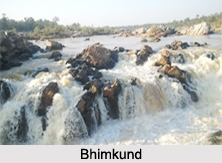
 History of Bhimkund in Kendujhar District of Odisha gives the detailed explanations of myths related to Lord Bhima one of the five brothers in Pandavas clans. Bhimkund is now a water reservoir formed in Eastern Ghats Mountain Range in India.
Reference from Mahabharata
Indian epic Mahabharata links Bhimkund with Pandava clan. Bhimkund came into existence after Bhima, one of the strongest brother in Pandavas hit the ground with his gada to quench the thirst of his wife Draupadi, while they are in disguise. When he hit his gada in the ground of this area, the water plunged on the earth and gave rise to the Bhimkund, now a waterfall and the tourist attraction in Kendujhar District of Odisha. It is being told that, Bhima, the second Pandava had taken bath in this reservoir and hence it was named after him. During Makar Festival in the month of January thousands of people gather here to take their holy dip in Bhim kund. Even now also, the local and the tourists come for the holy dip there.
Location of Bhimkund
Bhimkund lies in an underground cave and is about 30meters from the mouth. To the left of the entrance of Bhimkund, there is a small Shiva linga, the phallic representation of Lord Shiva or Mahadeva, which is now the place of devotion among the Hindus. But what is truly astounding here is that the roof of the cave has a small opening just above the Bhimkund, as this is the spot, where Bhima, one of the five brothers of Pandavas is said to have hit with his gada to quench the thirst for Draupadi. The depth of this pool is believed to be measureless among the local guides and the mythological believers.
Atmosphere in Bhimkund
Bhimkund is a lovely indigo blue which contrasts well with the red stone walls. There are some caves around it but no one has been adventurous enough to find out where they lead.
References from Narada Purana
There is another legend that claimed, Narada Muni performed the Gandharva Gayan (celestial song) in praise of Lord Vishnu. Pleased with his devotion, Lord Vishnu emerged from Bhimkund and the water turned blue because of Vishnu"s dark complexion. No wonder then that the pool is also known as Neel Kund and Narad Kund.
Related Articles
Badaghagra Waterfalls
Kendujhar District
Mayurbhanj Elephant Reserve
Baripada, Mayurbhanj district, Odisha