A number of churches are also to be found here dating back to the time of colonial rule in Mumbai. For instance, the
Afghan Memorial Church of St John the Baptist was designed by the town engineer Henry Conybeare and completed by Captain Tremcheere. The bell chamber and modified steeple were designed by Lieutenant James Augustus Fuller. The Church is important as it was the first in India to be designed using the new principles of Gothic architecture. It is Early English in style with a tall tower and spire, 189 ft high, which form a landmark from a considerable distance at sea. The walls are made of rubble faced in buff-coloured basalt from Coorla, with
Porbandar stone piers, arches and dressings. Internally, the narrow lancet windows have some of the finest stained glass made by William Wailes; in particular, the great west window, the central panel of which depicts the Crucifixion and
Jesus Christ seated in majesty. At the west end of the north aisle is a triple window of stained glass to General David Barr. In the west end of the south aisle is a fine Holditch organ. The chancel is paved with English encaustic tiles and between the lancet windows are the memorial marbles to the fallen of the Sind Campaigns and First Afghan War, 1835-43, in white, red, yellow and blue stone. The ornamental illuminated screen is a later addition, designed by William Butter-field. Many of the fittings were made by the Bombay School of Art.
The
Mount Mary Church, also known as the Basilica of Our Lady of the Mount happens to be a Roman Catholic Basillica situated at Bandra in Mumbai. The feast of Blessed Virgin Mary is celebrated on the first Sunday after 8th September which is the birthday of Virgin Mary. The feast is continued with a week-long celebration known as the Bandra Fair.
The new
Roman Catholic Church of the Holy name and the official residence of the Roman Catholic archbishop of Mumbai are also to be found among the monuments of Mumbai, located right behind the majestic hotel.
The
St. Andrew`s Kirk is a simple neo-classical church in the manner of James Gibbs. The steeple was demolished by lightning in 1826 and rebuilt a year later by John Caldecott, FRS, Astronomer of Trivandrum University. The Church was constructed in 1819.
The construction of the
St Thomas Cathedral was started in 1672 by Gerald Aungier and it opened in 1718. In 1833 the old belfry was replaced by the present tower. The interior is capacious, with a simple plan and plain Tuscan detail. The chancel (1865), by James Trubshawe, is a curious remnant of a much larger reconstruction scheme which failed with the financial collapse of 1865. The principal interest of the cathedral lies in its splendid heritage of monuments. The best is Bacon`s monument to Governor Jonathan Duncan, depicting him receiving the blessings of Hindus, commemorating his energetic suppression of infanticide in
Varanasi and Kathiawar through his agent Colonel Walker. Duncan is buried under a pavement in the nave.
The monument to Katharine Kirkpatrick (1766), mother of Major-General William Kirkpatrick and Major James Achilles Kirkpatrick, who as Residents at
Hyderabad established English supremacy in central India, is a fine marble medallion by Bacon. Note the eloquent inscription.
The
Christ Church at Byculla was built in 1835.It has a Greek Doric portico using spare columns imported for use on the Town Hall. The stained-glass window (1870) commemorates Mr Spencer Compton. A fine monument to Sir Robert Grant and other tombs and brasses of interest can be seen.
The foundation of the
All Saints` Church this church was laid by Lady Ferguson, the wife of Sir James Ferguson, the Governor of Mumbai. This Church became a permanent place of worship for the governors of Mumbai since 1881 as
Malabar Hill turned to be their place of residence. The church has been designed in modern style by Major Mant of the Royal engineers. The walls have been constructed with what is possibly Porbander or Coorla stone and the roof is tiled with
Mangalore tiles. It is a tall building 64 feet high, with a semi-circular chancel of about 16 feet in diameter and a ten feet square vestry. The Church was created as a separate ecclesiastical parish only in 1957.

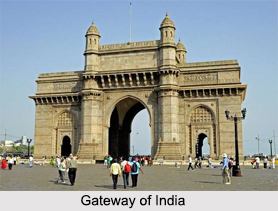 Mumbai, in the state of Maharashtra that holds a history of magnificent and ancient monuments that includes the Gateway of India, Chatrapati Shivaji Terminus, Ellora Caves and so on. The monuments present here are famous worldwide. Different kinds of architecture and art can be spotted in the monuments of Mumbai as it witnessed different dynasties of various eras. The Gateway of India happens to be the most popular monument of Maharashtra. It is also known as the starting point for tourists who visit Mumbai.
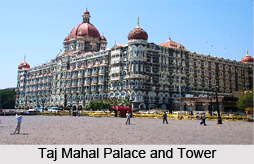 Another major historical landmark of Mumbai is the Taj Mahal Palace and Tower. It is a monument in its own right, powerful and with an atmosphere of self-assured Edwardian solidity. It was built by the millionaire industrialist J. N. Tata and it still retains its social cachet. It is best viewed from out at sea; its prominent red dome, belvedere and curved corner towers, capped by Moorish domes, form a metropolitan landmark. The Taj Mahal hotel is often touted as one of the great hotels of the East.
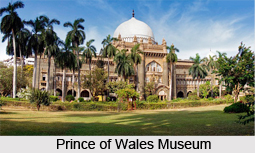 There are three main sections in the museum - Art, Archaeology and Natural History. The Art section contains an excellent collection of arms, the Sir
 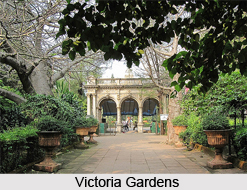 The colossal Rajabai Tower is based on Giotto`s campanile in Florence. . It takes its name from the mother of its benefactor, Mr Premchand Roychand. Around the octagonal lantern are sculpted figures 8 feet high which represent the castes of western India. Above these, forming crocketed finials, arc another set of figures, twenty-four in all, modelled by the Assistant Engineer, Rao Bahadur Makund Ramchendra. Under the clock dials on each face are four small machicolated balconies. From the top of the tower a magnificent view of the city can be obtained, but access is not always possible. However the clock chimes can hardly be held now.
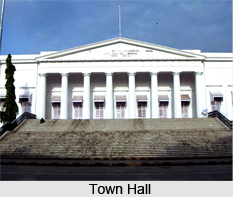 The Town Hall is the finest neo-classical building in India, a sophisticated, assured essay in the Greek revival style. It was designed by Colonel Thomas Cowper and completed after his death in 1825 by others, mainly Charles Waddington, although a certain Augustine of Portuguese origin is reputed to have played an important subordinate role. The facade is raised high on an arcaded basement approached by a massive flight of steps. Projecting jhilmils or window hoods are part of the original design and demonstrate the successful adaptation of Greek Doric architecture to an Indian context. Greek palmettes are seen on the pelmets to the jhilmils. The Doric columns were shipped from England but were considered so monumental on arrival that the original idea of paired columns was dropped, the leftovers being diverted for use at Christ Church, Bycullah, which was under construction at the time.
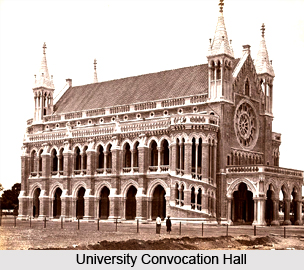 The University Convocation Hall was designed by Sir George Gilbert Scott in 1874.It has been built in the Decorated French style of the fifteenth century. It was financed by the great Parsee benefactor Sir Cowasjee Jehangir Readymoney, to whom there is dedicated statue by Thomas Woolner in the Gardens. The south end is apsidal and separated from the body of the hall by a grand arch. A handsome carved timber gallery carried on enriched cast-iron brackets encloses three sides. Open spiral staircases, recalling those of the great French chateaux at Blois and Chambord, provide external access to the side verandas.
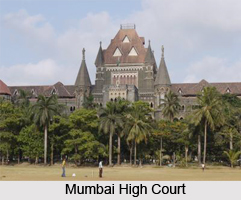 The Mumbai High court is another tropical English Gothic construction. It was designed and built by Colonel James Augustus Fuller, `the leading constructional engineer of his day`. This enormous pile is 562 ft long and 195 ft wide, dominated by a large central tower 186 ft high, on cither side of which arc lower octagonal spire-capped towers crowned by figures of Justice and Mercy. These contain private staircases for judges, the main staircase on the eastern side being approached by a groin-vaulted corridor in Porbandar stone with a floor of Minton tiles. The gaunt exterior is roughly dressed in blue basalt enriched with dressings of stucco, Porbandar, Coorla and Sewri stones, surmounted by steeply pitched roofs clad in Taylor`s patent red tiles.
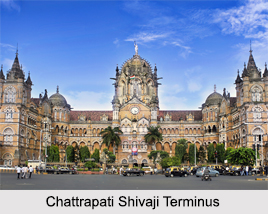 The
The 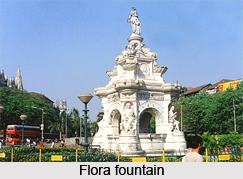
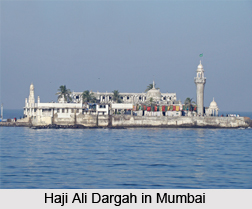 One of the prime religious monuments of Mumbai is the Haji Ali Dargah. The Dargah was built in 1431 by Haji Ali, a rich Muslim merchant who gave up all worldly pleasures before going on a pilgrimage to Mecca. It is situated 500 yards from the shoreline in the centre of Worli Bay. This dargah was built in the ocean and joined to the mainland by means of a narrow pathway. This pathway is more than 1312 feet in length and can be walked on only during a period of low tide. Constructed as a fine example of the Indo-Islamic style of architecture, the dargah features a single minaret and a beautiful marble courtyard. The central shrine is placed in the courtyard. The tomb is always covered by a brocaded red and green sheet supported by a delicate silver frame. There are marble pillars within the hall which are adorned with mirrors with multiple hues.
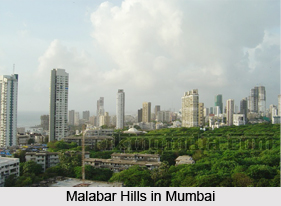 The
The 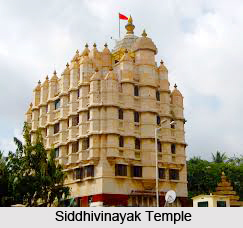 The
The 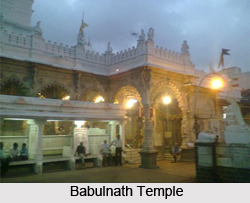 Near the steps leading to the towers is the distinctive profile of the
  The
The