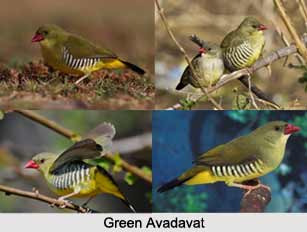
 Green Avadavat or Green Munia is an Indian Bird that bears a scientific name "Amandava Formosa".
Category of Green Avadavat
Green Avadavat is a species of Estrildid finch family with green and yellow on the body, a bright red bill and black "zebra stripes" on the flanks. They are endemic to the Indian subcontinent and were formerly popular as cage birds.
Distribution of Green Avadavat
The name "avadavat" is a corruption of the name the city of Ahmedabad in Gujarat, which was a centre of bird trade in ancient India. They have a restricted distribution and populations are threatened by the bird trade. Green Avadavat has been a popular cage bird and has been in the bird trade since the late 19th century. It continues to be common in the wild in areas such as Mount Abu in Rajasthan, but has declined mainly due to trapping. In trade the bird is called the green waxbill. The entire flocks of Green avadavat are easily trapped using bait and decoy birds.
Structure of Green Avadavat
Green Avadavat is approximately 10 cm long with green above, yellow below, black and white bars on the flank and reddish bill. Both sexes have pale tips to wing-coverts and tertials. The upper plumage is olive green. The upper tail coverts are more yellow and the tail is black and rounded with broad feathers. The chin is pale yellow and the lower breast, belly and vent are brighter yellow. The flanks are barred with brown and white. The bill is waxy red and the legs are pale fleshy or brown. The female is slightly paler than the male. Young birds are duller with a black bill and lack the barring on the flanks.
Habitat of Green Avadavat
Green Avadavat is found mainly in the dry scrub regions and agricultural lands and is often found close to water. The largest populations are in central and north-western India. A population of escaped birds once existed near Lahore. The key areas where Green avadavat are well known are in central India, around southern Rajasthan, central Uttar Pradesh, southern Bihar and West Bengal extending south to southern Maharashtra and northern Andhra Pradesh. There are some records from further south from Wyanad District in northern Kerala and it is unclear if these are wild populations.
Breeding of Green Avadavat
The breeding range of Green Avadavat is in central India that is from October to January but is also known to breed in July.
Nests of Green Avadavat
The nest of Green Avadavat is made out of broad leaves of grass or sugarcane and is spherical with an entrance on the side. Several nests may be built in the vicinity by pairs that form a loose colony. They forage in small groups especially in the non-breeding season.
Egg of Green Avadavat
The clutch of Green Avadavat is four to six eggs.
Song of Green Avadavat
The voice song of Green Avadavat is high-pitched warble, ending with prolonged trill with weak seee and swee notes not unlike that of Turdoides subrufus.