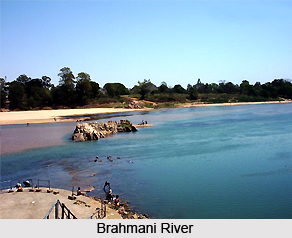
 Geography of Sundargarh district, Odisha, covers a vast variety of landscapes including mountainous terrains, inaccessible forests, isolated peaks and river valleys. The district primarily exhibits an undulating table-land having different altitudes, often interrupted by hill ranges and meandering rivers like Brahmani and Ib. The land of the district has a slope from north to south direction.
Topography of Sundargarh District
The southern part of the district has the Ib river valley and a well cultivated open land. In the Sadar sub-division of the district, the undulating land rises to an average altitude of 700 feet. At places, it is studded with peaks and hills of about 2000 feet height. In the western part of the district at Hemgir, the land rises gradually to the table-land of Chhotanagpur towards its north. In the area under the Bonai sub-division, situated in south east of the district, there is jagged forest along with hills intersected by passes and gorges. The region also houses a narrow valley of the Brahmani River and its tributaries. During rainy season, the stream of rivers often cuts of the communication. High mountain ranges such as Bichakani and Chheliatoka stand towering on east and west of the river valley respectively. Bichakani hill of the district is much significant as it hosts million of tonnes of iron-ore which finds extensive usage in Rourkela steel plant. The regions of Panposh and Sundargah subdivisions have an altitude of 700 feet above the sea level whereas Bonai sub division has a height of 800 feet above the sea level.
Forest of Sundargarh District
The district houses forests of northern tropical dry deciduous type where the common varieties found are Sal, Kurum and Assan with Sal forming the dominant species. Good quality of vegetation is found in eastern part of Rajagangapur and Bonai regions. Rich mineral resources are found in the forests such as lead, limestone, manganese and iron ore. Some important forest products found in the district are kendu leaf, timber and bamboo, which find great utility in export industries. Previously the forests of Sundargarh district were highly inaccessible which often used to make the communication difficult. However with the practice of shifting cultivation by the tribal population, the forest cover has substantially reduced making them accessible. An area of 3534.92 square kilometres of the district is under the forest cover out of which 612.07 square kilometres area is under protected forest and 2664.64 square kilometres area is under reserved forest. To enhance the revenue generated by the forest products, much emphasis is laid by the state government on afforestation through various programs such as N.R.E.P and D.R.D.A.