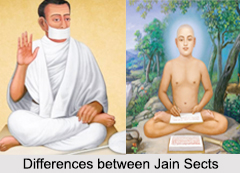
 Differences between Jain Sects depend upon the rituals, customs and manners that are opposed to each other. Both agree on the fundamental Jain principles and the five vows in Jainism. However, both have different views when it comes to scriptures, liberation, dress, birth of Lord Mahavira, etc.
The major differences between the Digambaras and Swetambaras are as follows:
1. Practice of Nudity - The Digambara stresses the practice of complete nudity as an absolute prerequisite to the mendicant"s path and to the attainment of salvation. Swetambaras assert that practice of complete nudity is not essential for attainment of salvation.
2. Liberation of Women - Digambaras say women are not mentally and physically capable of attaining salvation in that very life. Hence she must be reborn as male to attain liberation. Swetambaras believe women can attain salvation in that very life as the men.
3. Food of Omniscient - According to Digambaras, once a monk attains Kevali Jnana, he does not need food for his survival. This claim is rejected by the Swetambaras.
4. Idols of Tirthankaras - Digambaras idols are nude and eyes downcast in contemplative mood. Swetambaras on the contrary, depict their idols of Tirthankaras wearing loin cloth, body decked with jewels and glass eyes inserted.
5. Embryo of Mahavira - Swetambaras believe Mahavira was born to Queen Trishala but the womb was conceived by Brahmin lady Devananda. The embryo is believed to have been transferred by Lord Indra on the 83rd day after conception. Digambaras reject this claim as absurd and unreliable.
6. Marriage of Mahavira - Digambaras believe Mahavira was not married. Swetambaras believe Mahavira was married and had a daughter named Priyadarshani and lead a full fledge householders life till he became an ascetic.
7. Jain Canonical Literature- Digambaras believe that the original and genuine texts were lost long ago. Swetambaras believe in the validity and sacredness of 11 Angas and 12 Upangas.
8. Food of Ascetics - Digambara monks take their food standing with the help of knotted upturned palms from only one house where their Sankalpa is fulfilled while Swetambara monks collect food from different houses.
9. Jina Mallinath - According to Digambaras, Mallinath was a man whereas Swetambaras regard Mallinath as woman.
10. Possessions of Ascetics- Digambara ascetic are allowed only 2 possessions i.e. peacock feather whisk broom and wooden water pot. Swetambara ascetics are allowed to have 14 possession including loin cloth, shoulder cloth, begging bowls, etc.