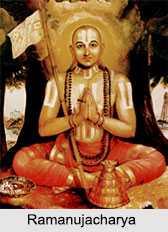
 Development of Vaishnavism in the post Ramanuja period received a great impetus. This period witnessed further growth of Vaishnavism through three successive stages. The first one extended for a period of two centuries up to the advent of Vedanta Desika and Pillai Lokacharya who were contemporaries. The second stage covers their life period and the third stage refers to the post-Vedanta Desika period extending nearly six centuries.
Development of Vaishnavism under Vedanta Desika and Pillai Lokacharya
During the first stage, a few immediate disciples of Ramanuja and his later successors expounded the teachings of their spiritual leader faithfully through oral discourses and writings which were in the nature of glossaries on Ramanuja`s works. An interesting feature of the literature that grew up during this period is that it was written in a popular style known as Manipravala which is Tamil language interspersed with words in the Sanskrit language or Sanskritised Tamil prose and therefore, easier to understand by persons not too well versed in Sanskrit. These works are mostly in the form of commentaries on some of the Sanskrit works of Yamunacharya and Ramanuja and more importantly on the Tamil hymns of the Alvars. It was for the first time that a commentary was written on the hymns of Nammalvar by Kurukesa also known as Pillan, the closest disciple of Ramanuja under the latter`s direction. This commentary is titled "Ardyirappadi", which literally means a work of six thousand units. This marks the beginning of popularisation of the teachings of Alvars.
This commentary of Pillan was followed by many other more detailed commentaries. Nanjiyar (A.D. 1182) wrote a commentary called "Onpatindyirappadi" on Tiruvaymoli. He was followed by Periyavaccan Pillai (A.D. 1228) who for the first time wrote commentaries on all the 4000 hymns of the Alvars. Another important contribution was made to the Manipravala literature by Vadakkuttiruvidi Pillai (A.D. 1217) who wrote an elaborate, scholarly commentary on Tiruvaymoli entitled "Muppaitiyarayirappadi" popularly known as "Idu". All these works in Manipravala style helped considerably to popularise the teachings of Vaishnavism, thereby establishing the claim of ubhaya-vedanta for the Visistadvaita. The ubhaya-vedanta signifies that the system of Ramanuja is based on the Upanishads and the Tamil hymns of the Alvars which accorded the status of revealed Scripture in so far as it contains the teachings of the Upanishads.
During this period a few important works in Sanskrit were also composed both as independent treatises as well as commentaries. These have thrown light on specific topics of Vaishnava theology. The "Sristava" of Srivatsanka Misra, the "Srigunaratnakosa" of Parasara Bhattar, the commentary of Nanjiyar on the "SriSukta" of the Rig Veda and the commentary of Periyavachan Pillai on the "Chatusloki" have expounded for the first time, the doctrine of Goddess Sri in Vaishnavism. Similarly, the four other lyrics of Srivatsanka Misra -"Atimanusastava", "Varadarajastava", "Vaikunthastava" and "Sundarabahnstava"; the "Bhagavadguna Darpatna"of Parasara Bhattar, the commentaries of Periyavachan Pillai on Ramanuja`s "Gadyas" and Yamunacharya`s "Stotraratna" provide a detailed exposition of the Supremacy of Lord Vishnu and His attributes. The "Srutaprakasika", the learned commentary on Ramanuja`s "Sri Bhasya", written by Sudarsana Suri in this period has provided a solid foundation for the Visistadvaita Vedanta.