
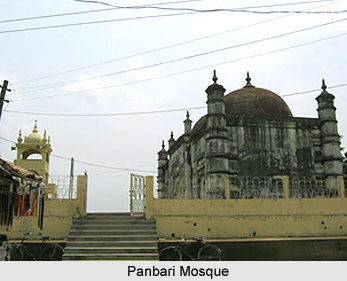
 Dhubri District of Assam is one of the administrative districts of the state. Interestingly, Assam starts with its south-western boundary with this district. Presently, Dhubri District is one of the three civil sub-divisions of former Goalpara district, formed in the year 1876 during British regime. In the year 1879, the district headquarters was shifted from Goalpara to Dhubri. Dhubri District is covering a total area of 2,838 sq kms including forests, hills, rivers, etc. This district has become one of the most densely populated districts of the country. Agriculture is the main livelihood for majority of the people of the district. The name Dhubri was derived from the tale of `Chand Sadagar`.
Dhubri District
Dhubri District, the administrative district of Assam, is one of the densely populated districts. This culturally rich district of Assam has three administrative sub-divisions and its economy is primarily agriculture based.
Introduction
Dhubri District of Assam is one of the administrative districts of the state. Interestingly, Assam starts with its south-western boundary with this district. Presently, Dhubri District is one of the three civil sub-divisions of former Goalpara district, formed in the year 1876 during British regime. In the year 1879, the district headquarters was shifted from Goalpara to Dhubri. Dhubri District is covering a total area of 2,838 sq kms including forests, hills, rivers, etc. This district has become one of the most densely populated districts of the country. Agriculture is the main livelihood for majority of the people of the district. The name Dhubri was derived from the tale of `Chand Sadagar`.History of Dhubri District
In the year 1669 AD, Raja Ram Singh of Amber was deputed by one of the greatest Mughal Emperors in India, Aurangzeb to crush a rebellion by the Ahom king Chakradhwaj Singha. However, Raja Ram Singh requested Guru Tegh Bahadur to accompany him. Guru`s role was proved much more crucial than his mere presence. This operation was actually a punishment for Ram Singh because it was from his custody that the Maratha Emperor, Shivaji and his son had escaped, a few years earlier.
On arrival to Kamrup District early in February 1669 AD, Guru Tegh Bahadur camped at Dhubri while Raja Ram Singh with his army camped at Rangamati Fort. However, the Mughal Army was confident but still not sure whether the holy man with them would be able to destroy the evil effects of magic and witchcraft of the Assamese. Just across the river, the superior numbers of the Imperial Mughal Army unnerved the Assamese but they were confident that the supernatural powers of their magicians would keep the attackers at bay. From across the river the Assamese army hurled a 26-foot-long stone, which came arcing across the sky like a missile and struck the ground, near Guru`s camp, so hard that nearly half of its length was embedded in the ground. It can still be seen in the same position. Later the Government of British East India Company placed a historical brass tablet when they tried to dismantle the tilted stone in the heart of the city.
On arrival to Kamrup District early in February 1669 AD, Guru Tegh Bahadur camped at Dhubri while Raja Ram Singh with his army camped at Rangamati Fort. However, the Mughal Army was confident but still not sure whether the holy man with them would be able to destroy the evil effects of magic and witchcraft of the Assamese. Just across the river, the superior numbers of the Imperial Mughal Army unnerved the Assamese but they were confident that the supernatural powers of their magicians would keep the attackers at bay. From across the river the Assamese army hurled a 26-foot-long stone, which came arcing across the sky like a missile and struck the ground, near Guru`s camp, so hard that nearly half of its length was embedded in the ground. It can still be seen in the same position. Later the Government of British East India Company placed a historical brass tablet when they tried to dismantle the tilted stone in the heart of the city.
Geography of Dhubri District
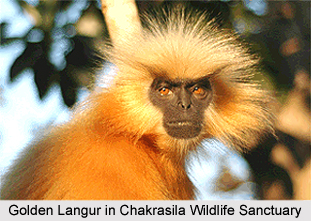 Geographically, Dhubri District is bounded both by inter-state and international border (West Bengal and Bangladesh) in the west, Goalpara District and Bongaigaon District of Assam and Garo Hills district of Meghalaya in the east, Kokrajhar district in the north, Bangladesh and Meghalaya in the south. This district is situated between 89.42 to 90.12 degree east longitude and 26.22 to 25.28 degree north latitude. The district is situated at 30 meters above the sea level. The general topography of Dhubri district is plain scattered with patches of small hillocks like Tokorabandha, Dudhnath, Chandardinga, Boukumari, Boropahar, Chakrasila, etc. All these are located in the north eastern part of the district. Brahmaputra River is flowing through this district from east to west with its tributaries like Champabati, Gourang, Gadadhar, Gangadhar, Tipkai, Sankosh,Silai, Jinjiram etc.
Demography of Dhubri District
According to the Population Census in 2011, Dhubri District had population of 1,948,632. Out of which the male and female were 998,346 and 950,286 respectively. Dhubri District`s population constituted 6.25 percent of total population of Assam.
The population density of Dhubri district is 1,171 people per sq. km. The average literacy rate of Dhubri was 59.36 percent. If things are looked out at gender wise, male and female literacy were 64.20 and 54.26 respectively. The total literates in Dhubri District were 943,680 of which male and female were 523,682 and 419,998 respectively.
Culture of Dhubri District
 Culture of Dhubri District is an amalgamation of distinctive artistic heritage as well as historical background. Dhubri District, which is popularly known as the gateway of western Assam, was also regarded as the meeting place of diverse cultural groups, which blended in the past. The growth of blended culture in this region particularly in case of literature and language, art and religion is due to constant process of absorption of various races, castes and beliefs of local people, invaders and migrated people. Dhubri District possesses a rich archaeological and cultural inheritance from the ancient time.
Dhubri District came in contact with the foreign invaders earlier than the rest of Assam. As this district is commonly called the doorway of this state, people of different ethnic identity came to this region with dissimilar aims. Interestingly, a major portion of them settled in this region. As a result, Dhubri District witnessed the growth of mingled culture, especially in language, art, literature and religion. The prominent local language of the people of this district is Goalpara District, which is popularly known as `Desi Bhasha`. Simultaneously, people also speak Assamese Language and Bengali Language mainly in the urban area of Dhubri District.
The culture of Dhubri District offers a glimpse of the traditional lifestyle of the people. As far as the dress of the women folk of this region is concerned, Saree is commonly used by both urban and rural women folk. In the earlier days, rural women wore a piece of cloth that was called `Patani`. Interestingly, this style of clothing is still seen in some rural areas of the region. The most significant ingredient of the cultural built-up of Dhubri District is its rich and indigenous folksongs and dances which are very popular from ancient time. The themes of these songs and dances are mainly based on religion and love affairs. Goalparia folk song is considered as the soul of the culture of this district.
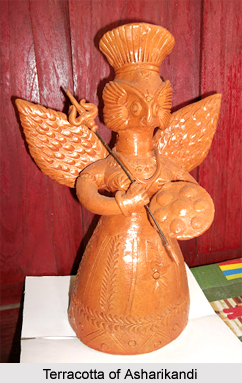
The material evidences of rich cultural tradition of Dhubri District are marked by the existence of several heritage buildings including temples, shrines and some archaeological remains and a range of crafts that are scattered all over the region. `Terracotta of Asharikandi` is a popular craft that is practiced among the "Kumbhakar" or Kumara (potter) community of Asharikandi village near Gauripur. Terracotta (means burnt clay) craft was previously confined to their families and neighbourhood areas. But, presently, it covers a major position through out the country. Pith Craft is a folk art of Kuhila practiced by the Malakar or Bhuimali communities of Dhubri District residing at Gauripur, Golokganj and Bilasipara area. It is locally known as `Sola` or `Kuhila` which are available in the muddy land. The rich culture of Dhubri District replicates the proper blend of rich ancient past and conventional inheritances.
Economy of Dhubri District
Economy of Dhubri District is principally dependent on agriculture and forest products. Main source of income of the people is paddy with extra production than its requirement. Jute and mustard seeds occupy the major share of cash crops produced in the region. From forest, mainly timber and bamboo add to the income. Fish, milk, meat and egg have small contribution to the economy. Land revenue collection is very small in amount whereas excise duty occupies a huge share. Devoid of any industrial production, Dhubri district is considered as a poor district. However, its rich natural wealth is yet to be explored fully that could boost up the economy. With the backwardness in literacy and in absence of rich-industrial infrastructure, the general socio-economic condition of the district is very poor. The economic growth rate of population is causing severe pressure on agricultural land holding.
Tourism in Dhubri District
 Tourism in Dhubri District is conferred with striking natural scenic beauties. Banks of Brahmaputra River with its abundant green fields, blue hills and hillock is almost like a feast to the eyes of the onlookers. The magnificent tourist spots of Dhubri District of Assam are the key attractions for the travellers coming from different parts of the world. Chakrasila Wild Life Sanctuary, Tegbahadur Gurudwara, Rangamati Mosque, Mahamaya Dham and the royal palaces attract the people for their unique and exclusive structures, religious sanctity and mythological significance.
Some of the attractive spots of Dhubri District are as follows -
Pilgrimage Tourism in Dhubri District
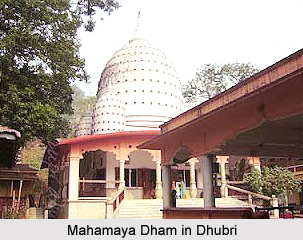
Mahamaya Dham
Mahamaya Dham of Bogribari is located around 35 kms east from Dhubri town. It is considered as next to Kamakhya in Guwahati and Madan-Mohan in Cooch Behar in its attraction to the pilgrims and tourists.
Rangamati Mosque
Famous Rangamati Mosque belongs to pre-Mughal period which can be recognized from its typical architectural design. It is about 25 kms away from Dhubri Town. It may be mentioned that Rangamati area was once very prosperous during the reign of the Koch rulers. It was also frontier post of the Koch rulers. During Mughal regime Rangamati was a great fort of the invading Mughal Army. This unique Mosque was used as a prayer place by the soldiers. There is also a deep well which was also constructed during the same period.
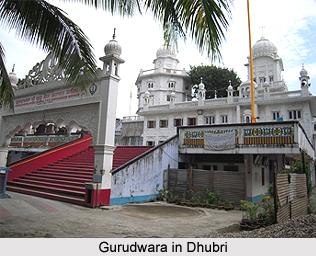 Sikh Gurudwara
In the heart of the Dhubri town and on the bank of the river Brahmaputra, this famous Gurudwara was established by ninth Sikh Guru Tegh Bahadur. Sikh devotees from all over the country and abroad visit this sacred place every year in the month of December to mark the martyrdom of Sri Guru Tegh Bahadur. Sikh devotees called this festival as Sahidee-Guru-Parav.
Panchpeer Dargah
This Dargah is the best example of religious harmony where all section of people irrespective of their religion pay visit with great respect.
Ramraikuti Satra
It is situated at Indo-Bangladesh and West Bengal border at Satrasal of Dhubri District. It is a very holy place established by Sri Sankaradeva in order to propagate the Satriya culture in this region.
Nature tourism in Dhubri District
Chakrasila Wildlife Sanctuary
In 1994, Chakrasila Hill Reserve Forest was declared as Chakrasila Hill Wildlife Sanctuary by the Government of India covering an area of around 4558 hectares. Golden Langur exists in Chakrasila Wildlife Sanctuary in addition to other rare species of animals like Leopard, Porcupine, Flying Squirrel, Civet cat etc. Adjutants Stork, Indian Owl, Hill Myna, Dove, Hornbill, Jungle Fowl, Kingfisher, Darter, Snipe, Teal etc. are the birds commonly found.
Florican Garden
It is a newly setup garden as well as natural park located at Bilasipara around 50 kms from Dhubri town. It is one of the attractive tourist places of the region.
Apart from these attractions, there are several other important places in Dhubri District. Some of them include Netai Dhubuni Ghat at Dhubri Town, Chandardinga Hillock and Dudhnath Mandir at Salkocha, Ramraikuti at Satrasal, etc.
Recently updated articles in States of India
Bandare Waterfalls, Meghalaya
Bandare Waterfalls in South Garo Hills, Meghalaya, is a secluded natural attraction surrounded by dense subtropical forests and rugged mountain terrai...
History of Thissur District
Early History of Thissur District explains flourishing of the port cities. Now these port cities are transformed into archaeological sites.
Tippi Orchid Research Centre, Arunachal Pradesh
Tippi Orchid Research Centre in Arunachal Pradesh is renowned for its rich collection of exotic and endangered orchids. Surrounded by lush rainforest...
Tourism in Nashik District
Pilgrimage tourism in Nashik district involves visiting the various places of Hindu and Jain worship located here. Some of the holiest sites for Hind...
Mangadu, Kerala
Mangadu in Kerala’s Kollam district is a significant megalithic site known for its urn burials, cist burials, menhirs, and stone circles. Excavations...
Related articles in States of India
East Indian States
East Indian States comprises of Bihar, Jharkhand, West Bengal, Odisha and also the Union Territory of Andaman and Nicobar Islands. It defines the cult...
Purnia District in Bihar
Purnia District is located in Bihar and extends from River Ganga to Nepal. The district has a rich Hindu history and glorious past.
Hooghly district
Hooghly District along the bank of the river Hooghly is one of the principal trading ports of West Bengal.
Geography Of Chittoor District
Geography of Chittoor district is spread along the topography of the land which is divided into two natural divisions; Chittoor has a dry and healthy...
Districts of West Bihar
Districts of West Bihar is comprised of medieval monuments that were built by the different governors of Mughal era.