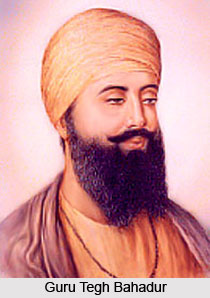
 Guru Tegh Bahadur, hailed as the ninth guru in Sikhism, was born as Tyag Mal in Amritsar on 1st April, 1621. Though the youngest son of Guru Hargobind and Mata Nanki Ji, he was courageous from his early years. He was named Tegh Bahadur (wielder of the sword) after he fought valiantly by his father`s side in the battle of Kartarpur. However, after witnessing violence in this war he adopted the path of renunciation and meditation.
Guru Tegh Bahadur was brought up in a traditional Sikh style and he was placed under the tutelage of Bhai Buddha and Bhai Gurdas, as a young boy. Bhai Buddha was in charge of supervising Guru Tegh Bahadur`s training in archery and horsemanship and Bhai Gurdas gave him the lessons about the old classics. Guru Tegh Bahadur`s prolonged spells of contemplation were some clear evidence of a deeply mystical temperament. The superbly sublime poetry of Guru Tegh Bahadur that is preserved in the Guru Granth Sahib, is expressing this strain of his genius in the best way.
After completing his training both in archery and horsemanship and also getting lessons about the old classics, Guru Tegh Bahadur entered into the family life and he married Gujari, on 4th February, 1633. After the battle at Karatpur in 1635, Guru Tegh Bahadur went to Bakala and lived there with his family. His stay at Bakala has been described in ancients Sikh texts. It was in this picturesque town that the news of his being the ninth guru, reached Tegh Bahadur. Thus on 20th March, 1665 Guru Tegh Bahadur assumed the responsibilities of a Sikh guru. As a guru he taught his followers to be brave, dependent and liberate themselves from numerous worldly attachments. Guru Tegh Bahadur visited different places including Kiratpur, Tarn Taran, Khadur Sahib, Amritsar and Goidwal. He also went to Dacca and Assam. He is also known to raise a habitation at Makhowal which comprised the villages of Lodhipur, Sahota and Mianpur.
Whilst Guru Teg Bahadur was busy in leading the Sikh community to follow the correct path, the Mughal Emperor, Aurangzeb adopted the policy of conversion. The Hindus were forced to convert into Islam. Such a policy was first introduced in Kashmir. Iftikhar Khan, the viceroy there implemented the policy forcefully. The Kashmiri Pandits turned to Guru Teg Bahadur for help as they were not prepared to be converted into Islam. The Sikh guru advised them to tell the Mughal authority that they will embrace Islam only if Guru Teg Bahadur did the same. On hearing this, the Mughal authority arrested him and some his followers in July 1675. After keeping him in the jail for three consecutive months, Guru Teg Bahadur was taken to Delhi in November 1675. There he was physically tormented so that he would accept Islam. However, no amount of torture could alter his decision to stick with his faith.
Guru Tegh Bahadur was finally asked to perform miracles and prove his divinity but he refused to indulge in such practices. Hence he was ordered to be beheaded at Chandni Chowk by Aurangzeb. The order was carried out in 11th November, 1675. Thus, Guru Tegh Bahadur laid down his own life while fighting for the freedom and rights of others. Besides spreading the postulates of Sikhism, Guru Tegh Bahadur will always be remembered for founding the town of Anandpur Sahib, an important religious center of the Sikhs. Moreover, he was martyred while fighting for the rights of the Hindus. Hence the world will always look upto him as a courageous, spiritual man who was respected other religions besides Sikhism.