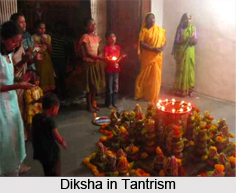
 Concept of Diksha in Tantrism helps the disciple to gain spiritual knowledge. Initiation is the giving of mantra by the guru. At the time of initiation the guru first establishes the life in his own body which is the vital force of the Supreme Guru whose lives in the thousand-petalled lotus. The day prior to this the guru should seat the intending candidate on a mat made of kusha grass. He then makes japa in his ear and ties his crown lock. The disciple repeats the mantra thrice, prostrates himself at the feet of the guru and then takes rest.
The divine Shakti which consists of mantra is transmitted from the guru`s body to that of the Shishya. Without Diksha, japa of the mantra, Puja and other rituals are said to be useless. Certain mantras are forbidden to be recited by shudra and women. The mantra chosen for initiation should be appropriate. Whether a mantra is sva-kula or a-Kula to the person, is determined by the Kula-chakra, the zodiacal circle called rashichakra and other chakra. Initiation by a woman is however considered most effective.
According to some, Diksha is of two types:
(i) Yahirdiksa: This consists of Puja, homa and other external rites through which the feelings are aroused.
(ii) Antardiksa: This helps in awakening the Kundalini energy.
However according to others, Diksha is threefold:
(i) Sambhavi: This is when the mind is purified.
(ii) Sakti: Here the spiritual energy is awakened.
(iii) Mantra: This stimulates the power of mantra and gods.
According to the Visvasara-tantra there are four types of Diksha: Kriyavati, Kalavati, Varnamaya and Vedhamaya. The Kularnava again states seven modes of Diksha: Kriya, Varna, Kala, Sparsa, Vak, Dak and Manasa. According to the Rudrayamala there are three kinds: Anava, Sakti and Sambhavi. The other forms are Krama, Pahcdyatana and Ekamantra. Anava Diksha is divided into ten sub-varieties.
In another way, Diksha is divided Kriya and Jadna. Aim of Diksha is to guide the person concerned along the way to salvation by removing the dirty substances which are: Anava, Buddhigata, Maylya. If these are not removed salvation cannot be attained.