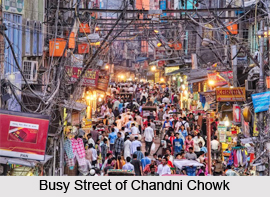
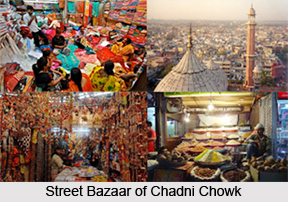
 Chandni Chowk is a busy market place after Sarojini Nagar market and one of the most preferred places among the people of Delhi from Mughal era.
History of Chandni Chowk
Chandni Chowk was designed and established by Princess Jahanara, Shah Jahan"s daughter, in 1650.
Architecture of Chandni Chowk
Chandni Chowk was shaped as a square that was given elegance by the presence of a pool in the centre of the complex. The pool shimmered in the moonlight, a feature which was perhaps responsible for its name. The shops were originally built in a half-moon shaped pattern, now lost. The bazaar was famous for its silver merchants, which also have contributed to the name as silver is referred to as Chandi in Hindi, a slight variation of which forms Chandni. The pool in the chowk was replaced by a clock tower until the 1950s.
Importance of Chandni Chowk
Chandni Chowk is a popular place for tourists also. Chandni Chowk was once the grandest Indian market in Delhi. Mughal imperial processions passed through Chandni Chowk. The tradition was continued when Delhi Durbar was held in 1903. Delhi Town Hall was built in 1863 by the British Empire in India.
Geography of Chandni Chowk
Chandni Chowk runs through the middle of the walled city, from the Lahori Gate of the Red Fort to Fatehpuri Masjid. Originally, a canal ran through the middle of the street. It was initially divided into three sections. One stretches from Lahori Gate to Chowk Kotwali (near Gurdwara Shish Ganj). This section, closest to the imperial residence, was called Urdu Bazar, that was the encampment market. The Urdu language got its name from this encampment. Ghalib noted the destruction of this market during the disturbances of the Indian Rebellion of 1857 and its aftermath. Another is from Chowk Kotwali to Chandni Chowk. The term Chandni Chowk originally referred to the square that had a reflecting pool. This section was originally called Johri Bazar.
Havelis in Chandni Chowk
Chadni Chowk has beautiful havelis. It has a big courtyard surrounded on four sides by spacious rooms and often another walled courtyard around the exterior. One of the largest preserved havelis in the area is the Chunnamal Haveli.
Related Articles
Delhi Sultanate, Medieval History of India
Delhi, National Capital Territory
Old Delhi
Monuments of Delhi
Culture of Delhi
Culture under Delhi Sultanate
Architecture of Delhi
Costumes of Delhi
Society of Delhi Sultanate
Economy under Delhi Sultanate
Feroz Shah Kotla
History of Delhi