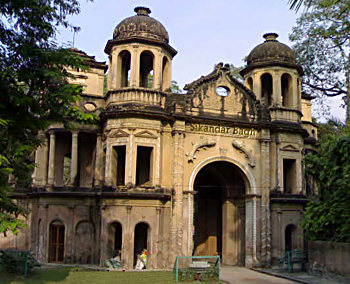
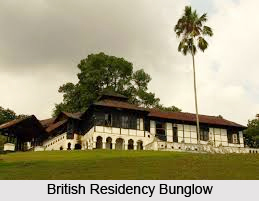
 British Residency Bunglow is also known as the Government Guest House or Residency Bungalow is a house of operation for the British army officers and the political leaders of British origin during the rule of British East India Company and the British Government in India.
Location of British Residency Bunglow
British Residency Bunglow is a two-storied palace situated at Asramam in the city of Kollam in the Indian state of Kerala. It lies close to the site of the old Kollam Airport situated at Asramam in the city of Kollam and was built by Colonel John Munro between 1811-1819. British Residency Bunglow is noted for the landmark the Chinnakada Clock Tower, which attracts the tourists of all section. Chinnakada Clock Tower was built during the time of British Empire in India and the clock was taken from Kolkata.
Features in British Residency Bunglow
British Residency Bunglow exhibits unique symmetry and harmonious blending of variegated artistic features. During the reign of British east India Company and the British Empire in India, British Residency Bunglow served as the British Residency for the British officers and the political leaders.
Architecture of British Residency Bunglow
British Residency Bunglow was built during the Travancore era by Gowri Parvati Bayi when Colonel John Munro was the British Resident. British Residency Bunglow has a blend of European, Indian and Tuscan architecture. The central portion of British Residency Bunglow has a rounded front, with a large gable decoration. Atop the building there is a crown with a lion seated on it, with the motto "Dieu et mon Droit" (God and my right) inscribed above. The 10 feet (3.0 m) entrance doors are made up of glass panes. The conference hall in the palace has an antechamber with an adjustable partition-like door while a large fanlight arching over divides the two rooms. The building has rich wooden flooring on the upper storey. The walls of the conference hall of British Residency Bunglow have the cornices and dentils bordering the four sides with embossed designs of festoons, urns, and floral forms. A motif of a large arch with an ornamental keystone, resting on pillars is embossed over the main doorway. The Edward Rose garden is another main attraction of the mansion.
Paintings in British Residency Bunglow
The antique prints in polished wooden frames adorn the walls of British Residency Bunglow including one that depicts the battle of Seringapatnam, dating from 1802.