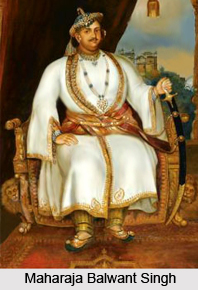
 Balwant Singh of Bharatpur was a prominent ruler or Maharaja of the princely state of Bharatpur, which was founded by Maharaja Suraj Mal in the year 1733. At present it is located in the Brij region in the state of Rajasthan. The princely state of Bharatpur belonged to the Rajputana Agency. Balwant Singh succeeded his father Maharaja Baldeo Singh after his death on 26th February 1825 and ascended the royal throne or gadi. He reigned over the territory from the year 1825 to 1853, when he died. The Maharaja of the princely state was born on 5 February 1820 at Jawahar Bagh in Bharatpur. He was the only son of Baldeo Singh, Maharaja of Bharatpur, and his wife Maharani Miraj Kaur. He belonged to the Sinsiniwar Jat dynasty.
Early Life of Balwant Singh
Balwant Singh of Bharatpur reigned over the princely state of Bharatpur under regency as he was still a minor at the time of his ascension. On 28th March 1825, he was captured and imprisoned by Rao Durjan Sal, his cousin, in the Fort at Bharatpur. The British India army besieged the Bharatpur Fort and rescued the young ruler Maharaja on 19th January 1826. Balwant Singh was installed on the throne of the princely state on 5th February 1826. Initially he ruled under the Regency of Maharani Miraj Kaur, his mother, until she was deposed by the British East India Company. Later Singh was reigned under a Council of Superintendence. He was invested with full ruling powers in the year 1835, after he reached the age of majority.
Rule of Balwant Singh
Maharaja Balwant Singh of Bharatpur under took various efforts to enhance the state of his territory and develop the administrative system of the princely state. He was a progressive ruler who implemented several measures for the development of the state and the betterment and welfare of the people of his state and the society at large. Several schools and educational institutes were established and medical facilities were also set up for general public. He also made many attempts to reduce taxes in the princely state of Bharatpur and to maintain financial stability. During his rule, he detained Bholanath Diwan and his associates.
In the year 1842, the eminent Maharaja transferred the Ballabhgarh state (now in Haryana) to the Jat rulers with the support of British government of India. Balwant Singh of Bharatpur helped the British administration in several occasions and supported the British rule in India.
Personal Life of Balwant Singh
In the year 1827, Balwant Singh of Bharatpur was married with the princess of Pichhore and the royal couple had a son, Maharaja Jashwant Singh in the year 1851. Maharaja Balwant Singh died on 21st March 1853 at Bharatpur and was succeeded by Jashwant Singh, who ascended the throne as the new Maharaja of Bharatpur.