 The princely state of Bharatpur was founded by Maharaja Suraj Mal in the year 1733. At present it is located in the Brij region in the state of Rajasthan. The princely state of Bharatpur belonged to the Rajputana Agency. The name of the town of Bharatpur was derived from the name of Bharata, brother of Lord Rama and Prince Lakshmana. Maharaja Suraj Mal, one of the greatest rulers, made the territory a formidable force and he seized the region of Bharatpur from Khem Karan. Suraj Mal established his capital in here and fortified the state by constructing a massive wall.
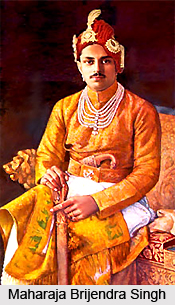
During the rule of British East India Company in India, the princely state of Bharatpur was spread an area of 5,123 sq. km. The rulers or Maharajas of the state were honoured with a 17 gun salute. The princely state of Bharatpur was the sole political entity which consisted of a chartreuse coloured flag. After the country achieved independence in the year 1947, the princely state was acceded into the Dominion of India, under the reign of the last ruling Maharaja Brijendra Singh. The territory was merged with 3 other neighbouring princely states and the Matsya Union was formed. This was later merged with other adjacent regions in order to form the current Indian state of Rajasthan.
The rulers of the princely state of Bharatpur were from Sinsinwar dynasty of Jats. The Jat clan of Gohad eventually signed a treaty with the British administration and supported them seize Gohad and Gwalior and from the Maratha rulers. Gwalior was then governed by the British Government and the administration of Gohad was given to the Jat rulers in the year 1804. Later they also reigned over Agra and Gwalior. The Gwalior fort was occupied twice by Maharaja Bhim Singh Rana from 1740 to 1756 and Maharaja Chhatar Singh Rana from 1780 to 1783.
The Agra Fort was seized by Maharaja Suraj Mal in the year 1761, which remained in the control of the rulers of the princely state of Bharatpur till 1774. After Suraj Mal, Maharaja Jawahar Singh, Maharaja Ratan Singh and Maharaja Kehri reigned over the Agra Fort, under the residentship of Maharaja Nawal Singh.
The chronology of the Maharajas of the princely state of Bharatpur are mentioned below-
* Maharaja Suraj Mal (1756- 1767)
* Maharaja Jawahar Singh (1767- 1768)
* Maharaja Ratan Singh (1768- 1769)
* Maharaja Kehri Singh (1769- 1771)
* Maharaja Nawal Singh (1771- 1776)
* Maharaja Ranjit Singh (1776- 1805)
* Maharaja Randhir Singh (1805- 1823)
* Maharaja Baldeo Singh (1823- 1825)
* Maharaja Balwant Singh (1825- 1853)
* Maharaja Jashwant Singh (1853- 1893)
* Maharaja Ram Singh (1893- 1900)
* Maharani Girraj Kaur- Regent (1900- 1918)
* Maharaja Kishan Singh (1900- 1929)
* Maharaja Brijendra Singh (1929- 1947)