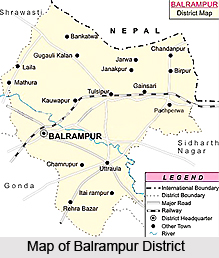
 Balrampur District is one of the administrative districts of Uttar Pradesh with Balrampur city as its district headquarters. According to census 2001, total population of Balrampur District is 1,684,567, in which rural population is 1549293 (male population is 817298 and female population is 731995). Urban population of the district is 135274 (males 71261 and females 64013). It has an average elevation of 106 metres (347 feet). Balrampur District was created on 25th of May, 1997 by the division of Gonda District.
Location of Balrampur District
Balrampur is situated on the bank of river Rapti. Siddharthnagar and Gonda districts are situated in the east-west and south sides respectively and Nepal is in its northern side. Total area of the district is 336917 hectares. In the north of Balrampur District is situated the Shivalik hills of the Himalaya Mountains.
Geography of Balrampur District
All the rivers of Balrampur District flow from north-west to south-east and belong to two main systems that of Rapti in the north and Ghaghara River in the south. Each is fed by numerous tributaries. The Rapti rises in the mountains of Nepal, and after traversing Bahraich District enters district Gonda. Its banks are usually high, but the river is continually changing its course. It only overflows its banks in wet seasons. On either side of Rapti River, but especially on the north, the country is cut up by innumerable deserted channels of the river. Many of these contain water for a part of the year only. But the only one which can be considered as a definite stream is that know as the Burhi Rapti which emerges near Mathura and flow across the district in a direction roughly parallel to that of the Rapti. Kuwana River flows with slow speed and Bishuhi River joins Kuwana. It covers very small part of the district.
Climate of Balrampur District is mainly divided into four seasons; the cold season from about the middle of November to February is followed by the summer season from March to the middle of June. The south-west monsoon season is from the middle of June to September. October and first half of November constitutes the post-monsoon or transition season. May is generally the hottest month with the mean daily maximum temperature at around 39 degree Celsius and the mean daily minimum temperature is around 24 degree Celsius. Balrampur District has a very hot summer season and in individual days maximum temperature may be as high as 48 degree Celsius. Generally mornings are highly humid except in the summer season.
Balrampur District is popular for the remains of early city of Shravasti. The district is almost 17 kilometers from Shravasti where Lord Buddha displayed his supernatural powers.