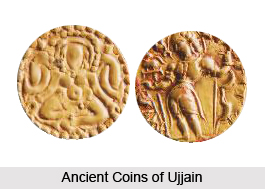
 Archaeology of Ujjain comprises the various kinds of ancient artefacts discovered from the city of Ujjain, in the central Indian state of Madhya Pradesh. A large quantity of old coins have been unearthed from this part of the country which indicate the reign of different royal dynasties and civilizations at Ujjain. These coins vary according to their structure, raw material, patterns and its technique of casting. The ancient archaeological coins have been carefully examined by the Ashwini Research Institute of Mahidpur, which include a wide variety of silver, gold and copper coins. The coins have been classified as Group A, Group B and Group C, according to their types.
Group-A Coins
Group-A coins are the coins which are irregular in shape, being ruthlessly hammered in many directions and generally punched in a single direction, though at times, they are also punched in both their sides. Sometimes, dotted circles are engraved on the reverse side of the coins, apart from the patterns of sun, crescent, bull, rabbit, `Trimatsya`, maker and `trigola` or Caduceus frog.
Group-B Coins
Group-B coins are round in size, embedded with various types of motifs like makar, dots and are usually cast thick coins. The designs are marked on them when they are terribly hot.
Group-C Coins
Such coins are rectangular in shape and are manufactured from silver, generally cut out from a uniform slice of metal. Their size resembles that of coins made of copper that are punched. Five symbols are engraved on one or two sides of the Group-C coins which are of 20 different variations. The motifs etched on the coins include those of part of tree, fishes, dotted sun along with rays, `frog makar`, `trikuta`, `star `makar chakra`, `Purusha`, `Chedit Trigola`.
Copper Punch-Marked Coins
These coins are generally rectangular pieces of copper cut from uniform sheet of copper which are marked with some punched symbols on their reverse sides. Patterns of star, sun, trikuta, bull, caduceus, peacock, Trishula Chakra, tree in railing, Purush Danda-Dhari, sun, Trikuta, shar-makar chakra rabbit and `Urdhvakeshin` are embedded on the coins. Quite often the symbol of caduceus adorns the reverse side of the coins.