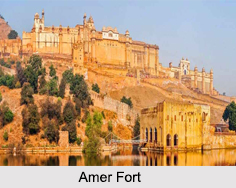
 Located in the town of Amer in the state of Rajasthan, the Amer Fort is one of the prime tourist attractions in Jaipur. The fort is situated atop a forested hill promontory that juts into the Maor Lake near the town of Amer.
Etymology of Amer Fort
Also known as Amber, the name is derived from the Ambikeshwar Temple, which is built on the Cheel ka Teela or Hill of Eagles, belonging to the Aravalli Mountain Range. It is said that Ambikeshwar is the local name of the Hindu God, Lord Shiva. However, local folklore suggests that the fort derives its name from Amba, the Hindu Goddess Durga.
History of Amer Fort
In 967 CE, the Amer settlement was founded by Raja Alan Singh, a ruler from the Chanda clan of Meenas and the fort of Amer was later built over the remnants of the earlier structure. The Amer Fort was constructed during the reign of Raja Man Singh, the Kachwaha King of Amer. In the later years, the structure of the fort was expanded by Jai Singh I, who was one of Raja Man Singh"s descendants. Over the centuries, the Amer Fort passed through several hands and underwent a variety of improvements and additions by its successive rulers.
In the medieval period, Amer was ruled by the Kachwahas from the 11th century onwards between 1037 and 1727 AD. During that time, Amer was also called Dhundar, which meant a sacrificial mount in the western frontier. The fort was also used as a palace and in the later part of the 16th century; the current Amer Palace was constructed, which was much larger than the existing home to the rulers. The older palace, known as Kadimi Mahal is known to be the oldest surviving palace in India.
Architecture of Amer Fort
Constructed of red sandstone and marble, the architecture of the Amer Fort was greatly influenced by Mughal architectural style. The fort is basically laid out on 4 levels, each with a courtyard. It consists of the Diwan-i-Aam, or “Hall of Public Audienceâ€, the Diwan-i-Khas, or “Hall of Private Audienceâ€, the Sheesh Mahal or mirror palace, the Jai Mandir, and also the Sukh Niwas where a trendy environment is synthetically produced by winds that blow over a water waterfall within the royal palace.
These courtyards of Amer Fort are marvellous instances of Hindu and Mughal architectural styles which beautify the interiors of the majestic palace grounds. Tourists visiting the Amer Fort come across the 4 different courtyards, which comprise of the Sila Devi Temple, Sheesh Mahal and several other impressive structures.
Visiting Information on Amer Fort
The Jaipur Junction is the nearest railway station at a distance of almost 14 km from the fort and the Jaipur International Airport is the closest at a distance of about 22 km from the Amer Fort.