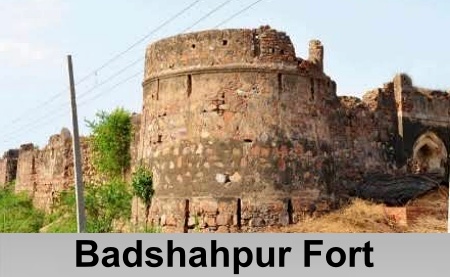
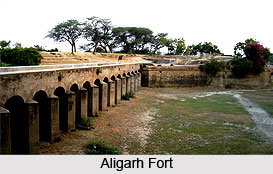
The fort, also known as `Aligarh Qila`, is enlisted among the strongest forts of the country. Aligarh Fort is situated three km to north of the Aligarh town. The present fort is the architecture of French Engineers and comprise of a regular polygon enclosed by a deep and broad ditch.
 Aligarh Fort was constructed during the reign of Ibrahim Lodi, by Muhammad who was the son of the governor of Kol, Umar, in 1524-25. It was rebuilt by Sabit Khan, the governor of this region during the rule of Farrukh Siyar and Muhammad Shah. In the year 1759, the fortress attained great significance under Madhavrao I Scindia and became the centre for the organization of his battalions in the European manner with the help of French soldiers. In September 1803, Lord Gerard Lake`s British army under the leadership of Perron, a French officer captured the fort from the Marathas during the battle of Ally Ghur. During the war of 1857 the troops stationed at Aligarh mutinied, but abstained from murdering their officers, who, with the other residents and ladies and children, succeeded in reaching Hathras.
Aligarh Fort stands on a hill at Barauli Marg towards the north of Aligarh Muslim University. The structure of the fort consists of about 30 feet high ravines on all sides and bastions are built on the angles of the walls. Presently Aligarh fort is under the administration of Aligarh Muslim University. The fort also houses the Department of Botany of the University which also maintains the floral gardens and plantations in the fort. A visit to this fort also requires special permission from the botany department. It also served as the seat of several governors and rulers of this region such as Sabit Khan, Surajmal Jat and Madhavrao Scindia.
In 1753, lieutenant Banasaur who was the commanding officer of contemporary ruler Surajmal Jat expanded the fort by constructing a warehouse for explosives, a basement and an air cooled kitchen.