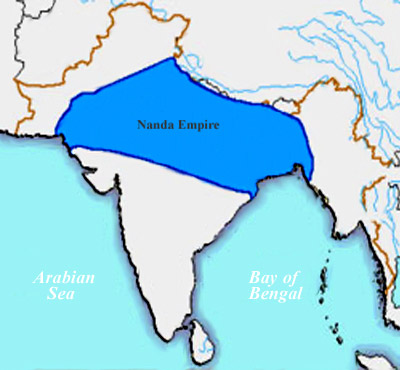
 The administration of Nanda dynasty had considerable amount of autonomy. It has been observed that the Nandas treated their home provinces differently as compared to the neighbouring ones. Unitary state was the system followed as per evidences. However there is less information regarding the administration of dominions by the Nandas. Greek writers refer to a common sovereign. People were given substantial autonomy. However the home provinces embraced the ancient mahajanapadas of Magadha (South Bihar), Vriji (North Bihar), Kasi (Varanasi), Kosala (Oudh) were treated in the same way as the sultans of Delhi dealt with the metropolitan provinces. Nandas held a strong position in their dominions as compared to their comparative weakness in the frontier regions.
Nandas are considered as the empire builders. The Greek writers refer to a system of provincial government under officials styled `nomarchs and hyparchs. A nomarch is a local ruler of a district. The word hyparch is used to denote a satrap. In the third century administrative charges called ahara, vishaya, janapada under functionaries styled mahamatras rajukas, pradesikas and rashtriyas who seem to answer to the nomarchs and hyparchs have been mentioned in various texts. Village was the lowest administrative unit.
Nandas made tax collection methodical by appointing officials. The treasury was continually filled which goes on to prove that the Nandas were wealthy. Canals were also built as well as irrigation projects were also carried out. An imperial structure based on an essentially agrarian economy began to develop. They had a very strong army that consisted of of 200,000 infantry, 20,000 cavalry, 2,000 war chariots and 3,000 war elephants.
This article is a stub. You can enrich by adding more information to it. Send your Write Up to content@indianetzone.com