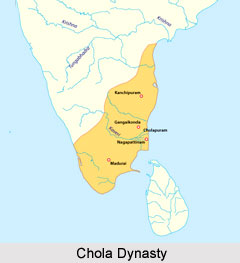
 Virarajendra Chola I ascended the throne after his brother, Rajendra Chola II as his nephew Rajamahendra suffered an untimely death. He ruled from 1063 AD to 1070 AD. At a time when he ascended the throne, the Cholas were trying to increase his empire and keep the existing ones intact. He defeated the Ceylon king and instituted the supremacy of the Chola Dynasty over Sailendra kingdom in the east. He had expeditions against hereditary enemies, the Western Chalukyas. He invaded them first in response to a challenge of Somesvara I to meet him at Kudal Sangamam again. However, Somesvara I did not turn up and the Chola army erected a pillar of victory on the banks of the Tungabhadra River.
In the outset of his rule Virarajendra fought and killed the king of Pottapi in Kerala. He also suppressed the Pandya rebels. Meanwhile the Western Chalukya ruler Somesvara I invaded the Chola capital, Gangaikondacholapuram. He had sent his son Vikkalan for plundering the Chola capital. Virarajendra was returning after defeating the Pandyas, the Sinhalas and the Chera kings. On seeing his capital in distress, he immediately tried to save the Chola capital from usurpation and routed Vikramaditya VI from there. He overpowered the Chalukya army and proceeded to the Chalukyan capital, Kalyanapura. There he defeated Somesvara I who fled the battlefield thereafter. The third war fought by Virarajendra against the Chalukyas was when Somesvara I sent his son Vikramaditya VI to occupy Vengi. Virarajendra`s army routed the Western Chalukyas at Vengi, after which they surrounded Kalyanapura, and burned the fortress at Kampili.
Inscriptions of Virarajendra Chola I
 There are numerous inscriptions detailing his various victories with the Western Chalukyas. Virarajendra was involved in the battle against the Western Chalukyas even before he became king. Under the command of Rajamahendra, he fought the Chalukya forces in the battle of Muddakaru. He has repeatedly defeated the Chalukyas in the battles held at Kudal Sangamam, Gangaikondacholapuram, Karur, Kampili and at Vengi. Somesvara was forced to flee away in each war and finally became a tribute paying subordinate of Virarajendra.
According to Virarajendra`s inscriptions at Perumber, after the expulsion of Somesvara II, Vikramaditya VI apparently handed him the entire Chalukyan Kingdom.
Conquests of Virarajendra Chola I
As per the historical records Virarajendra Chola I conquered Kadaram on behalf of a king who had come to ask for help and protection and handed it over to him. The Cholas led a series of raids throughout Indonesia and Malaysia for the next twenty years. Srivijaya, Kediri, Champa became independent kingdoms during the time of Virarajendra. The trade relations between Tamizhagam and the Far East continued unopposed. Virarajendra assumed a number of titles like Ahavamallakulakala and Vallabha-vallabha, or lord of the Western Chalukyas.
From Kudal Sangamam, Virarajendra crushed the Western Chalukya army led by Jananatha. He proceeded to conquer the entire Eastern Chalukya kingdom, defeated and re-captured Kalinga whose king had been in alliance with the Western Chalukyas. Virarajendra placed Vijayaditya, the Eastern Chalukya prince on the Vengi throne.
He died in early 1070 AD. He had started off his career initially by helping his father Rajendra Chola I, his brothers Rajadhiraja Chola I and Rajendra II in administration and war. He had a successful rule in terms of internal administration and military conquests. One of the striking aspects of his rule was he issued large number of grants and announcements. He had also patronized and cared for temples of all beliefs. He proved to be a capable and brave ruler, who was kind and protective to his subjects. Virarajendra`s reign was a lasting legacy. He succeeded in preserving Chola territories, as well as make overseas conquest, like Indonesia, Malaysia, Sri Lanka, and Nicobar Islands.