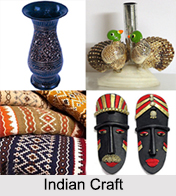
Designs in Indian embroidery are shaped on the base of the surface and the design of the material and the stitch. The dot and the swap dot, the circle, the square, the triangle and permutations and combinations of these form the design. The famous Indian embroideries are as follows:
Aari: Aari work contains a hook, plied from the top but fed by silk fibre under with the fabric spread out on a frame.
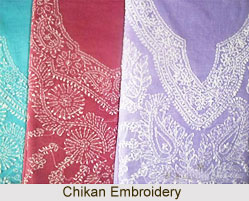
Chikankari: Chikankari is a fine and elaborate stitching style which is believed to have been introduced by
Nur Jehan, the wife of
Mughal ruler Jahangir. A chikan piece is created by block printing patterns on it. Craftsmen then stitch sew along the pattern and the finished piece is later washed to eradicate traces of the prints.
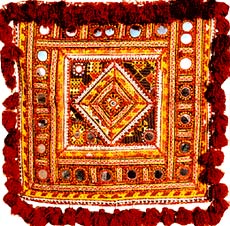
Banjara Embroidery: Banjara embroidery is a mix up of mirrors and beadwork. Bright red, yellow, black and white coloured cloth is laid in bands and joined with a white criss-cross stitch.
Banni or Heer Bharat: The Banni or Heer Bharat embroidery creates in
Gujarat and is exercised mostly by the Lohana area. It is done with silk floss and it is famous for its liveliness and richness in colour pallets & design patterns.
 Kantha
: Kantha work is recognized for its simplicity. Kantha was done on flexible
dhotis and
sarees, with an easy running stitch along the edges.
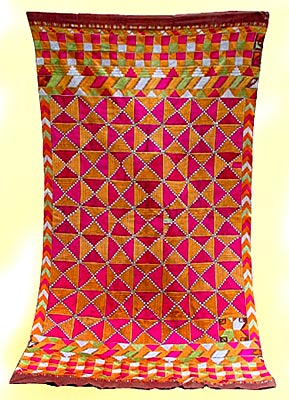
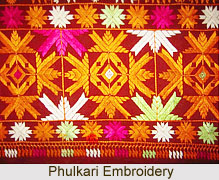
Phulkari: Phulkari is the embroidery of
flower motifs on textile. Usually practised by
women of the house as an amusement, this embroidery is pretty a unique one. The stitches are embroidered on the reverse of the cloth so that the design takes shape in the front.
Chamba Rumal: This embroidery increased in the generous hill states of
Kangra, Chamba, Basholi, and other nearest provinces.
Gota: It is a shape of
applique in golden thread, used for women"s ceremonial attire.
Karchobi: It is raised zari metallic thread stitching created by sewing flat stitches on cotton lagging. This technique is usually used for bridal and formal
costumes as well as for velvet coverings, tent hangings, curtains and the coverings of animal carts and temple
chariots.
Zardozi: Original Zardozi work used
gold and
silver threads as well as pearls and expensive stones and the choice of fabrics too had to be majestic. Zardozi work uses a mixture of copper wire with silver or golden polish and silk threads.
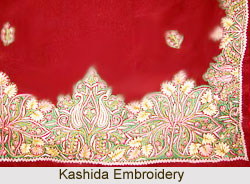
Kashidakari: Kashidakari draws a lot from the
flora of the state. However, human and animal figures are not a part of this style of embroidery. An exclusive feature of Kashidakari is the Kashmiri
tea pot.
Kashmiri Kashida: Kashmiri embroidery, also known as Kashida is used for phirans and namdahs as well as stoles. It draws encouragement from nature.
Birds, blossoms and flowers, creepers, chinar leaves, ghobi,
mangoes, lotus, and
trees are the most common themes.
Pichwai: Multi-coloured embroidered cloth-hangings made in Nathdwara,
Rajasthan. The central themes for Pichwai were focused on
Lord Krishna.
Rabari: This very bright embroidery style, by the severe contrast was traditionally used only for garments, but now it can be found on bags, accessories, home furnishings, etc. Mirrors of all shapes and sizes are included in the embroidery, as an effect of the belief that mirrors protect from
evil spirits.
Toda: The stitching adorns the shawls. The shawl, called poothkuli, has red and black bands between which the stitching is done.
Applique work is seen in
Odisha and Gujarat. It is basically a patch work in which coloured pieces are cut and sewn on a plain cloth. Embroidery of
Kutch is known as Aribharat is very attractive. Embroidery of Lambada tribes of
Andhra Pradesh is worth mentioning here. It is done on fine cotton or polyester. Kantha stitch is practiced in
Bihar and West Bengal. Here the threads are picked from old materials.

 Embroidery Work in India is carried out in Punjab, Uttar Pradesh, West Bengal and many other regions. Buttonhole or Blanket Stitch, Running Stitch, Cross Stitch, Satin Stitch and Chain Stitch are some of basic techniques of stitching used in Indian Embroidery. It has also given way to machine stitching with the advent of the industrial era. There are diverse varieties of Indian embroidery.
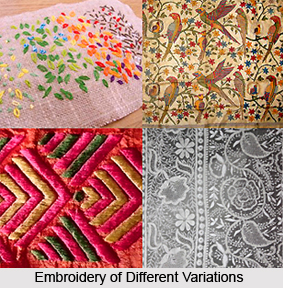 Embroidery is one of the most ancient and popular art forms in Indian villages. It has been an integral part of Indian villagers` occupation since the ancient period and has earned popularity in the international market in modern times as well. Embroidery is actually the art or handicraft of beautifying fabric or other materials using needle and thread or yarn. People sometimes use the other materials like metal strips, pearls, beads, quills, sequins, etc. for doing embroidery as well.
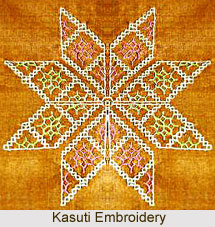
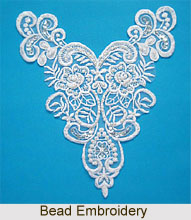 Embroidery in Southern India is the manifestations of excellent craftsmanship. Embroidery is an age old tradition which has originated in India since time immemorial. A variety of embroideries have developed in this region over time which has become the unique features of their cultural heritage. Embroidery of southern region is characterized by the intricate patterns made by threads of vibrant hues. Often other elements like metals, beads, precious stones are also used to embellish the fabrics.
 Embroidery in