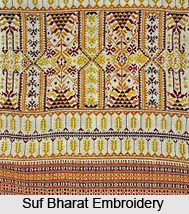
 The Suf Bharat embroidery style bears a resemblance to the Phulkari of Punjab, Baluchi embroidery of Iran and the needlework of Swat and Hazara in Pakistan. This embroidery work can, thus, be identified as a style of embroidery common to the wider region of Southwest Asia.
In Rajasthan, Rabari women are well known for embellishing many household articles with suf bharat embroidery style. Among these are articles of daily use like the rela, a type of odhni, the thalphosh, which is an envelope for a plate and the bokani, which is a long embroidered strip of the fabric that can be tied at the waist or wrapped around the head. This embroidery is also popular with Jat, Bishnoi, Meghval, Rajput and Sindhi Musalman women. The distinguishing feature of suf bharat embroidery style is that it is worked from the reverse side of the fabric in surface satin stitch, forming superior geometrical motifs. The style is also known as tantik that is derived from the word tantu (thread), since the embroiderer works in the motifs by counting the warp and weft threads.
Sufis embroider fabrics with plied cotton or in some cases with silk floss thread as well. Subtle movements and shades are created with the use of passam or the untwisted floss, producing dramatic effects with mirrors and other accessories. Radiating lines from the romanian stitch worked around the circumferences of the mirrors has been a distinctive appearance to the cloth, while the herringbone stitch is used to fill in the larger spaces. The predominant combinations of colours used in suf bharat embroidery style are yellow on red or red on white. However, a wider colour palette is available to artisans, including a abundance of reds, greens and yellows with a somewhat smaller amount of colours like white, black and blue.
The basic motif of Suf Bharat embroidery style is the triangle, from which all other motifs are said to originate and to which the name suf refers. Suf embroidery is not always geometrical in shape and sometimes takes the shape of figures such as camels, humans or peacocks. The motifs of suf bharat embroidery style are neither sketched nor outlined with thread. Unlike those oipakka and kharak styles, they are worked by counting thread. There is also a noticeable similarity in the suf bharat embroidery designs and the wall paintings of this region, especially the mandana style. Some popular motifs are the chulangar or chulna, guntari, bhugaiiyo, munjar, kugari, kungriyopanri and sur.