 Vakataka dynasty, an Indian dynasty, ruled parts of today`s Maharashtra and Madhya Pradesh from the third century to fifth century. Vakataka dynasty is the most important follow-up dynasty of the Satavahanas, contemporary with the Guptas. Vindhyasakti founded the dynasty and his name is also found in the Puranas.
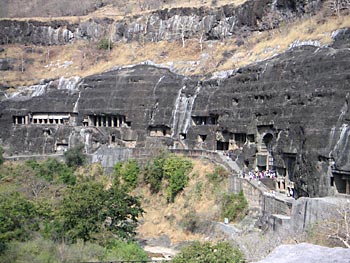
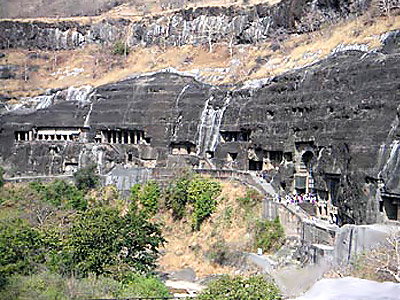
The name of Vindhysakti is derived from the name of the goddess Vindhya after whom the mountains were named. The dynasty possibly has originated there. Almost no fact is actually known about the life of Vindhyasakti. In the Cave XVI inscription of Ajanta, he was described as the banner of the Vakataka family and a Dvija (Brahmin). It is also stated in this inscription that he added to his power by fighting memorable battles and he had a large cavalry. But no royal title is prefixed to his name in this inscription.
The Puranas state that he ruled for 96 years and was placed at various locations in south Deccan, Madhya Pradesh and Malwa. Bagat, a village in the Jhansi district is said to be the home of Vakatakas. But after disproving the theory regarding the northern home of the Vakatakas, historian points out that the earliest mention of the name Vakataka occurs in an inscription, found on a section of a pillar at Amaravati which accounts the gift of a Grihapati (householder) Vakataka and his two wives. This Grihapati in all possibility was the progenitor of Vidhyashakti. It appears from the Puranas that Vindhyasakti was a ruler of Vidisha (in the present day Madhya Pradesh state) but this fact does not carry any evidence.
The next ruler of Vakataka dynasty was Pravarasena I. (270-330), who maintained the realm as a great power and called himself an "all ruler". He conducted wars with the Naga kings and has become an emperor in his own right. He was perhaps the only emperor in the dynasty, with his kingdom embracing a good portion of North India and whole of Deccan. He carried his arms to the Narmada in the north and occupied the kingdom of Purika, which was being ruled by a king named Sisuka. In any case, he certainly ruled from Bundelkhand in the north to the present Andhra Pradesh in the south. The puranas state this ruler to have ruled in Vakataka dynasty for a reign of 60 years.
Pravarasena I may have conquered parts of North Kuntala comprising of Kolhapur, Satara and Sholapur districts of Maharashtra and extended the power of Vakataka dynasty. In the east, he may have carried his possession to Dakshina Kosala, Kalinga and Andhra. He was a staunch follower of Vedic religion and performs several Yajnas (sacrifices), which include Agnishtoma, Aptoryama, Shodasin, Ukthya, Atiratra, Brihaspatisava, Vajapeya, Sadyaskra and four Asvamedhas. He heavily donated to the Brahmins during the Vajapeya sacrifice as per the Puranas. He took up the titles like Samrat and Dharmamaharaja. He called himself as Haritiputra. His Prime Minister Deva was a very pious and learned Brahmin. The Puranas say that Pravarasena I has four sons. He married his son Gautamiputra to a daughter of King Bhavanaga of the influential Bharsiva family, which might later prove to be helpful. However, Gautamiputra predeceased him and he was inherited by his grandson Rudrasena I, the son of Gautamiputra. His second son, Sarvasena set up his capital at Vatsagulma (the present day Washim).
It is generally believed that the Vakataka dynasty was divided into four branches after Pravarsena I. Two branches are known and two are unknown. The known branches are the Pravarpura-Nandivardhana branch and the Vatsagulma branch.
 Origin of Vakataka Dynasty reveals that they belonged to South India and their home was probably Vidarbha. Keeping this as the base they extended their arms towards north and west thereby bringing
 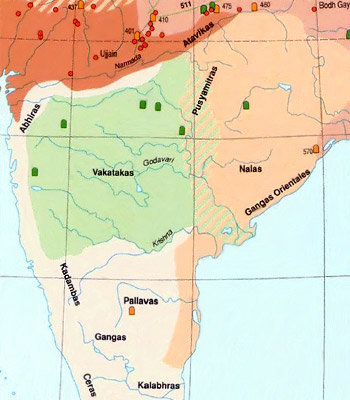 Branches of Vakataka dynasty reveal the complete lineage of the dynasty. After Pravarsena I there have been four divisions of the branches. Two branches are identified and two are not known. Pravarpura-Nandivardhana branch and the Vatsagulma branch are the known branches.