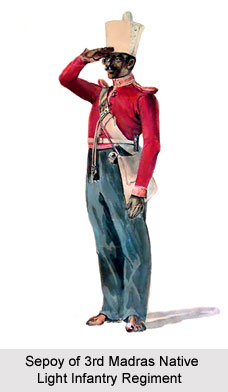
 The 3rd Madras Native Light Infantry was chiefly an infantry battalion of the British East India Company, which existed from the year 1759 to 1922. It was a part of the Madras Native Infantry under the Army of the Madras province, before the beginning of the Sepoy Mutiny, also known as the Indian Rebellion of 1857. The Madras Army was the armed forces of Madras Presidency and was established with the purpose of protecting the commercial interests of the British East India Company. It was amongst the 3 main Presidency Armies in British India. The military regiment was also included as a part of the Madras Command.
The Government of India Act 1858, which was authorized after the Sepoy Mutiny in the year 1857, transferred the authority of the 3 Presidency Armies from the British East India Company to the British Empire in India. Subsequently the British Empire took control over the British East India Company and the three Presidency Armies, namely the Bengal Army, the Madras Army and the Bombay Army. The 3rd Madras Native Light Infantry was also known as the 63rd Palamcottah Light Infantry.
History of 3rd Madras Native Light Infantry
The 3rd Madras Native Light Infantry was formed as the 4th Battalion Coast Sepoys in the year 1759. It was amongst the earliest regiments of the British Indian Army. The military unit participated in the Battle of Sholinghur during the Second Anglo Maratha War; the Carnatic Wars; the Battle of Ava during the Second Anglo Burmese War; and the Battle of Mahidpur during the Third Anglo Mysore War. The battalion was later stationed at China and was incorporated as part of the armed forces of the British Empire. The unit participated in the Boxer Rebellion. The Regimental Centre was established at Trichinopoly (now Tiruchirappalli) in the year 1914.
After the year 1902, the source of recruitment for almost all of the regiments in Madras (now Chennai) in the British Indian Army was transferred to the martial races of the British Punjab and other regions in northern India. However, the 3rd Madras Native Light Infantry was still recruited from south India. The military regiment comprised of 8 companies in 1914, among which 4 companies were Madrasi Muslims, 2 companies were Tamils and the rest included Christian Madrasis and Parayans. The unit also included around 17 Indian officers and 13 British officers.
The regiment had the common bugle horn badge of light infantry regiments, in brass which included the digit 63 in the curl of the bugle and a crown above. In the year 1910, the full official uniform included a scarlet tunic with emerald green facings and dark blue breeches and the turban and puttees were in khaki.
Operations of 3rd Madras Native Light Infantry
During the First World War, the 3rd Madras Native Light Infantry initially served in British India as part of the 5th (Mhow) Division on duties of internal security. Later the 63rd Palamcottah Light Infantry was sent to British East Africa in October 1914 as part of the Indian Expeditionary Force B. The unit served in East Africa on lines of communication service and later went back to British India.
Dissolution of 3rd Madras Native Light Infantry
After the end of the First World War, the British Government of India renumbered and re-organised and the British Indian army. The separate single battalion infantry regiments were united together in order to raise multi battalion regiments. After the allotment of single battalions to the newly formed 20 larger regiments, nine single battalion regiments remained, which were disbanded by the British Indian Army. The 3rd Madras Native Light Infantry regiment was dissolved on 13 September 1922 as a part of the 9 single battalion regiments.
Designations of 3rd Madras Native Light Infantry
The 63rd Palamcottah Light Infantry of the British Indian Army held many titles through out its existence during the restructuring of the army, like all the other regiments. These are listed below-
* 4th Battalion Coast Sepoys (1759)
* 4th Carnatic Battalion (1769)
* 3rd Carnatic Battalion (1779)
* 3rd Madras Battalion (1784)
* 1st Battalion, 3rd Madras Native Infantry (1796)
* 3rd Madras Native Infantry (Palamcottah Light Infantry) (1812)
* 3rd Madras Native Light Infantry (1885)
* 63rd (Palamcottah) Madras Light Infantry (1901)
* 63rd Palamcottah Light Infantry (1903)