About Development of Medicine
Development of Medicine was a significant evolution during the Rig Vedic age. From the Bava-Prakasa which is a well-known medical work and a discussion from the Mahabharata, it becomes apparent that there was existence of various diseases during that period. The humid and clammy climate of India was the cause of various for the Indo-Aryans. Hence a lot of research work was conducted by the learned people. Lord Brahma wrote a book on medicine. Rudra, a renowned physician known as the `Lord of the Physicians` had significantly contributed his works on medicine. Brahma had also preached about medicine to Daksha, one of the twelve sons of the great sage Bhrigu and king of Kanakhala and also Vivaswan, father to Manu. Vivaswan later wrote his own book on medicine called the `Bhaskara Samhita.` Manu did not have any inkling towards medicine but his three half-brothers, the two Asvins and Yama studied medicine with Vivaswan and Daksha. Even Lord Indra, the raja of the deva-Aryans had gained knowledge of medicines from the two Asvins. It is from Indra that the science of medicine passed down to India.
Sage Atreya, upon realising the miseries of the Indians determined to study medicine and hence went to Lord Indra where the later taught him science of medicine. The sage on returning back set up a medical school. Six of his disciples, Agnivesa, Bhera, Jatukarna, Parasara, Kshirapani and Harita became the most distinguished disciples. They also subsequently wrote noteworthy books on medicine.
Many sages were moved by the miseries caused by diseases in India hence they sought for means of cure of these diseases. They held a meeting in which present were Bharadvaja, Angiras, Garga, Marichi, Bhrigu, Bhargava (Sukra), Pulastya, Agasti, Asita, Vasista, Parasara, Harita, Gautama, Sankhya, Maitreya, Chyavana, Jamadagni, Gargya, Kasyapa, Narada, Bamadeva, Markandeya, Kapisthala, Sandilya, Kaundinya, Sakuneya, Saunaka, Asvalayana, Sankriti, Vishwamitra, Parikshita, Devala, Galava, Dhaumya, Kapya, Katyayana, Kankayana, Vaijavapa, Kusika, Vadarayani, Hiranyaksha, Lokakshi, Saraloma, Gobhila, Vaikhanasa, and Valakhilla. After the meeting they sent Bharadvaja to Lord Indra where the latter taught him about medicines. This helped in curing many illness and diseases.
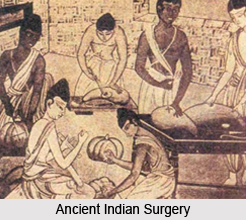
In the Hindu medical literature Charaka and Susruta are the most eminent personalities. They belonged to the epic age. Though they were not the original authors they were the greatest compilers. Charaka had compiled the magnificent works of the six disciples of Atreya. The minor loopholes in his work were amended by the learned Drirhavala, a writer of Panchanada. The latest work of Charaka was then finally placed in the court of Kanishka. Another notable person Divodasa, the king of Benaras was extremely proficient in medical science and excelled in surgery. Hence he was bestowed with the title Dhanvantari. Even Susruta, a son of the great sage Visvamitra had learnt the subject under his guidance. Another scholar Gautama wrote his work under the name Kumara-Bhritya, meaning treatment of the infants.
They discovered that the fact that the basic function of pliha (spleen) and yakrit (lever) in the body is to make blood. The Vedas mentioned about 360 bones in the body whereas Susruta proved that there existed 300 bones.
During the Rig Vedic age the use of numbers reveal their familiarity with the science of numbers. They were also aware of the decimal notations. There are many instances which prove that the Indo-Aryans knew the rudiments of geometry, mensuration and trigonometry. The dissections of animals for sacrifice and food show their knowledge about anatomy.
Indian Medicine in Post Vedic Period
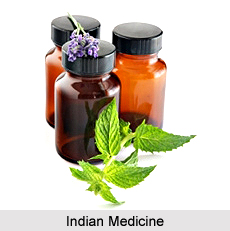 Post Vedic Period commences with the birth of Gautama Buddha in 600 B.C. as a prince in Kapilavastu. The Buddhist period concentrated upon eradication of sufferings and the all round development of medicine. The varied methods of treatment of that period were predominantly based upon the teachings of Atreya, the famous physician of Harappa in the Indus Valley Civilisation.
Medicines of Post Vedic Period : The Buddhist monks, besides being great social reformers were also accomplished physicians coupled with the zeal and ardour to attend to the masses and render a supporting hand to the sick and ailing members of the society. Lord Buddha was himself a great physician, possessing in-depth knowledge about medicine. The Buddhist monks when suffered from seasonal diseases were prescribed to take four types of medicines, Kalika, Yamika, Saptahika and Yavajjivika. In the Buddhist pharmacopoeia, the kalikas were the pulp of boiled rice or any other grain known as Manda, porridge or boiled rice called Oddna, sour gruel or kulmasa, meat or mamsa and cakes prepared from flour or opupa.
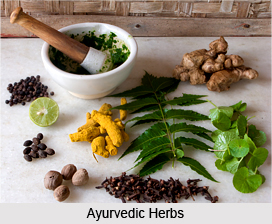 The Yamikas were 8 types of drinks, such as Cocapanam, prepared from cinnamon bark; Mocapdnam amde of plantain trees, i.e. Musa sapientum; Kolapanam a drink prepared from Jujube tree; Asvatthapanam a drink prepared from the fig tree; Udumburapanam, made from berries; Mrdvikapdnam, prepared from grapes and Kharjurapdnam, prepared from dates. The Saptdhikas used by the Buddhists were: taila or oil; sarpi or ghee; phanita, juice of sugarcane; madhu or honey; sarkara or dry sugar. The Yavajjivika were mulabhaisajya or root medicine; ganda bhaisyajya or tubers; patrabhaisajya or leaf medicine; puspabhaisajya or flower medicine; 5 jatus or lac like silajatu; 5 ksaras like alkalis; 5 lavanas or salts and 5 kasdyas or astringents like haritaki. Among the Mulabhaisajyas there are Vaca-Acorus Calamus; Musta-Cyperus Rotundus; Haridrd-Curcuma longs; Attvisa-Aconitum heterophyllum; Arka-Calotropis gigantea.
The Gandabhaisajyas used by the Buddhist monks were: Chandana, Chavika-Piper retro-fractum; Padmaka-Prunus Cerasoides; Devaddru-Cedrus Deodar; Guduci-Tinospora Cordifolia and Ddruharidra-Berberis Aristata.
The monks also used Patrabhaisajyas as their medicines for curing diseases. These were the leaves of Patola-Trichosanthes dioca; Vdsikd-Genddrussa vulgaris; Nimba-Azddirachta indicd; Kosataki-Luffa acutangula; and Saptaparna-alstonia scholaris.
The Puspabhaisajyas were the flower of Nimba (vide ante); flower or Dhatuki-Woodfordia floribunda; flower or Sati-Hedychium spicatum; and the filament or kesara of Padma-Nelumbo nucifera. The five Jatus are: Hingu or Ferula foetida; Sarjarasa or the exudation of Valeria indica.
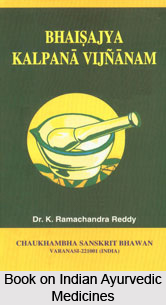
Besides these, there are five ksaras, five salts and five kasayas that were used during the post Vedic period.
The five ksaras are: Yavaksara- it is the alkali made from the remains of burnt green barley corns known as hordeum vulgare; Yavasukaksara also known as alkali are made of the ashes of burnt barley straw; Sarjiksara or impure alkali; Tilaksara or the alkali made from sesamum indicum and Vasakaksara is the alkali prepared from gendarussa vulgaris.
The five salts are: Saindhava-amonium chloride; Sauvarcala, the salt made by boiling soda with emblic myrobalan; Romaka, the salt derived from saline earth; and Samudraka, the salt extracted from sea water.
The five kasayas used during the post vedic period are: Amrakasaya, the astringent or mangtfera indica, Nimbakasdya, the astringent of Azadirachta indica; Jambukasaya, the astringent prepared from rose apple tree, i.e. Syzygium cumini; Sirisakasaya-Acacia sirissa; and Kosambakasaya.
Physicians of Post Vedic Period : The Post Vedic period marked the emergence of an assemblage of expert physicians blessed with profound pharmacological knowledge, rendering unremitting service to the ailing patients with impeccable results. Some of the noteworthy physicians to have served the society during that period are named below:
 Jivaka Jivaka, regarded as one of the eminent physicians of the post Vedic period was a follower and close associate of Lord Buddha. King Bimbisara recovered him from a garbage dump and reared as his own son. He was educated in the medical school of Taxila under the guidance of Atreya. The son of Bimbisara, Ajatasatru was converted into Buddhism by Jivika. He authored the book Brdhqjivakatantra.
Acharya Bhagabhata : Acharya Bhagabhata is known to have re-edited Charaka Samhita and later named it as `Astanga Ayurveda.`
Bagabhata : Bagabhata, another scholar of the same name, taught in Nalanda. He has authored the renowned medical text `Rasaratnasamucchya.`
Madhaba Kara : Madhaba Kara, a native of Bengal was a notable physician of the post Vedic period. He composed a book Madhaba Niddna that was later translated into Persian during the reign of the Abbasid Khalifa Haroon-al-Rashid of Baghdad. He wrote another book, named Ratnamdla that deals with studies on the materials of medicine.
 Chakrapani Dutta : A famous Bengali author of medical texts, Chakrapani Dutta was born in a village, Mayureswara in the Barendrabhumi (North Bengal) into a learned family of Lodhrabati. Chikitsd Samgraha or Chakradatta is a priceless reference book authored by him. Bhanu Dutta, his brother was also a physician and pathologist. Chakrapani had written two other books, Dravyaguna and Sarvasdra Samagraha. He had edited the diagnostic methods of Madhaba Kara, named as Chakradatta pradeepikd. Chakrapani Dutta had conferred upon him the honorary titles of Charaka Chaturandma and Susruta Sahasrandma for his work.
The dawn of the 12th century witnessed the frequent attacks of the Muslim invaders that resulted in a state of pandemonium. The scientific and literary pursuits were in complete abeyance. Thus, the sporadic attacks and the chaos state of affairs led to the rapid decline in the practice and research in medicine including ayurveda.
Developments in Pre-Alexandrian Greek Medicine
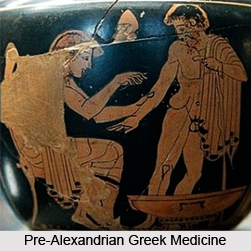 Hippocrates was an Asiatic by birth and had his medical education in Knidos in Asia Minor. So he had more of Indian medicine in his curriculum than the medicine of Greek mainland.
It is evident that among such a group of people as the Greeks, varying in state of civilisation, in mental power, in geographical and economic position and in general outlook, the practice of medicine could not have been uniform. Without any method of centralizing medical education and standardizing teaching there was a great variety of doctrines and of practice in vogue among them, and much of this was on a low level of folk custom. Such lower grade material of Greek origin has come down in abundance, though much of it is from a later time. But the overwhelming mass of earlier Greek medical literature sets forth for us a pure scientific effort to observe and to classify disease, to make generalizations from carefully collected data, to explain the origin of disease on rational grounds, and to apply remedies, when possible, on a reasoned basis.
There is ample evidence that the Greeks inherited, in common with many other people of Mediterranean and Asiatic origin, a whole system of magical or at least non-rational pharmacy and medicine from a remoter ancestry. Striking parallels can be drawn between these folk elements among the Greeks and the medical systems of the early Romans, as well as with the medicine of the Vedas, medicines of the ancient Egyptians, and of the earliest European barbarian writings. It is thus reasonable to suppose that these elements, when they appear in later Greek writings, represent more primitive folk elements working up, under the influence of social disintegration and consequent mental deterioration, through the upper strata of the literate Greek world.
Pre-Alexandrian Greek Medicines of Indian Origin : The first origins of Greek Medicine are scantily documented. Thus, as an instance, some prescriptions in the Ebers papyrus of the 18th dynasty, about the 16th century BC discovered at Thebes in 1872 resemble certain formulae in the Corpus Hippocraticum. A number of drugs too, habitually used by the Greeks such as, Andropogon (Bhustrina), Cardamom (Elaichi) and Sesame Orientalis (tila) are of Indian origin.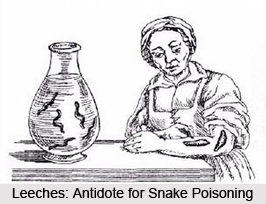
According to the earliest medical school of Cnidus, a Lacedaemonian colony in Asiatic Doris (ancient Turkey), its origin may perhaps reach back to the 7th century BC antedating the birth of Buddha in India and Hippocrates in Greece. The teachers of Cnidus were accustomed to collect systematically the phenomena of disease, of which they had produced a very complex classification. The physicians of Cos considered that the Cnidian physicians paid too much attention to the actual sensations of the patient and to the physical signs of the disease. The most important of the Cnidian doctrines were drawn up in a series of sentences of aphorisms, and these, it appears, inculcated a treatment along Egyptian lines of the symptom or at most the disease, rather than the patient, a statement borne out of the contents of the gynaecological works of probable Cnidian origin.
While the Indian system of medicine was at its zenith in the East, the Greeks were busy advancing medical knowledge in the West. As a result of unremitting diligence and prolonged experience, the Greeks had promoted the knowledge of "Materia Medica" through successive stages of development. Several useful and tested Ayurvedic drugs were included in Materia Medica, a Greek medical literature. Dioscorides (1st century AD) in his Herbal specifically states that the following plants among others were brought from India for medicinal purposes: Kardam (kardamomum), Nardostachys jatamansi (nardos), Kustha (kostos), Vacha (calamus acorus), Aguru (agallochon), Guggulu (bdellion) and Nil (indikon).
The Greeks, however, were not content with borrowing only the Indian drugs. They subjected some therapeutic measures, such as, application of leeches an antidote for snake poisoning that were prevalent in India to their own tests before they adopted it as useful therapy. Celsus (25 BC-50 AD) has given excellent account of lithotomy and cataract operation, as developed and practised by the ancient Hindus and described in the "Sushruta Samhita".
Developments in Medicine during British Rule
 Before the advent of the British in India the medical system of India was not all that structured. Traditional and ancient system of medicine from forests and `rishis` were in vogue in India for treating illness. It is after the British`s arrival in native soil, substantial changes took place in medicine. Britishers was responsible to bring home the western system of medical treatments, with advancements for every kind of patients. Developments in medicine and medicinal fields thus gained pretty momentum since the 17th century.
In 1761, the Army Medical Department was established in India, providing services to British troops associated with the British East India Company`s army.
In January 1764, the Bengal Medical Service was founded. The organisation consisted of four head surgeons, eight surgeons, and twenty-eight surgeon`s mates. Soon thereafter this organisation was replicated in the Madras and Bombay Presidencies. During the 1760s, the Military Subordinate Medical Service was organised in Bengal to employ Indians and European soldiers as compounders, dressers and apothecaries.
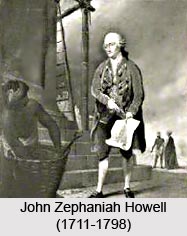
In 1767, John Zephaniah Howell (1711-1798) reported to the College of Physicians in London on his observations regarding the practice and level of effectiveness of variolation, or Indian inoculation for smallpox. Jenner`s discovery of the cowpox inoculation method for smallpox in 1798 brought to an end European use of variolation by 1802. Developments in medicine during the early advent of the British in India were kind of a boon to native residents, who still now did never hear about such advancements in the medical world.
In 1773, the British East India Company appointed a Board to screen and select candidates for appointment as assistant surgeons in the respective presidency medical services.
On 29th May 1786, a Hospital Board was created for each presidency which in May was converted to a Medical Board subordinate to the presidency`s Commander-in-Chief.
Developments in medicine received additional impetus when on 28th October 1788 Lord Charles Cornwallis (1738-1805) began the practice of granting military commissions to doctors, provided the appointee had twenty-one months of medical training in India. He also stipulated that medical officers could be lent to civilian duty with the provision of recall to military duty when necessary.
In 1794, the Madras Lunatic Asylum opened for the purpose of restraining the violent acts of the mentally ill. Patients were carefully placed in separate apartments according to class, gender and race. Similar institutions were established in Calcutta and Bombay during this period. By 1818 official Company policy called for the return of European lunatics to England if their incapacity lasted for more than one year. Medicinal developments were looked into watchfully, with every care and pain taken into account when protection and cure was the only concern.
In 1802, Jennerlan vaccination for smallpox was introduced in India. Dr. William Russell, Superintendent of Vaccination, carried out the inoculation of many European children located at Company stations throughout Bengal.
In 1810, John Fleming (1770-1829) of the Company`s Medical Service prepared from his study of plants a work on Indian drugs entitled, A Catalogue of Indian Medicinal Plants and Drugs with their Names in the Hindustani and Sanskrit Languages.
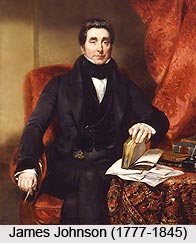
In 1813, James Johnson (1777-1845) published The Influence of Tropical Climates on European Constitutions, which proved to be the most influential medical work in India for the next forty years. It was highly critical of excessive British consumption of beef, pork and alcohol. Instead, he recommended the eating of more vegetable food. Developments in medicine were slowly coming to a full circle, owing to the good-will of the British men, awaiting more improvements in the turn of the century.
In 1853, John Snow (1813-1858) advanced the theory of continuous molecular action in association with his belief that cholera was transmitted only in drinking water contaminated by human excrement. These ideas formed the basis for much of the medical thinking on the source of cholera over the next thirty years.
 In 1856, Lord Dalhousie (1812-1860), Governor-General of India opened a Government Lunatic Asylum in Calcutta under the supervision of an East India Company medical officer.
In January 1858, the Indian Medical Service established in each presidency (Bengal, Bombay and Madras) the Office of Director-General. This measure occurred in consequence of the Crown taking over medical services from the British East India Company. Developments in medicine had a slight push up towards a different goal when the British Crown with Her Highness decided to rule India directly under Her administration, from England.
In 1859, the Crown appointed the Royal commission on the Sanitary State of the Army in India. Although the Commission did not visit the subcontinent, it did interview men with Indian experience. Its 1863 report identified the high Army death rate as due to: inadequate supply of clean water, poor sewage, bad drainage and crowded and poorly ventilated troop barracks. The Commission also commended the establishment of a sanitary commission in each presidency. From this work emerged the concept of the Government of India responsibility for India`s public health.
In 1860, Sir Clements Robert Markham (1830-1916) explored parts of Peru in search of the cinchona tree for shipment and establishment in India. Cinchona, as the source of quinine, was used to fight malaria. This and later attempts to grow cinchona in India however became problematic with the success of its cultivation by the Dutch in Java.
In 1861, a cholera epidemic occurred in Northern India of such severity that in consequence, four European international sanitary conferences were convened to negotiate quarantine measures as a means for preventing the spread of cholera. The 1861 conference at Constantinople particularly focused on health measures used at the port of Bombay as the originating point of many Muslim pilgrimages to Arabia which often proved to be the source of cholera outbreaks.
Developments in medicine under British regime were to witness even more augmented measures, when in 1864 the Sanitary Department of the Indian Medical Service was created. From the 1890s its officers generally held to the value of bacteriological medicine and possessed a sense of reform in matters of public health. The level of intervention by the sanitation officer into Indian life was always tempered by the fear of creating the conditions for a "second mutiny".
In 1867, the Delhi Female Medical Mission, associated with the Society for the Propagation of the Gospel, began operations in Delhi. In 1868, the Contagious Diseases Act reinstated the provision of "lock hospitals" for the treatment of prostitutes suffering from venereal diseases located at or near army cantonments throughout India. They had earlier operated from 1805 until their abolishment in 1833.
In 1871, Government of India began the manufacture of morphine from opium and quinine from cinchona bark in replacement of costly irregular imports. This was a sharp move towards emergency developments in medicine, because these prescribed medicines were to take a significant role in medical world much later.
In 1872, Sir Joseph Fayrer (1824-1907) published a significant work on Indian snake poison, Thanatophidia of India (1872). In 1873, Fayrer and Sir Lauder Brunton demonstrated that the venom of the cobra produced a fatal respiratory paralysis.