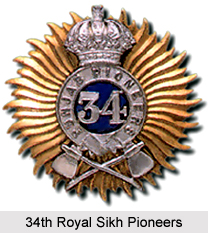
 The 34th Royal Sikh Pioneers, also known as the 32nd Bengal Native Infantry, was an infantry unit of the British Indian Army. The unit was formed under the Honourable English East India Company during the Indian Mutiny in 1857 and served till the year 1922. The 32nd Bengal Native Infantry was incorporated as a part of the Bengal Army in 1895. The army of the erstwhile Bengal Presidency was one of the 3 Presidency Armies in British India. The 34th Royal Sikh Pioneers was also known as the Mazhabi Pioneers and consisted of 3 battalions.
History of 34th Royal Sikh Pioneers
The 34th Royal Sikh Pioneers was raised during the Sepoy Mutiny in 1857 as the Punjab Sappers by the British East India Company. The unit was re-designated various times and was named as the 32nd Punjab Pioneers in 1901. It was later designated as the 34th Sikh Pioneers in 1903. In order to honour the visit of the Prince and Princess of Wales in British India, the infantry regiment took in the Rawalpindi Parade in the year 1905.
Military Operations of 34th Royal Sikh Pioneers
The 34th Royal Sikh Pioneers participated in the Siege of Delhi and Lucknow and also provided service in the Capture of Lucknow during the Great Revolt of 1857. The troops also fought in the Second Afghan War in the year 1878 and later took part in the Relief of Chitral in 1897. The 32nd Bengal Native Infantry was merged with the 3rd (Lahore) Division during the First World War. The regiment was sent to the Western Front during the Campaign at Mesopotamia. The infantry unit also participated in the Palestine and Sinai Campaign.
Development of 34th Royal Sikh Pioneers
In the year 1922, the British Indian Army was restructured and regrouped by the British Government of India after World War I. The single battalion infantry units were united to form regiments of 4 to 6 battalions. The 34th Royal Sikh Pioneers regiment was eventually re-designated as the 2nd Battalion, 3rd Sikh Pioneers.
After the Indian independence on 15th August 1947, the British Indian Army was divided among the Union of India and the Dominion of Pakistan. The 32nd Bengal Native Infantry regiment was assigned to the modern Army of independent India.