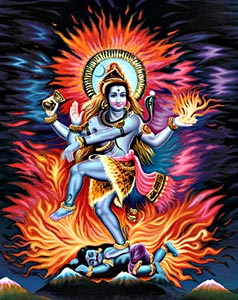
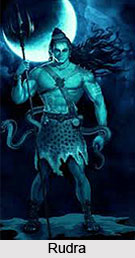
 Rudra is an agent of creation. He is the Puranic God who sprang from the forehead of Lord Brahma. Rudra is radiant as the noontide sun and violent. He is the bulk figure made of half-male and half-female. Rudras are forms and followers of the God Rudra-Shiva and make 11 of the Gods in the Hindu pantheon.
Dual Nature of Rudra
With the order of Brahma, Rudra became two-folds, disjoining his male and female natures. The male part of Rudra is divided into eleven persons. Each person was of multiple characters, some were pleasant, some repulsive, some ferocious and some mild. Rudra multiplied his female nature manifold, of complexions black or white.
Creation of Rudra
The Vishnu Purana affirms that in the early days of Kalpa, Brahma made a decision to create a son like himself with all his qualities. Then all of a sudden a purple complexion youth appeared running and lamenting with a low cry. Brahma asked him the reason why he was weeping then the boy asked to give him a name. Brahma named him "Rudra" and told the boy to be comforted. Rudra still wept seven times, and Brahma therefore gave him seven other denominations. Rudra with the other seven personalities was endowed with a region, wife and prosperity.
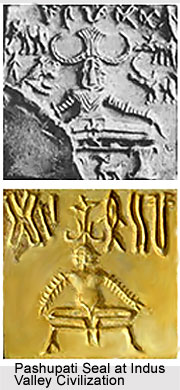
The eight manifestations are named Rudra, Bhava, Sarva, Isana, Pasupati, Bhima, Ugra, and Mahadeva. Lord Brahma named the eight manifestations. He also assigned to them their respective positions. The positions of the eight manifestations were the Sun, Water, Earth, Air, Fire, Ether, the Ministrant Brahman and the Moon. The eight Rudras together are one, under as many appellations, and in as many types.
Ekadash Rudra
The Matsya Purana lists the names of the "Eleven Rudras", who assist Lord Vishnu in fighting the demons. They are as follows:
1. Kapali
2. Pingala
3. Bhima
4. Virupaksa
5. Vilohita
6. Ajesha
7. Shasana
8. Shasta
9. Shambhu
10. Chanda
11. Dhruva
The Vishnu Purana lists them as:
1. Manyu
2. Manu
3. Mahinasa
4. Mahan
5. Shiva
6. Rtudhvaja
7. Ugraretas
8. Bhava
9. Kama
10. Vamadeva
11. Dhritavrata
They are at times identified with the Maruts - sons of Rudra; while at other times, considered distinct from them.