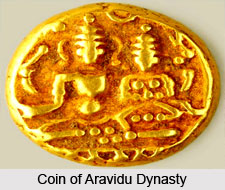
 Aravidu Dynasty was the fourth and last Hindu dynasty which ruled Vijayanagar Empire in South India.
Founder of Aravidu Dynasty
The founder of Aravidu Dynasty was Tirumala, whose brother Rama Raya had been the masterful regent of the last ruler of the previous dynasty. Rama Raya`s death at the Battle of Rakasa-Tangadi (also known as the Battle of Talikota) in the year 1565 led to the subsequent destruction of Vijayanagar Empire, which ruled the South India in the midst of Dark Age, by the combined forces of the Muslim states of Bijapur. The main rulers of Aravidu dynasty were as follows:
Rama Raya (1542-1565 CE)
Rama Raya, (1542-1565 CE) commonly known as "Aliya" Rama Raya, was the progenitor of the "Aravidu" dynasty of Vijayanagar Empire.
Tirumala Deva Raya (1565-1572 CE)
Tirumala Deva Raya (1565-1572 CE) was perhaps the original Coronated King of the Vijayanagara Empire from the Aravidu Dynasty.
Sriranga Deva Raya I (1572-1586 CE)
Sriranga I also known as Sriranga Deva Raya, (1572-1586 CE) was the king of Vijayanagara empire, from 1572-1586. He conceded the restitution of the Vijayanagara empire, but his reign was stained with repeated attacks and loss of territories from his Muslim neighbours.
Sriranga II (1614-1614 CE)
Sriranga II also known as Sriranga Chika Raya (1614-1614 CE), was nominated in 1614 by King Venkata II to ascend him as king of the Vijayanagara Empire in Southern India.
Rama Deva Raya (1617-1632 CE)
Rama Deva Raya, also known as Vira Rama Deva Raya (1617-1632 CE), succeeded the throne following a ghastly war in 1617 as the King of Vijayanagara Empire. In 1614 his father,Sriranga II the preceding King and his family were gruesomely murdered by rival factions headed by Jagga Raya, who was one of their kins. Rama Deva himself was smuggled out of the prison by Yachama Nayudu, a faithful commander of earlier king Venkata II. The defeated Jagga Raya sought harbour in the jungle but sprung up and sought aid from the Nayaks of Gingee and Madurai, both willing to set out of the Vijayanagara bond, to assail Yachama Nayudu and Rama Deva. Yachama Nayudu and Ramadeva sought support from the Tanjore Nayaks, who still treated the Vijaynagar as their authority.
Venkata III (1632-1642)
Venkata III also known as Peda Venkata Raya, the grandson of Aliya Rama Raya became the King of Vijayanagara Empire from 1632-1642.
Sriranga III (1642-1652 CE)
Sriranga III 1642-1652 CE was the ultimate ruler of the Vijayanagar Empire, who came to power in 1642.
Capture by Timma Raja
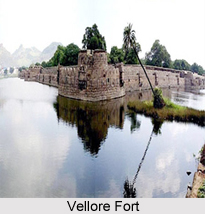
Venkata III`s paternal uncle, Timma Raja, another brother of Sriranga II, considered himself to be a better claim, detained the government at Vellore Fort, persuading Venkata III to remain in his native place Anekonda. The Nayaks of Gingee, Tanjore and Madurai declared support for Venkata III, while Timma Raja got from none and was looked upon as a usurper. Timma Raja however made lot of trouble and civil strife continued until his death in 1635.Initially he was winning, until the King Peda Venkata (Venkata III)`s nephew,Sriranga III took to the field and beat Timma Raja with help from the Dutch in Pulicat,compelling him to accept Venkata III`s claim. Timma Raja was allowed some territories under his control, but stirred up trouble the second time, only to be slain by the Nayak of Gingee in 1635. Peace was finally restored and Peda Venkata Raya or Venkata III returned to Vellore to take charge.
Madras Land Grant
On 22 August 1639 Francis Day of the British East India Company attained a miniature strip of Land in the Coramandal Coast from in Chandragiri. The region was under by the Damerla Venkatapathy, Nayak of Vandavasi. It is the place to build a factory and warehouse for their trading activities.
Trouble from Southern Nayaks
In the year 1647 the Nayaks of Tanjore and Madurai, resulting out of some complications endeavoured to seize Venkata III, and assailed Vellore but were overpowered and peace was patched up.
 Insurgence of Sriranga III
The Kings loyal nephew, Sriranga III for certain reasons turned against the King in 1638 and engineered an invasion from Bijapur.The Bijapur - Sriranga III combine initially attacked Bangalore making the King Venkata III buy peace after an expensive deal.In 1641 the same combine launched another attack and were just 12 miles to Vellore Fort, but Southern Nayaks attacked their camp with backing.
Golkonda Forces and the Kings of Aravidu Dynasty
In the following year 1641, the Golkonda Sultan witnessing the disarray sent a huge force along the East Coast. The Golkonda army after facing a stiff confrontation near Madras by Venkata III`s army backed by Gingee Nayaks and Darmala Venkatapati,the chieftain of Madras and Poonamalee advanced towards Vellore Fort. But Venkata III, now badly under threat from all sides retreated to the Jungles of Chittoor and died October 1642. Venkata III did not have any heirs and was instantly succeeded by his deceitful nephew Sriranga III, who came to Vellore Fort after deserting the Bijapur camp.
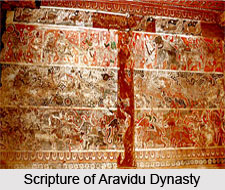 Aravidu dynasty , the fourth and last to hold sway over the Vijayanagara Empire, is often not counted as a ruling dynasty of that empire, for reasons delineated below. Rama Raya patronised the Sanskrit scholar Rama Amatya. Aliya" Rama Raya and his brother Aliya Tirumala Raya were sons-in-law of the great Vijayanagara emperor Krishna Deva Raya. The word "Aliya" means "son-in-law" in the
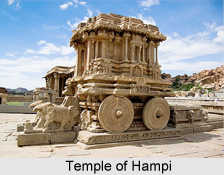
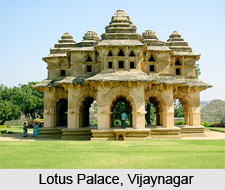
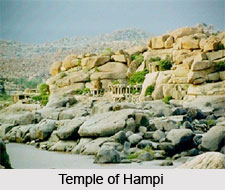
 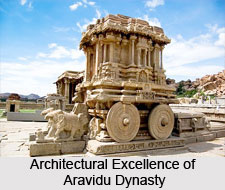 Vijayanagara architecture is a vivacious amalgamation of the Chalukya, Hoysala, Pandya and Chola styles, phrases that flourished in previous centuries.Its stylistic trademark is the ornate pillared Kalyanamantapa (marriage hall), Vasanthamantapa (open pillared halls) and the Rayagopura (tower). Artisans used the locally accessible hard granite considering its resilience as the kingdom was under unvarying hazard of incursion. While the empire`s monuments are fanned out over the entire Southern India, nothing surpasses the vast al fresco theatre of monuments at its capital at Vijayanagara, a UNESCO World Heritage Site.
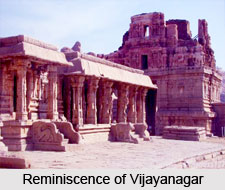
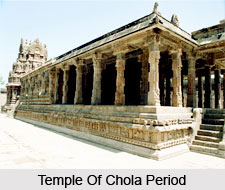 A characteristic of Vijayanagara architecture exhibiting the multi-ethnicity of the great conurbation is the occurrence of several secular structures bearing Islamic features.While political history concentrates on the ongoing conflict amid the Vijayanagara Empire and the Deccan Sultanates, the architectural record reflects a more creative interaction. There are several arches, domes and vaults that show these influences. The concentration of structures like pavilions, stables and towers suggests they were for use by royalty.
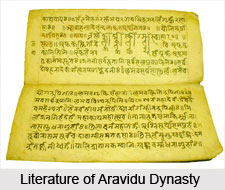 During the reign of the Vijayanagar Empire, poets, scholars and philosophers inscribed in Sanskrit and the regional languages, Kannada, Telugu and Tamil and enclosed such subjects as religion, biography, Prabhanda (fiction), music, grammar, poetry and medicine. The Telugu language became a popular literary medium, reaching its peak under the patronage of Krishnadevaraya.
 The monarchs of the Vijayanagara empire sustained the smooth functioning governmental methods developed by their precursors, the Hoysala, Kakatiya and Pandya kingdoms, to govern their territories and made changes only where necessary. The King was the eventual power, backed by a cabinet of ministers (Pradhana) headed by the prime minister (Mahapradhana). Further important titles recorded in inscriptions were the chief secretary (Karyakartha or Rayaswami) and the imperial officers (Adhikari). All high-ranking ministers and officers were obligatory to pursuemilitary training.
 On the battlefields, the king`s commanders led the troops. The empire`s war strategy rarely involved massive invasions; more often it employed small-scale methods such as attacking and destroying individual forts. The empire was among the first in India to use long-range artillery commonly manned by foreign gunners. Army troops were of two types: The king`s private army unswervingly recruited by the empire and the feudal army under each feudatory. King Krishnadevaraya`s personal army consisted of 100,000 infantry, 20,000 cavalrymen and over 900 elephants.
 Excavations have revealed the remains of a well-connected water distribution system accessible exclusively within the majestic inclusion and the large temple complexes (suggesting it was for the exclusive use of royalty, and for special ceremonies) with sophisticated channels using gravity and siphons to transport water through pipelines.
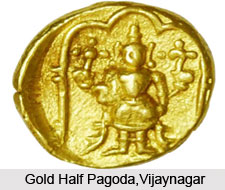
 The empire`s economy was largely dependent on agriculture. Corn (jowar), cotton and pulse legumes grew in semi arid regions, while sugarcane, rice and wheat thrived in rainy areas. Betel leaves, areca (for chewing), and coconut were the chief cash crops, and large-scale cotton production supplied the weaving centers of the empire`s vibrant textile industry. Spices such as turmeric, pepper, cardamom and ginger grew in the remote Malnad hill region and were transported to the city for trade. The empire`s capital city was a booming business center that incorporated a mushrooming market in large quantities of precious gems and gold.[40] Prolific temple building provided employment to thousands of masons, sculptors, and other skilled artisans.