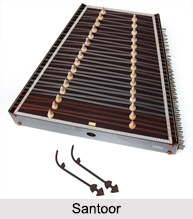
 Believed to have originated in the north western part of India, Santoor dates back to the ancient Vedic period and is a traditional instrument in Jammu and Kashmir. Shaped like a trapezoid, the Santoor is a hammered dulcimer that is generally made out of walnut and has 25 bridges. Each of these bridges has 4 strings, thus making a total of 100 strings.
History of Santoor
The modern day Santoor hypothetically traces its origins to the Shata- Tantri Veena of Vedic times. This instrument was made from the strings of the Munja grass, and was called the "Vana Veena" or the Veena of the forests in ancient times. It is held by musicologists that there are many different varieties of the Santoor which exist in countries all over the world.
While the instrument is said to have existed in Kashmir, after a series of Islamic invasions during the medieval times, it underwent many modifications. Sufism took the place of the predominant Shaivism and the Sufis adopted the Santoor as part of their musical ensemble called the "Sufiana Qalam", where it was played along with instruments like the Rebab and the Sitar to the accompaniment of religious singing.
The contemporary Santoor is largely the result of the innovations and changes brought about in the Sufiana instrument by Pt. Shiv Kumar Sharma. Though there are musicians who use the Sufiana instrument with the 100 strings, the Santoor used today by Shiv Kumar Sharma has only 86 strings and is tuned differently.
Structure of Santoor
A variation of the Iranian Santoor, the variation in the structure of the Indian Santoor exists in regard to the number of strings, their arrangement and thickness, the number of bridges and also the modes of playing adopted by different players. The sound box of the Santoor, which acts as a resonance chamber, is made of the wood of mulberry or walnut.
A typical Santoor has two sets of bridges, providing a range of three octaves. The bridges are made of rosewood, and their upper portion is covered usually with ivory to obtain a fine tone. The strings, which are approximately 86 to 100 in number, are tuned differently. The ones made of steel are tuned to the higher octave, while the thicker strings made of copper or bronze are tuned to the lower octave. The strings are hooked to metallic pins on one side and, on the other, tied to tapering tuning pegs through a hollow drilled in them. The player tunes the instrument by using a tuning key with which he tightens or loosens the strings. The number of strings passing through each bridge is usually three or four and the number of bridges varies from about 25 to 29.
Playing of Santoor
The musician has to sit in an asana called the "ardha padmasana" position and place the instrument on their lap. The broader side of the Santoor is supposed to be closer to the waist of the musician, while the shorter side must be away. The Santoor is played with a pair of light wooden mallets held with both hands.
Since it is a delicate instrument, the notes are produced by striking the set of strings that produce the notes of the Raaga using both the mallets. The left hand strikes have to be complemented by the right hand strikes to produce the desired notes. The volume of each note would depend on the strength of each stroke. Players get the desired tonalities and pitches by shifting the angle of the mallet, as also the stress given to the strikes. Stylistic variations are numerous in this regard.