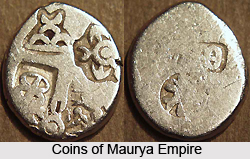
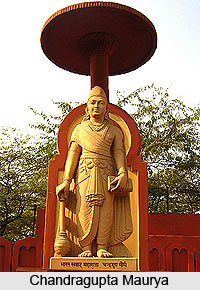
 Chandragupta Maurya in foreign Greek and Latin accounts is known as Sandracottos or Andracottus. There are different theories regarding his origin .It is often said that Chandragupta originated from Magadha possibly as the son of a Nanda prince and a maid named "Mura". Others claim that the Mauryas were the Muras or rather Mors, while another view is that the Mauryas are of kshatriya origin of Indo-Scythian lineage.
According to scholars, Chandragupta was born into a family left destitute by the death of his father, chief of the migrant Mauryas, his maternal uncles left him with a cowherd who brought him up as his own son. Later, he was sold to a hunter to tend cattle. Purchased by a Brahmin politician, Chanakya, Chandragupta was taken to Taxila (now in Pakistan) where he received education in military tactics and the aesthetic arts. On the advice of Chanakya he collected military assistance and ended the autocracy of the Nanda dynasty.
He with the help of Chanakya, began laying the foundation of the Mauryan Empire. Kautilya and Chandragupta formed their own army and started making conquests. With Kautilya`s aid he established a strong and centralized empire on the model of the Achaemenids of Iran. Kautilya also known as Chanakya was the prime minister of his kingdom. After Alexander`s death in 323 BCE, Chandragupta turned his attention to North western India where he defeated the satrapies.
At a young age of twenty he had conquered the Macedonian satrapies in India as well as conquered the Nanda Empire in 325 B.C. With this his empire extended from Bengal and Assam in the east to the Indus Valley in the West. After this he conquered Punjab in 322 B.C.after the death of Alexander (III) the Great, expanding his empire west to Iran. He defeated Seleucus (I)Nicator ,who had attempted to restore Macedonian rule in the east in 305B.C. Seleucus gave India (present-day Pakistan and part of the Punjab) and eastern Afghanistan in exchange for 500 war elephants for use in his western campaigns.
After Chandragupta`s conquests, the Maurya Empire extended from Bengal and Assam in the East, to Afghanistan and Balochistan in the West, to Kashmir and Nepal in the North, and to the Deccan Plateau in the South.
After annexing the eastern Persian provinces of Seleucus eastern Persian provinces, Chandragupta had a vast empire extending across the northern parts of Indian Sub-continent, from the Bay of Bengal to the Arabian Sea. He began expanding his empire beyond the barrier of the Vindhya Range and into the Deccan Plateau. He succeeded in unifying most of Southern Asia.
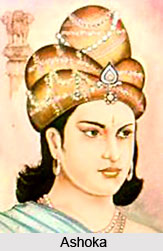
Chandragupta gave up his throne towards the end of his life and became an ascetic under the Jain saint Bhadrabahu. Chandragupta Maurya handed the throne to his son, Bindusara, who became the new Mauryan Emperor. Bindusara is the father of Ashoka the Great, who was one of the most influential kings in history due to his important role in the history of Buddhism.