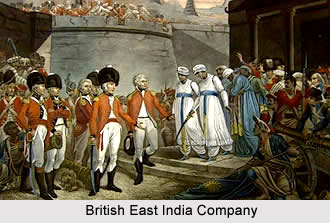
 British East India Company was a joint-stock company that was originally formed to do business with the East Indies. But eventually, the company ended up doing business primarily with the Indian subcontinent and China. It is commonly said that in the history of the world there is no more wonderful story than that of the advent of the British Empire in India. History says that it was not the result of deliberate design. East India Company was unique as it started its humble beginning as the mere trading company and later took over political interest and changed to the ruler of the entire country.
Foundation of British East India Company
The British East India Company was in fact the venture of some of the influential businessmen of London who acquired the Crown`s charter for special permission to trade in spices in the East Indies (presently South Asia) and the permission was granted for a period of 15 years. The East India Company started with a capital of 72,000 pounds and had around 125 shareholders. One Governor and 24 directors who constituted the Court of Directors led it.
Foothold of British East India Company in the Country
There is a very interesting history behind the British East India Company`s strengthening its foothold in India. Initially, the British traders had enmities with their Dutch and Portuguese counterparts in the Indian Ocean. The victory of the company over the Portuguese in the Battle of Swally in 1612 brought them in favour with the Mughal Emperor Jahangir. Probably comprehending the pointlessness of waging trade wars in distant seas, the English decided to look into options for gaining a grip in mainland India, with the authorized sanction of both countries - Britain and India. The company appealed to the Crown to launch a diplomatic mission.
In course of time ships belonging to the British East India Company arrived in India and docked at Surat, finally establishing it as a shipping spot in 1608. Within the next two years, the company was able to construct its first factory in Machilipatnam on the Coromandel Coast of Bay of Bengal. The lofty profits earned by the British East India Company in the beginning encouraged King James I to grant subsidiary licenses to other trading companies in England. But, in 1609, he extended the charter given to the Company for an indistinct time. Moreover, there was a clause, which stated that the charter would cease by force if the trade became unbeneficial for three successive years. Attempts to set up a factory on the Hooghly River commenced in 1640, but were ineffective until 1690. This settlement later developed into the city of Kolkata.
Within the year 1652 there were around 23 English factories in India. The main factories became the Fort St George in Chennai, walled forts of Fort William in Bengal, and the Bombay Castle. In 1634, the Mughal Emperor extended his hospitality to the British traders in the region of Bengal and in the year 1717 completely removed all customs duties for the purpose of trade. The British East India Company had frequent conflicts with foreign contenders. Therefore, as a safeguard, it ultimately accumulated its own military and administrative departments, thereby becoming a regal power in its own right. By 1689, the British East India Company dubiously acquired the status of a `nation` in the Indian mainland, separately governing the vast presidencies of Bengal, Mumbai and Chennai.
The British East India Company became the single most prominent performer in the British global market, and reserved for itself an unquestionable position in the administrative procedures of the Government. The British victory in the Battle of Plassey in 1757 brought Bengal, and gradually the whole of India under the control of the company. Thus, the British East India Company changed its role and became the ruling authority in India.
However, the British East India Company faced a lot of resistance from the regional rulers. The victory of Robert Clive against Siraj-Ud-Daulah at the Battle of Plassey in 1757 got rid of the last trace of resistance in Bengal. This victory alienated the British and the Mughals, since Siraj Ud Daulah had effectively been a Mughal liege ally. But the Mughal Empire was already on the decline after the demise of Aurangzeb, and was collapsing into fragments and enclaves. After the Battle of Buxar, Shah Alam II, the ruling emperor, gave up the governmental rights over Bengal, Bihar, and Orissa. Haidar Ali and Tipu Sultan, the famous rulers of Mysore, also posed a great treat to the British forces. But with the killing of Tipu Sultan by British in 1799, and gradual deteriorating of the Maratha Empire as an outcome of the three Anglo-Maratha wars, the British also got hold of Bombay and the adjacent areas. Thus, the British had control over almost all the parts of India except the Mughal Empire, which was also achieved during Sepoy Mutiny of 1857, hundred years later from the battle of Plassey.
There were many acts passed in relation with East India Company like East India Company Act 1773, Pitt`s India Act on 1784, Act of 1786, Charter Act of 1813, 1833 and 1853. In the year 1858, the East India Company was dissolved and the British Government took the responsibility of administration of India.
British East India Company
British East India Company had the strategic instrument to establish their 200-year long sway over the Indian dominion. Formerly, the British East India Company was a joint-stock company associated with the Dutch East Indian Company.