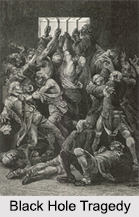
 Black Hole Tragedy is an incident that depicts the dark side of Indian History. On June 20, 1756, Siraj-ud-daulah, the then Nawab of Bengal, captured Fort William and Calcutta (Kolkata), wherein lied the main power of the British East India Company. The British and Anglo-Indian prisoners of war were thrust into a small and stuffy dungeon at Fort William after the fall of the fort, which is referred to as the "Black Hole of Calcutta". 146 people were reported to be imprisoned, of which only 23 men (including Holwell) came out alive.
The British claimed that the dungeon with a probable dimension of 24 feet by 18 feet was not spacious enough to accommodate so many people who were forcibly pushed into the congested place. The British records held that by the next morning 123 of the prisoners had succumbed to the adverse conditions, mainly due to suffocation, unbearable heat and crushing.
John Zephaniah Holwell of the British East India Company and one of the survivors of this tragedy mainly provided this statistical information. But some say that the total number of captives was not more than 69. The controversies about the exact toll continue till date and the exact figures are not known. The Black Hole of Calcutta was afterwards used as a warehouse, and an obelisk, 50 feet (15 m) high, was set up in remembrance of the dead. No traces of the black hole remain today.
Incident of the Black Hole of Calcutta
There is significant history behind the capture of Fort William and the incident of the Black Hole of Calcutta. The British set up Fort William to safeguard the British East India Company"s trade in the city of Calcutta in the region around Bengal. In 1756, with an aim to colonize Bengal and gradually the rest of India and also to be preparing for probable combats with the French forces, the British began strengthening the military defence of Fort William. In doing so, they interfered a lot into the internal political and military affairs of Bengal. The ruling Nawab of Bengal, Siraj-ud-Daulah, was unsatisfied with such excessive interference and saw it as a possible threat to the sovereignty of Bengal. He ordered the British to cease the ongoing military actions but the British did not listen to him. As a result, to curb the atrocities of the British, the Nawab of Bengal stormed the fort and killed many. The battalion"s chief officer planned an escape, and a token force was kept in the military fort under the control of John Zephaniah Holwell, who was a military surgeon as well as a top East India Company civil servant. In the meantime, the soldiers belonging to the allied troops, who were primarily Dutch abandoned the fight and the British ultimately failed to resist the attack of the Nawab.
 Indian troops took the surviving defenders prisoner. Among the prisoners were civilians as well as soldiers. Holwell and three other captives were sent as prisoners to Murshidabad, the rest of the survivors were released after the interference and subsequent victory of Robert Clive. A few months later, Robert Clive and his troops were sent to "retaliate". They fought the Battle of Plassey and defeated the Nawab. This marked the foundation of the British rule in India.
Black Hole Monument
John Zephaniah Holwell had erected a memoriam on the spot of the Black Hole of Calcutta to honour the dead, but around 1822 (the precise date is uncertain) it vanished. Lord Curzon, who became Viceroy of India in 1899, constructed a new monument in 1901 at the corner of Dalhousie Square, which is the probable site of the Black Hole. During 1940, when the Indian National movement was at its peak, the epitaph was removed from Dalhousie Square and again established in the graveyard of St John"s Church, where it remains till date.