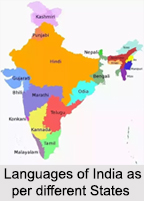
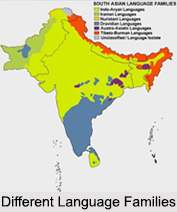
 Known to have the second highest number of languages, the languages of India primarily belong to two major linguistic families: the Indo- European, whose branch the Indo- Aryans is spoken by about 75 percent of the total population. And then there is the Dravidian, which is spoken by the rest 25 percent of the population. Other languages spoken in India come mainly from the Austro-Asiatic and Tibeto-Burman linguistic families, as well as a few language isolates. The individual languages of India number several hundreds and more than a 1000 if major dialects are included.
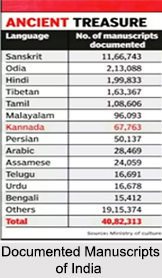
While Hindi in Devanagari script is the official language of the Central Government of India, with English as a provisional official sub-language, individual state legislatures can adopt any regional language as the official language of that state. The Constitution of India recognizes 22 official languages, spoken in different parts of the country. In addition, the Government of India has awarded the distinction of classical language to Kannada, Malayalam, Odia, Sanskrit, Tamil and Telegu.
 History of Languages of India
India is the home of the Indo-Aryan and Dravidian language families, which is indigenous to the Indian subcontinent. The southern Indian languages are from the Dravidian family, while the Proto- Dravidian languages were spoken in India in the 4th millennium BCE and started disintegrating into various branches around 3rd millennium BCE. These branches were classified into 4 groups: North, Central (Kolami–Parji), South-Central (Telugu–Kui), and South Dravidian (Tamil-Kannada).
The northern Indian languages are from the Indo-Aryan family which evolved from the Old Indic languages. The Indo-Aryan languages developed and emerged in 3 stages: Old Indo-Aryan, Middle Indo-Aryan stage and New Indo-Aryan. The modern north Indian Indo-Aryan languages all evolved into distinct, recognisable languages in the New Indo-Aryan Age.
The influence of foreign languages in India has been massive. The Indian sub-continent has endured many conquests throughout its history. Certainly the one with the longest-lasting effect was the Aryan invasion which brought Vedic speech with it. Sanskrit, Sauraseni Prakrit, and then Sauraseni Apabhramsa served as languages of interregional communication from early times until the Muslim invasions in north India in the 13th century. During this time, Persian became the court language and was later used as an official language during the reign of Mughal Emperor Akbar. In 1837, the British replaced Persian with English and Hindustani in Perso-Arabic script for administrative purposes, and the Hindi movement of the 19th century replaced Persianised vocabulary with Sanskrit derivations and replaced or supplemented the use of Perso-Arabic script for administrative purposes with Devanagari.
 Official Languages of India
In British India, prior to Independence, English was the sole language for administrative purposes as well as for higher education purposes. In 1946, the Indian Constitution declared Hindi in Devanagari script to be the official language of the union, unless the Parliament decided otherwise, the use of English for official purposes was officially to cease after the constitution came into effect, on January 26, 1965. The prospect of the changeover led to much alarm in the non Hindi-speaking areas of India, as a result of which the Parliament enacted the Official Languages Act, 1963, providing for the continued use of English for official purposes along with Hindi, even after 1965.
An attempt was made in late 1964 to expressly provide for an end to the use of English, but it was met with protests from across the country, some of which turned violent. The proposal was dropped because of the widespread protests and the Act itself was amended in 1967 to provide that the use of English would not be ended until a resolution to that effect was passed by the legislature of every state that had not adopted Hindi as its official language, and by each house of the Indian Parliament. Thus, the Constitution of India does not give any languages of India the status of national language.
Prominent Languages of India
The prominent languages of India are listed below as follows:
| Language | Family | Total No. of Speakers as per 2011 Census |
| Hindi | ndo- Aryan | 69.2 crore |
| English | Indo-European | 12.9 crore |
| Bengali | Indo- Aryan | 10.7 crore |
| Marathi | Indo- Aryan | 9.9 crore |
| Telegu | Dravidian | 9.5 crore |
| Tamil | Dravidian | 7.7 crore |
| Urdu | Indo- Aryan | 6.3 crore |
| Gujarati | Indo- Aryan | 6.0 crore |
| Kannada | Dravidian | 5.9 crore |
| Malayalam | Dravidian | 3.37 crore |
| Odia | Indo- Aryan | 4.3 crore |
| Punjabi | Indo- Aryan | 3.66 crore |
| Sanskrit | Indo- Aryan | 0.0025 crore |
 Other Languages of India