 The Viceroys of India had a significant and noteworthy role in shaping the state of the country during the British rule. While the British ruled India, the head of the British administration in India was the Governor General and Viceroy of India. This office was formed in the year 1773, where the officer had direct control only over Fort William, but supervised other British East India Company officials in India. Complete authority over all of British India was granted in 1833 and the official became known as the Governor-General of India. In 1858, India came under the direct control of the British Administration.
To reflect the role of the Governor General as representative, the term Viceroy of India was applied to him. The title remained in existence from 1858 till 1947, when India became independent in 1947.
Some of the most reputed and prominent Viceroys of India are mentioned below-
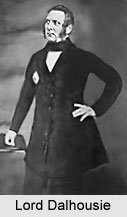
Lord Dalhousie, Viceroy of India
Lord Dalhousie was appointed Governor General of India in 1848. His policy of Annexation was a lethal weapon of conquest that raised the rule of the East India Company to the height of glory. Lord Dalhousie annexed Satara in 1848, Jhansi in 1853 and Nagpur in 1854 on the ground of misgovernment. Dalhousie annexed Oudh in 1851 and Berar was taken over from the Nizam in 1853 as he had delayed his tribute to the paramount power, the British. Dalhousie a fragile man by constitution had an amazing sweep and energy. He laid down the main Railway lines, telegraph network and brought about many far-reaching changes in the administration. He established universities at Kolkata, Chennai and Mumbai.
 Lord Canning, Viceroy of India
Lord Canning was the Governor General of India from 1856 - 1862 and the first Viceroy in India from 1 November 1858. Well-known as a reflective and industrious, person, he tried to suppress the Indians after they were defeated in the Sepoy Mutiny of 1857.
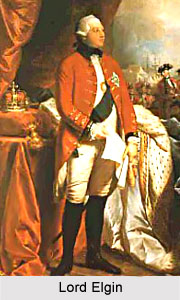
Lord Elgin, Viceroy of India
Lord Elgin (1811-1863) was Governor General and Viceroy of India from 1862 to 1863. Born on 20 July 1811, Lord Elgin was educated at Eton and Christ Church at Oxford. He was a British colonial administrator and diplomat, best known as Governor General of the Province of Canada and Viceroy of India. His second wife was Lady Mary Lambton, daughter of the 1st Earl of Durham.
 Lord Elgin was one of the most trained Viceroys ever appointed by British Government in India. Indian Administration under Lord Elgin furnishes a perfect cross section made in the Government of India. He peculiarly gave Anglo-Indian Administration a new orientation. His decisive action during early days of Mutiny, in placing himself and every soldier at disposal of Canning, had greatly helped India at a very critical moment. Elgin`s career in India was cut short by his sudden death after only twenty months of office. He spent the summer of 1863 at Shimla and died of heart disease at Darmashala. The main event of his time was the Ambala campaign in the Northwest frontier to suppress a tribal insurrection there.
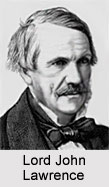
Lord John Lawrence, Viceroy of India
Lord John Lawrence was a British statesman who served as Viceroy of India from 1864 to 1869. He soon became a magistrate and tax collector in Delhi, where he was known for his concern for the plight of the peasantry.
Lord Mayo, Viceroy of India
Lord Mayo (1822-1872) was the Viceroy and Governor General of India from 1869 to 1872. He was born on 21 February 1822, christened Richard Southwell Bourke and graduated from Trinity College, Dublin. He consolidated the frontiers of India and reorganised the country`s finances; he also did much to promote irrigation, railways, forests and other useful public works. While visiting the convict settlement at Port Blair in the Andaman Islands, for the purpose of inspection, he was assassinated by Sher Ali, a Muslim convict.
It was during his administration that the first general census in India was undertaken in 1870. He organized a statistical survey of the country and created the department of agriculture and commerce. While he inherited serious deficits, untrustworthy estimates and incomplete statistics, he left behind, proper estimates and punctual accounts and statistics. To educate the young sons of the Indian princes and chiefs he founded Mayo College at Ajmer.
Lord Lytton, Viceroy of India
Lord Lytton (1876-1947) was Governor of Bengal from 1922 to 1927 and for some time officiating Viceroy of India. Victor Alexander George Robert, Second Earl of Lytton, was born at Shimla, when his father, the first Earl of Lytton, was the Governor General of India. Lord Lytton took charge in 1876. He was appointed the governor of Bengal at a very crucial time when the colonial government was determined to implement the India Act of 1919 and when Indian National Congress was determined to get this unacceptable Act annulled. Throughout this period he faced resistance from the Swaraj Party, which always participated in the elections and got elected with majority seats but consistently refused to form a ministry.
 Lord Lytton is particularly remembered for his unpleasant encounters with Sir Ashutosh Mukhopadhyay, the vice chancellor of University of Calcutta. Lord Lytton tried to interfere in the working of Calcutta University, but Sir Ashutosh maintained his stronghold on Lytton. Lord Lytton`s rule was unpopular.
Though he had excelled as a poet, a novelist and essayist, he was not an able administrator. He brought reforms in trade bringing the policy of free trade. The Criticisms of the British policy led to the passing of the Vernacular press Act in 1878 and Indian Arms Act. In the field of financial reforms he brought reduction of Import duties, financial decentralisation and equality of tax duties.
Lord Ripon, Viceroy of India
Lord Ripon (1880-1884) was sent with the affirmed purpose of introducing a more sympathetic system into the administration of India. He repealed the abhorrent Vernacular Press Act of Lytton. He also introduced a system of local self-government. His one more measure, the Ilbert Bill extending the jurisdiction of Indian magistrates over Europeans involved in Criminal offences made him popular with the Indians.
Lord Dufferin, Viceroy of India
Dufferin (1884-1888) succeeded Ripon in December1884. During his administration Burma ceased to be an independent power. In the case of Burma its northern province, Pegu was already annexed for the same reason. The remaining part was also annexed on January 1, 1886.
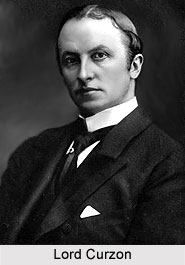
Lord Curzon, Viceroy of India
Lord Curzon (l899-1905) was an imperialist. He carried his measure of the partition of the Bengal through, despite severe opposition of the people of Bengal. This gave rise to a countrywide agitation and brought all the political leaders of all the provinces under the banner of the Indian National Congress.
To Lord Curzon, the then imperialist Governor General, division of Bengal into two regions viz. East and West, meant the balancing of the Hindu West with the Muslim East. He envisaged that these two communities had separate needs and they could thus be considered adequately, when the Eastern Bengal is separated. The scheme of partition was later revoked in 19l2. But it had already hurt the national feelings tremendously and shaken the confidence of the Indian elite in the bona fides of the British professions about the development of self-government by Indians.
Viceroys of India
Viceroys of India played a vital part in influencing the future of India and the Indian people. Several Viceroys have taken the office until Indian independence.