Gods of India - Informative & researched article on Gods of India
 Indianetzone: Largest Free Encyclopedia of India with thousand of articlesIndian Religion


in  
 Art & Culture|Entertainment|Health|Reference|Sports|Society|Travel
Forum  | Free E-magazine  | RSS Feeds  
Indian Religion : Vastu Shastra |Indian Religions |Indian Myths |Indian Mythology |Gods of India |Goddesses Of India |Religious Thinkers of India |Types of Religion in India |History of Indian Religion |Indian Yogis |Ajivikas |Sacred Scriptures in Indian Religion |Tantrism |Shaivism |Indian Communities |Sacred Animals in India |Roman Impact on South Indian Art and Society |Bhattacharyas |Indian Classical Terms
Home > Society > Indian Religion > Gods of India
Gods of India
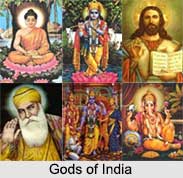
Gods of India form an inseparable part of the life of the people. Indian Gods are considered to be mysterious superhuman beings who are worshipped in this country in various forms.

 Gods of India form a superhuman and mysterious race of mighty humanoid beings that were prayed to by the ancient Aryan and Vedic tribes of the Mid-East from around 3000 BC till modern times. They were recognized mainly in Hinduism. Hinduism is among the oldest and largest surviving religions in the world. The concept of God in India lies in the fact that God resides in the soul of every individual. The soul can not be separated from the divine God, the soul is immortal and so is God. God is the master of all creation and the destruction as well. He is the only one and many as well. God pervades in everything and everywhere, He is the colossal being and stays in the gigantic things as well as in the smallest particle of the world. Hinduism defines God as the being who is visible and at the same time invisible, He has a form and He is formless as well.

Hinduism is the connotation of impersonal origin, and as a Hindu religion is termed as `apauruseya`. The Hindu gods are the eternal deities appearing to be sovereign and different, but in reality are aspects of the same Brahman, the supreme God. Indian Gods are the Hindu deities in a number of incarnations. Hindu religion has several Gods and Goddesses that are worshipped by the inhabitants of India. As per the Hindu belief, the God and Goddesses are living beings of a separate macrocosm. There exists a broader cosmos different from the visible one and the Hindus believe that the Gods are guiding each and every pace of human beings from their own world.

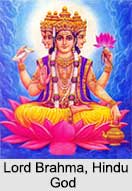
Gods of IndiaLord Brahma<
He is the God of Creation, an important parivara or family deity among the Hindus. He is seen with four heads representing four Vedas, which is also called the four `Yugas`. Seated on a lotus, Lord Brahma`s `vahana` is the swan. It is believed that he was born from the naval of Lord Vishnu at the end of one cycle to start a fresh cycle. Myth has it that Lord Shiva cursed him that he would not be worshipped and it is evident from the fact that there are no temples to worship him.

Lord Vishnu
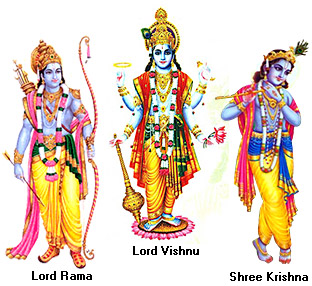
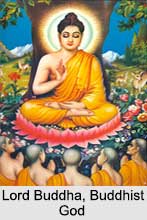
He is the God of maintenance, protection and sustenance among the Gods of India. He was instrumental in introducing the souls into the cycle of life by Brahma sustaining them. His complexion is the color of dark clouds and so is often known as `Nilameghashyamalan`. Being merciful, Vishnu is seen resting on the ocean on his bed of Adisesha (serpent with thousand heads), taking `avatar` for rescuing humans from evils. He has ten avatars or incarnations which are Matsya avatar, Kurma avatar or Turtle, Varaha avatar or Boar, Narashima avatar or Lion, Vamana avatar or the Dwarf incarnation, Parashurama avatar . Lord Vishnu`s seventh incarnation is Lord Rama who is highly worshipped among the Gods of India. The eighth incarnation is Lord Krishna who is an important god in Hindu religion and the next is the Buddha avatar. The Kalki avatar is the final and the tenth incarnation of Vishnu. The last incarnation is still to come with the end of the Kali Yuga or the present age of decline.

Gods of IndiaLord Shiva
Lord Shiva is the God of destruction and is highly revered among the Gods of India. He is greatly worshipped in the form of `linga` or phallus that is built on a pedestal. Enormous energy of the creator is denoted by the `linga` which absorbs the creator Brahma, Vishnu and Gayatri Devi in its heart. All the energies assimilate into Shiva, who is known for His angry image and infinite knowledge always meditating. Destruction and creation all are blended into one power that is called Shiva, whose existence is incomplete without his consort Parvati.

Gods of IndiaLord Ganesha
Lord Ganesha is one of the prime Gods of India who is worshipped at the commencement of any important action or venture, related with business or art. Known as Vigneshwara, he is known to remove all hindrances in the way. He is seen in the form of an elephant head in a human body, with four arms, a huge belly and a snake adorning it. Ganesha`s `vahana` that he rides is a rat which represents subdued vanity, conch- sound that creates Akash. Laddu that he holds is `Sattva`, snakes refer to Shiva and control over passion and the hatchet alluring to the freedom from desires.

Lord Jagannath
This God is the name given to describe a deity form of Krishna. He is considered merciful and the oldest and renowned Jagannath deity at Puri in Orissa. The famous Rath Yatra or car festival is organized every year to mark Krishna`s home coming in Mathura. This acquires a huge dimension in Orissa where the wooden cart is pulled by thousands of pilgrims.

Lord Hanuman
He is also known as Anjaneya and is among the most important Gods and Goddesses in the Indian epic Ramayana. He assisted Rama in recovering Sita from the captivity of Ravana and was blessed with enormous energy and power by the Gods. Lots of myths are associated with him and he is highly worshipped in temples all over assuming the status of a deity among the other Gods of India.
Lord Indra
Another most important God of India is Indra who is known as the king of the Gods and the ruler of the heavens. He is a great warrior and he is also regarded as the God of rain and thunder. Numerous stories are also associated with him, which also tells how he lost the heavens to the Demons. He is bedecked with conch, hook, rainbow, noose and Vajra.

Apart from various Gods, the people of India also worship a large number of Goddesses. The Goddesses are worshipped in almost all places in India. They are prayed in various forms in the country. Some of the major Goddesses of India includes Goddess Parvati, Goddess Kali, Goddess Durga, etc.

Goddess Parvati
Goddess Parvati is the most widely worshipped Goddess in India who is the manifestation of Shakti and is the Female Creative Energy of the Universe. Shakti is also related to Prakriti, the `material-nature` of Ishwara, which unites with Brahma, to give birth to everything around. Shiva, the Purusha or Male Productive Principle of the Universe, is believed to be in conjunction with the Prakriti, expressed in Parvati, which sustains the flow of life. Shiva is thus, the synthesis of the opposite principles of life, which portrays the totality of existence- the Creator and Destroyer; ascetic and erotic; spiritual and material.

Gods of IndiaGoddess Durga
She is one of the shades of Parvati, and an expression of Shakti or Prakriti. Goddess Durga Universe`s Kind Mother and she is also Destroyer of Evil. This Goddess holds the Trishul, sometimes the sword, in her different images. One of the hands of this Goddess is displayed in Varadaa-Mudra or in a stance of giving boon to her true devotees. In the state of West Bengal, she is projected as an idol with ten arms. Each of the arms is carrying the weapons and articles, furnished to her by the other gods, for squelching the demon, Mahishasura.

Gods of IndiaGoddess Saraswati
Goddess Saraswati is the conferrer of wisdom and knowledge. The stringed musical instrument, called Veena, and the book, which she holds in her hands, attests her as the celestial Mistress of all kinds of learning, be it the creative arts (music) and scientific research, talent and skills. This Goddess is greatly revered by the people of India and is regarded as the Vedas` Mother. Goddess Saraswati is the consort of Brahma and this identification gives colour to her image with greater meaning. She is the home of the creative intelligence of Brahma and is also famous as Vak Devi or the great Goddess of speech.

Lord Agni
In India several natural objects are also worshipped and some of the natural objects are considered as the forms of Indian Gods and Goddesses. Lord Agni or Fire-god is a Hindu and Vedic Deva. This God is beneficent as well as destructive. Lord Agni the acceptor of sacrifice and the messenger of Gods. So all tributes made to him is distributed among other gods and goddesses. He enjoys immortality and perennial youth since fire is used everyday. Agni or fire is fundamental to existence, being a constituent of the Panchamahabhutas or Five Great elements namely, earth or Prithvi, Agni or Tejas i.e., fire, Jala (water) or Ap and Sky or Akasha.

Lord of Wind
Pavan or Vayu, the god of wind or air, in Hinduism is mainly a deity which is worshipped. Similar to Agni, the God forms a part of the five tatvas or elements which are known as the Panchamahabhutas. In Sanskrit language, the word Vayu is related to the Latin word `Vita`, which means life. Indeed, Vayu is Prana or vital life-force. Prana mobilizes the senses or Indriyas. Prana is manifestation of Brahma in union with Prakriti, is the generator of thoughts and other psychological activities. Breath is Gross Prana and Vital force is Subtle Prana. Vayu or Pavan-Deva is hence the God of life, depicted as the `Mukhya-Vayu` (the chief Vayu) or `Mukhya Prana` (the chief of Life).

Gods of IndiaLord Varuna
Furthermore, the people of India also worship the god of water and ocean called Lord Varuna. He is the source of water, which sustains life, the water in the rivers, sea and oceans, and even the rains that fall, and at times causes floods. Lord Varuna rides on Makara, his mount, or a type of holy sea-creature. The ancient scriptures, however deliver a different data. In Vedic religion, Varuna is considered as the god of the rain, sky, and of the ocean. He is also the creator of Law and of the underworld. His residence is the celestial sea, Rasa. Rig Veda picturises him as the most prominent demon or Asura, interested in social and ethics matters. It also celebrates him as the chief of the Gods. Varuna was the head of the Adityas or the solar deities. The Atharva Veda highlights Varuna as the strict maintainer of morality. He is omniscient, catching liars in his snares. The stars are his thousand-eyed spies, keeping vigilance on every action of men. It is much later, that Varuna obtained his present status as the God of water.

Lord Kartikeya
The origin of Lord Kartikeya, the symbol of masculine might, has link with the desperation of Gods for the birth of the much-awaited son of Shiva, who could obliterate the ghastly demon, Taraka. Unfortunately, Shiva at that time was keen on asceticism. Parvati, his consort, was pleaded by the distressed gods, reeling under Taraka`s assault. Parvati managed to procure the divine essence of Shiva in a seed, and handed it over to the gods. So fiery was this seed, that it burnt the fire-deity Agni, singed the wind-god Vayu, boiled the river-goddess Ganges and set alight the forest of reeds. After the conflagration got extinguished, the six forest nymphs known as Kritikas discovered a six-headed child under the embers within a lotus. They took care of the child and named him Kartikeya. On the sixth day of his life, the child let out a roaring war-cry, picked up his lance, attacked and killed Taraka. He turned out to be the invincible commander of the gods and earned them countless victories and a peacock is his mount. In North India this God is regarded as a bachelor and in South India Lord Kartikeya is having two consorts. The first one is Devasena, daughter of Indra, who enthusiastically eulogized him for his outstanding bravery.

Thus, the Gods of India from the ancient period form an integral part of the religious life of the Hindus. Apart from these well-known Gods and Goddesses, the people of India worship a large number of deities, the list of which goes on and on with the religious beliefs of the people of this country.

(Last Updated on : 10/04/2013)
Recently Updated Articles in Indian Religion
Lord Subrahmanya
Lord Subrahmanya Swamy is considered to be the universal lord who blesses human beings and helps them get rid of their sins.
Folk Gods of Kumaon
Folk gods of Kumaon have a rich history and they provide expression to the famous and popular ideas of the people.
Seven Sisters
Seven Sisters are the most famous among Dravidian deities in Southern India. The seven sisters also have a younger brother Potu Eazu.
Savitr
Savitr is a solar deity and off-spring of Vedic deity Aditi. Savitr has been mentioned in eleven hymns of Rig Veda.
Kanaka Durgamma
Kanaka Durgamma is the form of Goddess Shakti who is responsible for the entire welfare of the village.
E-mail this Article | Post a Comment
Forum
Forum on Indian Religion
Free E-magazine
Subscribe to Free E-Magazine on Society
 
 
Gods of India - Informative & researched article on Gods of India
Sitemap
Contact Us   |   RSS Feeds
Copyright © 2008 Jupiter Infomedia Ltd. All rights reserved including the right to reproduce the contents in whole or in part in any form or medium without the express written permission of
Jupiter Infomedia Ltd.