Introduction
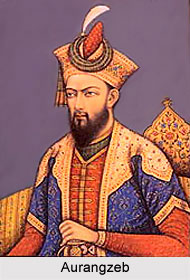 Shah Jahan and among the last Mughal Emperors to rule over India. He was born in 1618 at Dohad near Ujjain. Aurangzeb was a hardworking and thorough man who had proved himself as an able administrator in the years that he spent in the Deccan as well as other regions of the Empire. He learnt all the tactics of diplomacy due to his expertise as a skilled soldier and general and his accession to the throne was through a fierce battle with his own brothers, the contestants in the battle for authority. Under him the Mughal Dynasty reached its greatest height. He assumed the title of Alamgir (Conqueror of the World), Badshaah (emperor), and Ghazi (Holy Warrior) to propound the essence of the roles he would play. His experience as the governor of Gujarat, Multan and Sind helped him to strengthen his much coveted position. Being a deeply religious-minded man, he lived a most disciplined life. His food and dress were very simple and he never drank alcohol. He conducted his life strictly along Islamic laws.
Administration of Aurangzeb
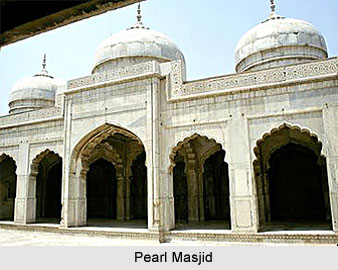
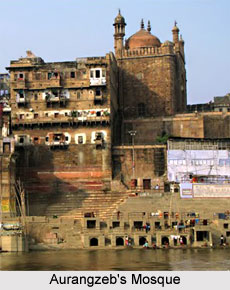
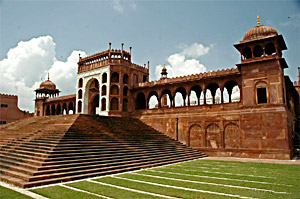
As a Mughal Emperor, Aurangzeb ruled over the largest area in India compared to the other monarchs. He proved himself as a capable ruler and ruled with an iron fist and keen intellect. Since his youth, Aurangzeb was deeply devoted to Islam and a staunch Sunni Muslim. It was in keeping with this that he lived a life of great piety even in the court and tried to rule the country as much as was possible along Islamic injunctions. Aurangzeb felt that he had become superior not only to administer the empire in a better way but also to protect and strengthen Islam particularly its Sunni faith. Aurangzeb believed that all Mughal rulers who ruled prior to him committed one blunder- they did not try to establish the supremacy of Islam in India. He therefore tried to reverse this trend during his reign because he believed that it was the foremost duty of a Muslim king. This duty of Aurangzeb limited his vision, narrowed his concept of kingship and made him intolerant towards the majority of his subjects. He introduced a number of reforms which would ensure a genuine Muslim rule in his dominion. He appointed censors of public morals in all important cities to enforce Islamic law, and he tried to put down such practices as drinking, gambling, and prostitution. Cultivation of Narcotics was banned throughout the Empire and even he banned Sati. He denounced all illegal exactions and did away with all those taxes which were not authorised by Muslim law. Even though these steps actually proved quite effective and popular with the people, he later went on to become increasingly Puritanistic. This included banning music at the court which led to a number of state musicians losing their jobs, festivities on the Emperor`s birthday and giving of gifts to the emperor were banned etc. His religious intolerance was reflected in a number of ways. He stopped celebrating the Hindu festivals like Holi, Diwali etc. at the court. He also framed certain laws to be observed by the Muslims as their religious duty. That is why even liberal Shias and Sufis were punished during the reign of Aurangzeb. Aurangzeb became quite intolerant towards the Hindus and ordered the provincial governors to demolish the schools and temples of the Hindus. In April 1679 A.D., Jizya was imposed on the Hindus. Pilgrimage tax on the Hindus was also revived and while the Muslim traders remained free from tax the Hindus were asked to pay a per cent of the value of their commodities as tax.In his administration, he was particularly attentive to matters concerning the maintenance of the imperial mosques. He built the beautiful Moti Masjid in the Red Fort, which is a jewel in white marble, and the magnificent Badshahi Mosque in Lahore, with its imposing domes towering over the red sandstone walls.
Military Campaigns of Aurangzeb
As a statesman his achievements have been quite immense. For one, the strong kingdoms of Bijapur and Golconda were captured in less than a year. It is a tribute to Aurangzeb`s control over the affairs of the empire that no major upheaval occurred in the north during his prolonged absence in the Deccan, but there are clear indications of many minor disturbances and a general slackening of administration.
Revolts during the Reign of Aurangzeb
The first organised revolt of the Hindus against the policy of religious persecution of Aurangzeb was that of the Jat. The Jats under their leader Gokul revolted against the tyranny in 1669 A.D. In 1670 A.D., the temple of Keshav Rai was destroyed on the orders of Aurangzeb. It further inflamed the Hindus but they were however defeated in the battle of Tilpat. The Jats were punished severely but they remained undaunted. In 1686 A.D., they again raised the standard of revolt under their leader Raja Ram and gave serious trouble to the Mughals. This revolt of the Jats continued till the death of Aurangzeb and ultimately, the Jats succeeded in establishing their independent kingdom with its capital in Bharatpur. The revolt of the Satnamis was also an important occurrence during the reign of Aurangzeb. They fought bravely but were ultimately defeated by the forces of Aurangzeb. The Sikhs under the leadership of Guru Gobind Singh revolted against Aurangzeb. Though they did not succeed much against the mighty power of the emperor, but it made the Sikhs a powerful fighting community in Punjab because of which they played an important part in the future politics of Punjab. The Rajputs fought against Aurangzeb both on political and religious grounds. Aurangzeb doubted the loyalty of the Rajputs and desired to finish their independent existence and annex their states to the empire.
Combat with the Marathas
Aurangzeb`s aggressive Deccan Strategy was a blunder. His resolution was to subjugate the Shiah states of Bijapur and Golconda. The people of Bijapur gave the Mughals a tough situation with the support of the Marathas and the Sultan of Golconda. The rise of Shivaji disrupted the dreams of Aurangzeb. Mughal Governor, Shaista Khan could do no harm to the Marathas. But the Mughals under Jai Singh devastated Shivaji. However in 1665, Shivaji was forced to sign a peace treaty. All his lifetime he thwarted Mughal programmes of mashing Maratha influence. He died in 1680, asking his son Shambhuji to continue the war. Shambhuji gave shelter to Aurangzeb`s rebellious son, Prince Akbar. This act bothered Aurangzeb who came down to the Deccan in 1682, to deal with the situation. After repeated efforts, on 22nd September, 1682 he confiscated the land of the Bijapuris. Golconda too was besieged in 1687. But the Marathas ignited a national resistance against the Mughals by 1691.Their resurgence continued beyond 1700. Aurangzeb was a well-read man and had command over the Persian, Turki and Hindi language. He even wrote beautiful Persian poem. A selection of his letters (Ruq`at-i-Alamgiri) is a testimony of simple and elegant prose composed by the Emperor. He understood music well but he gave up this amusement in accordance with Islamic injunctions. However, his religious fanaticism did no allow the arts to flourish in his courts, as he disbanded the musicians, abolished the office of the poet-laureate, discontinued the work of the court chronicler, and offered little encouragement to painters. In the cultural field, the chief contribution of Aurangzeb was the spread of Islamic learning and general diffusion of education. The Islamic academic curriculum, known as Dars-i-Nizamiya, was begun in his reign.
Aurangzeb resided in the Deccan till the last days of his life. Gradually with time, he could witness the errors he had committee in administration.. His long-term warfare had turned the royal treasury bankrupt. He wrote to his son Azam, while brooding over his shortcomings. He died in 1707. When he died, Aurangzeb left an empire faced with a number of menacing problems. The failure of his son`s successor led to the collapse of the empire in the mid-eighteenth century.
Achievements of Aurangzeb
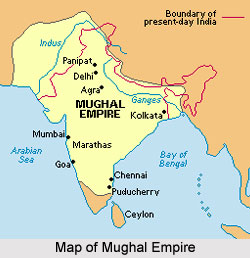
 Achievements of Aurangzeb are quite impressive and have proved to have had far-reaching repercussions. Since the beginning of his reign right up till his death he was engaged in almost constant warfare in order to try and increase the bounds of the Mughal Empire. He had managed to build up a huge army and started a program of military expansion along all the boundaries of his empire. In keeping with this policy of expansion, he pushed north-west into Punjab and what is now Afghanistan and in the south towards Bijapur and Golconda.
Conquests of Aurangzeb in the East
The earliest conquests of Aurangzeb were in the eastern parts of the empire. During the time when Aurangzeb was still fighting with his brothers, the Ghinud rulers of Cooch Behar and Assam had taken advantage of the troubled conditions and invaded certain imperial dominions. In 1660, on Aurangzeb`s orders, Mir Jumla marched to Dhaka and occupied Cooch Behar within a matter of weeks. They then left for Assam and on March 17, 1662 the Ahom kingdom was annexed and the Raja was forced to sign a humiliating treaty. The Mughals got an immense tribute and also conquered some forts and towns near the frontier of Bengal. Another major addition to the kingdom that came during this time was the Chittagong, which was a stronghold of the Arakan pirates who were making the area unsafe. Chittagong was later renamed as Islamabad and proved to be a valuable addition to the kingdom.
The conquest of the region known as East Pakistan too was an achievement particularly of Aurangzeb`s reign. The area that lies east of the Brahmaputra River had remained isolated from the rest of the subcontinent for a long time mainly due to its geographical situation, climate, terrain, and the ethnic origin of the population. The isolation of this region was broken during the reign of Aurangzeb and they became a part of the main population now.
Conquests of Aurangzeb in the Northwest
 As soon as the eastern region was dealt with, trouble started in the northwest frontier regions of the empire. Bhaku, a Yusafzai leader, rebelled in 1667. This rebellion was quelled and for some time the area was quiet till trouble broke out again in 1672. A number of combined groups of tribes revolted against the authorities. Though the governor of Kabul tried to take on the rebels he was defeated and Aurangzeb himself intervened in the situation. He directed the operations in the troubled area for a year and finally with the use of force and diplomacy was able to restore peace in the area. Despite all this trouble, Aurangzeb`s reign saw a transformation of the Mughal-Afghan relations and order was established along the frontier regions.
Aurangzeb and the Sikhs
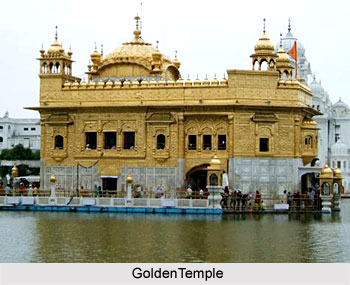
Aurangzeb faced a number of problems from the Sikhs. In fact it was this community which ultimately played a pivotal role in weakening the empire. Aurangzeb dealt with them in a harsh and ruthless manner. Initially, the relationship between the Sikhs and the Mughals had been quite friendly. When the religion of Sikhism had been established by Guru Nanak, it was see as part of a general religious movement to bring Hinduism and Islam closer together. In fact the Emperor Akbar had also visited the third Sikh Guru and made presented him with the land on which the Golden Temple is now built. However, they gradually arose conflicts between the Sikhs and the Mughal authorities. Trouble started during Jahangir`s reign and the Sikhs started organising themselves into an army from that point onwards and conflicts with the Mughal Government continued. The ninth Guru, Guru Tegh Bahadur, became extremely authoritative and even started gathering tributes from the local population. He was defeated by the Imperial forces and taken to Delhi where he was put to death by Aurangzeb. The Hindu Rajas of the Punjab Hills were suffering due to the increased military strength of the Sikhs and at last they approached Aurangzeb for help. Aurangzeb sent forces to assist them and defeated the Guru in his stronghold at Anandpur.
Aurangzeb and the Marathas
Aurangzeb faced the biggest trouble from the Marathas and there ensued a long and bitter struggle between the Mughals and the Marathas. The Marathas were helped greatly in their uprising by the fact that in the Deccan the Muslim conquest was not as extensive as in the north. Moreover, the Hindus here also held a number of high posts in the administrative machinery of the region. Since Maratha statesmen and warriors controlled various departments of the Muslim states of Ahmadnagar, Golconda, and Bijapur, the conflicts of the Mughals with these states provided them with an opportunity to advance their sectional interests. Shivaji was among the most successful of the Maratha leaders who revolted against the Mughals. Aurangzeb had sent a series of Mughal generals to get Shivaji, such as Shayista Khan, Dilir Khan and Mirza Raja Jai Singh as well as his own son, Prince Muazzam. Many confrontations ensued and Shivaji always managed to come out successful. However, it was the cruelty of his son Shambhuji and his atrocities against the Muslims of Burhanpur which forced the Mughal ruler to take some concrete steps against him. Aurangzeb reached Aurangabad in the Deccan in the third week of March, 1682, and the last twenty-five years of his life were to be spent in that part of the subcontinent. Bijapur and Golconda which often gave shelter to the Maratha raiders were finally annexed in 1686 and 1687, and Shambhuji was captured and executed in early 1689. The Mughals achieved many successes against the Marathas, but these proved temporary. After Aurangzeb`s death, the Marathas became a major factor in the downfall of the Mughal Empire.
Thus the achievements of Aurangzeb have been quite a few and rather remarkable. His constant policy of expansion, even though it cost him many lives and an enormous amount of from the treasury, led to a widening of the boundaries of the Mughal Empire and the quelling of long drawn out issues of contention.
Revolt of Jats During Aurangzeb
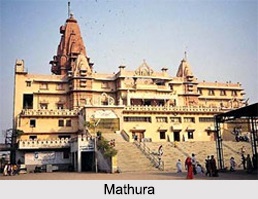
Revolts of the Jats during the reign of Mughal Emperor Aurangzeb took place under the leadership of Gokul in 1669 A.D. The Jats organised the first revolt of the Hindus against the policy of religious persecution of Aurangzeb. The local Muslim officer at Mathura, Abdul Nabi destroyed the temples of the Hindus and disrespected their women. In the year 1661 A.D., Abdul Nabi destroyed a Hindu temple and raised a mosque on its ruins.
The Jat under their leader Gokul revolted against the oppression in 1669 A.D. killed Abdul Nabi and looted the tehsil of Sadabai. In 1670 A.D., the temple of Keshav Rai was destroyed by the orders of Aurangzeb. It further inflamed the Hindus and Gokul could collect twenty thousand followers and he defeated a few small Muslim forces which were sent against him. He was, however, defeated and killed at the battle of Tilpat. The Jats were punished severely. But, the Jats remained undaunted. In the year 1686 A.D., they again raised the standard of revolt under their leader Raja Ram gave serious trouble to the Mughals for many years, defeated a few Mughal officers and attacked even Agra. Raja Ram was, however, defeated and killed in 1688 A.D. But then Churaman, the nephew of Raja Ram led the Jats.
This revolt of the Jats continued till the death of Aurangzeb and, ultimately, the Jats succeeded in establishing their independent kingdom with its capital in Bharatpur.
Imperial Treasury of Aurangzeb
 Imperial treasury of Aurangzeb was a most impressive collection of wealth and a display of immense grandeur. An account of the immense wealth of the Mughals has been available from the accounts of the French jeweller and traveller Tavernier. He was one of the few foreigners to be granted the singular honour of viewing part of the treasure of the Mughals and he left a detailed description of the display. On 2 November 1661, Aqil Reza opened the doors of the vault to the merchant, and a most ceremonious presentation followed. Four eunuchs laid out two large wooden trays lacquered with gold leaf and covered with little carpets especially made for this purpose, one of red and the other of green embroidered velvet, in front of three scribes who counted and recorded in turn. Tavernier`s experienced eye enumerated thousands of gems, which could have paid a king`s ransom many times over.
Pearls in the Imperial Treasury of Aurangzeb
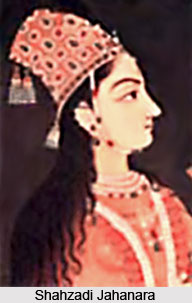
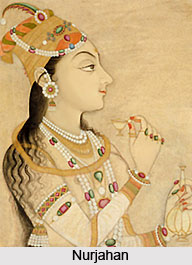
Amongst the breathtaking, glittering array was an enormous pearl which Shahzadi Jahanara Begum Sahib had given her father during one of his weighing-ins. There was another huge round pearl that shone like a mirror, which Shah Abbas II had given to Aurangzeb. It was comparable in purity and size to another pearl that Aurangzeb had bought for its beauty, which he often wore around his neck, alternating it with his famous topaz. There was a frame of pearls that hung around the portrait of Aurangzeb`s grandfather Jahangir, and even the cord from which it hung was made of these jewels. In the picture, he wore on his turban a brooch of pearls held by another pearl of 47 ratis. Jahangir is known to have been very fond of pearls and He himself had gifted his most faithful servants a lot of these jewels. It seems that Shah Jahan inherited the preference for the fruit of the oyster. He had a band of 130 pearls wrapped around Jahanara`s arm to celebrate her recovery in 1644. Aurangzeb was also presented with a fantastic necklace of 280 pearls by Mir Jumla`s son Muhammad Amin Khan. However, probably the most beautiful pearl of the Mughals was the one with a yellowish shine embedded in the head of the peacock of the famous Peacock Throne.
Emeralds in the Imperial Treasury of Aurangzeb
In the Treasury there were several prominent emeralds. One was an exceptionally large stone of 217 carats from Columbia. On one side it was engraved with flowers and foliage, on the other was a verse from The Holy Quran. There was a more modest emerald, of 78 carats and on one surface were inscribed the words, `He who possesses this talisman enjoys God`s protection.` It was believed that all sorts of human faults, fears and desires could be addressed by these amulets, such as fear of blindness, invisible enemies, and requited love, since green is the colour of Venus. However, since green was also the favourite colour of the Holy Prophet Muhammad of Islam, emeralds were much sought after for their mysterious powers by the Mughal court. The purest of these was Akbar`s emerald, a stone of 426 Ratis, and Jahangir had two famous emeralds gifted to him, one by Abdul Khan and the other by the Raja of Burma, and, of course, there was the large prominent emerald of the Peacock Throne.
Diamonds in the Imperial Treasury of Aurangzeb
Engraving is much more difficult on diamonds than on emeralds, but sometimes royalty would have their names engraved on special diamonds to show their ownership. One 88 carat diamond, bearing the name of Shah Jahan, son of Jahangir, was suspended by a golden cord in front of the Peacock Throne. It was taken away by Nadir Shah and subsequently engraved with the name of his Persian successor. Mir Jumla offered his best diamonds to the Emperor Shah Jahan in order to gain favour at court. The largest diamond he possessed was said to be the size of an egg and was a rose-cut. It had been excavated from the famous Kolour mine near Golconda, which Tavernier claims was worked by 600,000 labourers. A miniature depicts this fabulous jewel surrounded by jagged blue rocks guarded by serpents, eagles fly above holding pieces of diamond-studded meat in their talons.
 Among the treasure there were also `red diamonds`. They too were shown to the French jeweller, glittering translucent pebbles looking like blobs of coagulated blood. The name belies their worth. They are not diamonds, they are a type of ruby, in fact of poorer quality since they are actually a variety of spinel. Red diamonds are said to have a blood-red colour and are also known as Oriental Corundum. They are usually found in the mines of Badakhshan, a province of Afghanistan. One such jewel of better quality and size was used to adorn the Peacock Throne and was later set in the Persian tiara. Another huge spinel is known as the `Taimur Ruby` and is now in the British crown jewels. It was said to have been looted by Tamerlane when he sacked Delhi in 1398. He took it away hidden in his furs. It has part of the Mughal genealogy engraved on it, starting from the Emperor Jahangir. There are a total of six names, the last being Ahmed Shah Durrani, who was not a Mughal. After Timur, it fell into the hands of Shah Abbas I of Persia, who in 1610 presented it to Jahangir as a `world tribute`, and thus the jewel returned to the dynasty. The emperor immediately had his own name engraved on it along with the Hijri date of 1021, and Akbar`s name. Subsequently Shah Jahan and Aurangzeb did likewise.
Proper and more precious corundums were among the collection as well. Akbar owned one weighing 284 ratis, his son Danyal gave him a second one weighing 104 ratis, and a third was presented by a Raja.
Rubies in the Imperial Treasury of Aurangzeb
Jahangir owned two rubies, respectively weighing 300 and 168 ratis, gifted by Asaf Jah, Nur Jahan`s elder brother and father of Mumtaz Mahal. In return, the emperor gave his brother-in-law a sword called `the rower of heads`. Zamana Beg known as Mahabat Khan, famous for having killed a Rajput Raja on Jahangir`s orders, offered the emperor a ruby of 300 ratis, and Prince Khurram gave his father one weighing 192 ratis which he had received as a gift from Raja Man Singh of Udaipur. In return, Jahangir gave the prince two rubies from the rich Mogok mines in Burma. One weighed 312 ratis and was engraved. It is believed that it must have been imperfect and engraved to cover the defect.
Jahangir was so fond of rubies that he wore five of them on his turban, the largest was 288 ratis. Aurangzeb did not care as much for them, though he is known to have accepted one weighing 125 ratis with pleasure.
Sapphires in the Imperial Treasury of Aurangzeb
If the emperor had any preference among jewels, it was for sapphires. Among the few purchases he made was a rare yellow sapphire bought in Goa. It weighed more than 112 ratis and must have come from the mines of Ratnapura in Ceylon. In the traditional lore of the empirical properties of jewels, the sapphire was considered `the gemstone of kings par Excellence, gave good counsel to the wearer, always on condition of clarity, purity, and without any stain`. In the collection that Tavernier saw, there were comparatively very few sapphires. One that must have caught his jeweller`s eye was a beautiful one with purplish-blue reflections weighing 40 ratis. This jewel is depicted in a miniature of the Emperor dated 1670. It hangs on his chest on a plain strand of pearls, half hidden by his hand, which is holding a violet iris matching his floral brocade Jama. The red and blue brocade turban is entwined with mauve gauze, its folds clasped by a brooch with a purple ruby flanked by two pearls. Bluish feathers rise from the Sarpeh. The emperor wears a sumptuous cloak of old-gold brocade, embroidered with little red and yellow flowers and lined with sable. The whole painting is a deliberate harmony in pale purple, suggesting the royal pride of the imperious figure in kingly dress transposed into melancholic patience. Violet hues are also symbolic of the amethyst, which represents religious zeal and philosophy, preserving the soul from drunkenness and passions. Even the choice of the sapphire and iris are suggestive in this regard.
Thus described above was the imperial treasury during the time of Aurangzeb- resplendent in the transparent fire of diamonds, the orange and blue flames of sapphires, the burning glow of yellow topazes, the radiance of rubies, and the flash of star sapphires.
Conquest of Golconda by Aurangzeb
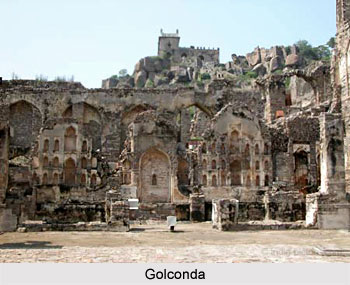
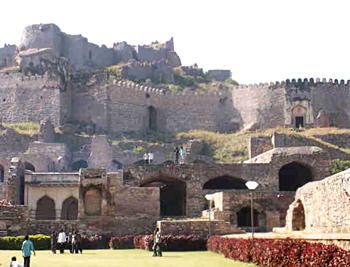 Conquest of Golconda by Aurangzeb was one of the greatest achievements of the Emperor. This rich kingdom, which controlled the famous diamond mines of the Carnatic, had long been coveted by the Mughals. Shah Jahan had invaded it in 1635. He adopted a religious pretext to justify his action. He posed as the `Champion of the True Faith` and warned Qutb Malik, the Sultan of Golconda, that he was ordained by God, not just as the leader of the Sunnis, but to be the destroyer of those who did not conform to His idea of Islam. Shah Jahan then ordered him to establish Sunni practices in his kingdom if he wanted to protect himself from being invaded. The ensuing negotiations led to a compromise- the Sultan would pay tribute to the Emperor and the Emperor would withdraw his troops. In fact, the Mughal army was under pressure to forego its intention of conquest, being harrassed by the Maratha tribes.
In 1655, Mir Jumla, an ambitious Persian from Ardistan, who had visited Aurangzeb`s court a few times, became the means by which to capture Golconda. He had come to India in the retinue of a horse trader, and went on to become a prosperous merchant, made a lot of money, and owned several armed ships. His magnificent style of living and sharpness brought him several contacts at the court of Golconda. He started passing himself off as a Sayyed a descendant of the Prophet Muhammad, and slowly sought to gain the favour of the Sultan, Abdullah Shah Qutb, on whom he lavished presents of beautiful elephants, textiles from China and Europe, etc. The Sultan was impressed by his wealth, and courtiers spoke highly of him, so he condescended to accept the presents, and thus the Persian slipper-merchant established himself at court. He attended promptly to any task the Sultan gave him, and won his favour so that finally the Sultan made him Governor of Karnatic.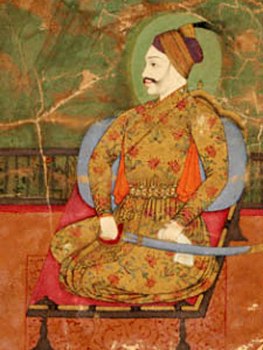 In this position he built up a fabulous fortune by collecting diamonds from the mines and pillaging gems from the idols in Hindu temples. He built up his own personal army with artillery, and hired elite European cannoneers. Even the Sultan began to feel envious and suspicious of his powerful Governor. A situation of conflict and tension arose between the Sultan and Mir Jumla and Muhammed Amin, his son, was arrested.
In his attempt to free him Mir Jumla sought allies against the Sultan. Aurangzeb`s capital was only a fifteen-day journey away, so he went to him. Aurangzeb welcomed Mir Jumla and the two men became personal friends. The prince gave him forty thousand cavalry and led the attack himself. When the troops advanced, the frightened Sultan fled, abandoning his palace and treasure, part of which was buried in the tombs of his ancestors, but Aurangzeb was not able to appropriate his because of subsequent developments.
Aurangzeb behaved considerately towards the women of the harem, freeing them and allowing them to rejoin their husband if they so wished. Mir Jumla retrieved his son, and then the three of them began the pursuit of Abdullah Shah Qutb. However, Shah Jahan intervened in Shah Qutb`s favour and ordered Aurangzeb to return to Aurangabad. The only condition imposed on the Sultan was that he should pay for the cost of the expedition. Aurangzeb recognized that Dara Shikoh, his younger brother, was the mind behind this move of the Emperor that foiled his victory before it was complete. To offset the damage, he sent a marriage proposal for the daughter of the Sultan to be wed to his son Muazzam, which the now yielding Sultan readily accepted. By this move, Aurangzeb hoped that by this match his son would succeed to the kingdom of Golconda, thus his heir would inherit this rich stronghold in the Deccan, not be subject to Shah Jahan`s whims, and be independent when Dara Shikoh eventually became the emperor, as seemed most likely.
Later, Shah Qutb died without a male issue and the nobles put up a scion of the noble family, Abul Hasan, to the throne. He however was an incompetent ruler not too interested in the matters of administration. At this point in time Aurangzeb ordered his son Muazzam to invade Golconda with a view to annexing it to the Mughal Empire. There was no scope for compromise anymore especially as Golconda was a Shia ruling state. When the battle broke out, the Sultan`s arny was defeated as not only was it small in size but Aurangzeb had bribed the commander of the army to join the Mughal Army at Hyderabad. The Sultan fled the fort of Hyderabad without fight and fled to Golconda. The Mughal Army captured Hyderabad and swiftly moved to Golconda. The Sultan made a last bid to make peace with the Mughals and a temporary settlement was made by Prince Muazzam. However, when Aurangzeb returned he attacked the fort of Golconda against the terms of the treaty and after almost eight months it fell to the Mughals in 1687 AD. Sultan Abul Hasan was imprisoned in the Daulatabad Fort and was given a pension for his life. Golconda was annexed to the Mughal Empire. All the wealth of the Golconda dynasty including seven crores of rupees in cash, heaps of jewellery and gold and silver ornaments and other extremely valuable items were seized and acquired by Aurangzeb.