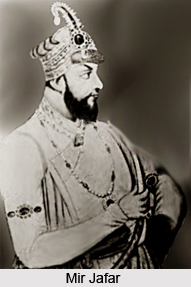
 Mir Jafar or Sayyid Mir Muhammed Jafar Ali Khan bears the formal title of Shuja ul-Mulk, Hashim ud-Daula, Nawab Jaafar Ali Khan Bahadur, Mahabat Jang. He was the first Nawab of Bengal, Bihar and Odisha under the British rule in India. He was the second son of Sayyid Ahmad Najafi. He is remembered in India by the name of Gaddar-e-Hind. He took over the reign as the eighth Nawab of Bengal and also counted as the first of Najafi dynasty.
Military Career of Mir Jafar
Mir Jafar got a job in the army of the Nawab and gradually promoted himself. Nawab Alivardi Khan afterwards married off his half-sister Shah Khanam and provided 7000 horses to command. His early military career was glorious. Mir Jafar rescued the nephew of Alivardi Khan, the hapless Sauqat Jung, from the hold of Mirza Baqir at Katak. He also played a vital role in various military campaigns of Alivardi Khan, against the Marathas and against the earlier Nawab Murshid Quli Khan`s grandson.
Betrayal of Mir Jafar
Mir Jafar was an ambitions man. He had conspired along with Ataullah (the faujdar of Rajmahal) of murdering Alivardi Khan. However the conspiracy was disclosed and he was deprived of most of his powers. Thereafter he returned to Murshidabad and was successful to win the trust of Siraj-Ud-Daulah, the grandson of the Nawab. There he conspired with Shawkat Jang to invade Bengal, which was again disclosed resulting in his replacement. Then, there was a pact between the British and Mir Jafar to overthrow Siraj in order to make him the Nawab of Bengal.
The British soldiers under the command of Robert Clive advanced to Murshidabad and confronted Siraj in the Battle of Plassey in the year 1757. Mir Jafar`s army betrayed Siraj-Ud-Daulah by denying fighting for him and in the end Siraj was defeated and killed. Mir was made the new Nawab. However he realized that the British had high expectations and he attempted to set free from them with the help of the Dutch. In 1758, Robert Clive discovered through his agent Khoja Wajid that Jafar had made an agreement with the Dutch at Chinsurah; these circumstances later led to the "Battle of Chinsurah". The Dutch were defeated by the British and British retaliated by compelling Mir to renounce the throne in favour of Mir Qasim, his son-in-law. Mir Qasim was made the ruler but he did not bow to the British. The Company fought with him and he was overthrown. Mir Jafar however was able to gain the confidence of the British and he was again made the Nawab of Bengal in the year 1763. He was the Nawab till he died in the year 1765. Mir Jafar"s rule is regarded as the initiation of the British rule in India. It was a key stem in the complete domination of British in India.