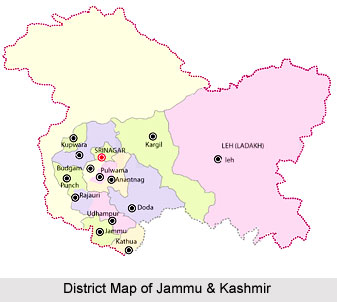
The Northwestern Thorn scrub forests in India form an ecoregion that represents a large expanse of degraded dry forest surrounding the Thar Desert. Though, they are neither exceptionally species-rich nor high in endemism, the forests harbours viable populations of some important species like Chinkara, Chousingha, and Blackbuck. The ecoregion is located in the northwestern part of the Indian subcontinent and according to many ecologists; this thorn scrub represents a degraded state of tropical dry forests. The ecoregion encircles the Thar Desert and Indus Valley Desert ecoregions and includes the western half of Gujarat (excluding the mountain of Girnar). Extending through the state of Rajasthan, where it is bounded on the southeast by the Aravalli Range, the ecoregion also encompasses most of Haryana and Punjab states of India as well as the Jammu region of Jammu and Kashmir, extending to the foothills of the Himalayas. More than 60 protected areas exist here; however, they are small and amount to only slightly more than two percent of the ecoregion.
The Northwestern Thorn scrub forests in India receive an average annual rainfall of less than 750 mm and the temperature can exceed 45ºC during the hottest months. The temperature can also drop below freezing during the winters. These flat alluvial lowlands extend into the low hills and local variations in soil salinity affect the distribution of vegetation in these forests. The patches of highly saline soil usually are bare of vegetation. The vegetation in these forests is stunted and open and mainly dominated by the Acacia species like A. senegal and A. leucophloea, etc. These species rarely exceed the height of 6 m and some of the other characteristic species found in these forests include Prosopis spicigera, Capparis zeylanica, Salvadora spp., Carissa spp., Gymnosporia spp., Grewia spp., and Gardenia spp., etc. The xerophytic climber species like Tragia, Rivea, Tinospora, Vitis, and Peristrophe, etc. can also be found in these forests.

The thorn forest transitions into xerophytic shrub-land and semiarid vegetation in the drier areas of the Northwestern Thorn scrub forests in India, are usually dominated by the Euphorbia species. A Zizyphus scrub intermingles with the Euphorbia scrub and it is characterised by the species, Zizyphus nummularia. Some of the other species include Acacia leucocephala, Acacia senegal, Anogeissus pendula, and Dicrostachys cinerea. As the soils in these forests are poor, they promote a Cassia-Butea community. However, the soils are more saline closer to the coast, and here, the community includes Salvadora and Tamarix. On the other hand, the southwestern part of the Aravalli Range also supports a distinct deciduous forest that is mainly characterised by the species like Anogeissus pendula, Aegle marmelos, Boswellia serreta, Cassia fistula, Mitragyna parviflora, Diospyros melanxylon, and Wrightia tinctoria, etc.
Though, the Northwestern Thorn scrub forests in India are not exceptionally species rich or quite high in endemism, they do harbour a number of large mammal species of conservation importance. These species include the Leopard, Caracal, Chinkara, Chousingha, and Blackbuck. The forests provide habitat to a total of ninety mammal species, out of which, two bats are considered as endemic to the ecoregion. These bats are the Triaenops persicus and Rhinopoma muscatellum. Both these bats are considered as strict endemics and their known range is limited to this ecoregion. Apart from these, the Chousingha and Blackbuck are also considered as threatened species (IUCN 2000).
The Northwestern Thorn scrub forests in India are home to an impressive number of 400 bird species, which is one of the highest among all the ecoregion in this bioregion. Out of these 400 bird species, two are considered as endemics. These species are the White-Winged Tit, and Rufous-Vented Prinia. The Rufous-Vented Prinia is a strict endemic that is limited to this ecoregion, and the White-Winged Tit is declared as a near endemic shared with the adjacent Kathiawar-Gir Dry Deciduous Forests. Apart from these, the forests also harbour the globally threatened bird species like Indian Bustard and Lesser Florican (IUCN 2000).
Northwestern Thorn Scrub Forests in India
Northwestern Thorn scrub forests in India spread across the states of Gujarat, Rajasthan, Haryana, Punjab and Jammu.