 An Ecological park is defined as a territory which primarily aims to protect the ecosystem in which it is located. These protected areas also serve as recreational centers and allow public entrance. The species sheltered in an eco park receive special care. These parks are known to be typically managed the state. India is also involved in protecting the ecosystem by establishing several eco parks. India is a vast country with great biodiversity and ample natural resources. The country is considered as the seventh largest in the world by geographical area and hence, it is home to a large number of species of flora and fauna. To preserve this great collection of the Indian flora and fauna, several eco parks have been established in different parts of the country. The north eastern states of India are no exception. In fact, the state of Assam is one of those places that serves as a home to two of the most popular and important eco parks of India. These eco parks are Kaziranga National Park and Manas National Park.
Kaziranga National Park
Kaziranga National Park was established in the year 1905. Globally, this park can be pinpointed at latitudes 26 degrees 30 minutes north and 26 degrees 45 minutes north and longitudes 93 degrees 08 minutes east to 93 degrees 36 minutes east. It is located on the banks of the mighty Brahmaputra River within two districts namely the Kaliabor subdivision of Nagaon district and the Bokakhat subdivision of Golaghat district. It occupies an area of about 430 square kilometres (170 sq mi). It is approximately 40 km (25 mi) in length from east to west and about 13 km (8 mi) in breadth from north to south. Summer, monsoon and winter are the three seasons of this park. Uncontrolled and illegal activity of poaching of the one-horned Rhinos caused the Kaziranga National Park to be declared as a wildlife sanctuary in 1940. One-horned Rhino is considered to be a prehistoric survivor and therefore needed special care and protection. This park was recognized as a Tiger Reserve in 2006 for the conservation of tigers. It was also declared as an Important Bird Area by BirdLife International for the protection of avifaunal species. Kaziranga is known to have attained considerable success in wildlife conservation, relative to other protected areas in India. The managing body of Kaziranga National Park is the Government of India and the Government of Assam. The park celebrated its centennial in 2005 after its establishment in 1905 as a reserve forest.
Flora of Kaziranga Wildlife Sanctuary
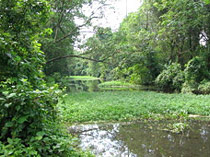
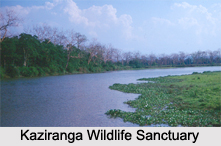
Kaziranga Wildlife Sanctuary is a home to large clumps of semi-evergreen forest. It also consists of elephant grass, which is characteristically dense and tall. The vast distribution of elephant grass is intermixed by small swamplands left behind by the receding floodwaters of the river Brahmaputra. These swamplands have an abundant cover of water lilies, water hyacinth and lotus.
Fauna of Kaziranga Wildlife Sanctuary
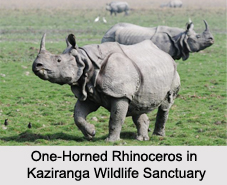 The Kaziranga Wildlife Sanctuary protects about two-thirds of the world`s great one-horned rhinoceroses. More specifically, this sanctuary is a home to about 1,651 adult rhinos (663 male, 802 are females, 186 unsexed), about 294 sub-adults (90 males, 114 females, 90 unsexed), about 251 juveniles and about 205 cubs. It is also a home to the highest density of tigers among protected areas in the world. Indian elephants, Indian bisons, swamp deers or barasingha, hog deers, sloth bears, tigers, leopard cats, jungle cats, hog badgers, capped langurs, hoolock gibbons, wild boars, jackals and wild buffalos are other major animals sheltered in the Kaziranga Wildlife Sanctuary.
Avifauna of Kaziranga National Park
Kaziranga National Park is also considered to be a birding paradise. Some of the birds found here are the grey-headed fishing eagle, oriental honey buzzard, black-shouldered kite, black kite, brahminy kite, pallas`s fishing eagle, Himalayan griffon, white tailed eagle and red jungle fowl. During winters, a large number of migratory birds descend on the parks lakes and swampy areas. They are the greylag geese, bar-headed geese, ruddy shelduck, gadwall, falcated duck, red-crested pochard and northern shoveller.
Reptiles of Kaziranga National Park
Rock pythons and many more varieties of snakes and monitor lizards are the reptiles of Kaziranga National Park.
Manas National Park
Manas National Park was established in the year 1990. Globally, this park can be pinpointed at coordinates 26 degrees 43 minutes north and 90 degrees 56 minutes east. It is located in the Himalayan foothills in Assam and a portion of it stretches to the neighboring country, Bhutan. It occupies an area of about 950 square kilometers. This area falls in five districts of Kokrajhar, Chirang, Baksa, Udalguri, and Darrang. This park experiences a minimum temperature of about 15 degrees Celsius and a maximum temperature of about 37 degrees Celsius. The annual average rainfall of this park is about 333 cm. Heavy rainfall occurs in the area occupied by the park between May and September. On October 01, 1928, Manas National Park was declared a sanctuary and on December, 1985, it was declared as a World Heritage Site. This park is also a project tiger reserve, an elephant reserve and a biosphere reserve. The managing body of Manas National Park is the Ministry of Environment and Forests, Government of India.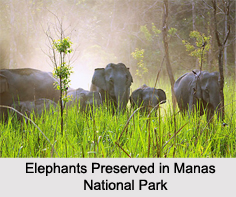
Flora of Manas National Park
Manas National Park has two major biomes. They are the grassland biomes and the forest biomes. The east Himalayan mixed moist and dry deciduous forests are the most common type of vegetation of the Manas National Park. Other types of vegetation are the low alluvial savanna woodland, sub-Himalayan light alluvial semi-evergreen forests in the northern parts and the Assam valley semi-evergreen alluvial grasslands, which cover almost 50% of the park.
Fauna of Manas National Park
Manas National Park Assam is very diverse in terms of its animal population. More specifically, this park is a home to about 55 species of mammals, 380 species of birds, 50 of reptiles and 3 species of amphibians. Out of these wildlife, about 21 mammals are India"s Schedule I mammals and 31 of them are threatened. The Assam roofed turtle, hispid hare, golden langur and pygmy hog are the rare and endangered endemic wildlife protected in this park. Some of the potentially aggressive creatures sheltered by the park are tigers, elephants, rhinos, wild buffaloes, leopards, clouded leopards and the rare Black Panthers. This park is also well known for its population of the wild water buffalo.
Avifauna of Manas National Park
Manas National Park is also a home to many resident and migratory bird species. More specifically, it serves as a home to more than 450 species of birds. Some of these species are Giant Hornbills, red jungle fowls, bulbuls, brahminy ducks, khaleej pheasants, egrets, pelicans, fishing eagles, serpent eagles, falcons, scarlet minivets, comb duck, bee-eaters, magpie robins, pied hornbills, gray hornbills, mergansers, harriers, ospreys and herons.
Related Articles:
Indian Flora and Fauna
Eco Parks in India
Jammu and Kashmir Eco Park
West Bengal Eco Parks
Tamil Nadu Eco Parks
Maharashtra Eco Parks
Rajasthan Eco Parks