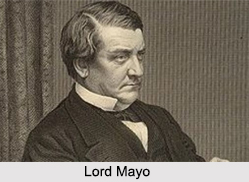
 Richard South well or the 6th Earl of Mayo was known as Lord Mayo in India. He was styled by Lord Naas from 1842 to 18767. He was the statesman or viceroy of India and also a prominent member of the British Conservative Party form Dublin in Ireland. He began the procedure of decentralization of finance. The policy of non-intervention was followed by him in matters of foreign affairs. He opened up a college known as "Mayo College" in Ajmer for enlightening the students of the aristocratic families.
Early Life of Lord Mayo
Lord Mayo was born on 21st February in the year 1822 in Dublin. He was the eldest son of 5th Earl of Mayo also known as Robert Bourke and his wife, Anne Charlotte. He received his education from the Trinity College in Dublin.
Lord Mayo and India"s First Census
The first census of India was carried out in 1871 under Lord Mayo"s orders. The statistical survey of India took its shape by him along with directions of William Wilson Hunter. He produced a printed account for every town, village and district that was compiled carefully after local inquiry. It disclosed the whole social and economic facts in the life of people. This was the most exhaustive work since the "Ain-I-Akbari."
Intervention policies of Lord Mayo
He continued the policy of Non intervention followed by his immediate predecessors and through diplomatic maneuver secured the good will and friendship of Sher Ali, Ameer of Afghanistan, who met the viceroy at Ambala in 1869. Mayo secured the Russian recognition of the Oxus as the Northern Afghan border. Perhaps his great achievement was the reform of financial management. He increased the salt duty and income tax, enforced economy in the public administration, introduced decentralized finance with provision for fixed block grants for five years to the provincial governments and substantially improved the finances of the country. Formerly the center controlled all finances and the provinces had to make out cases for allocation of funds and spent what they could get.
 Other Policies of Lord Mayo
He consolidated the frontiers of India and reorganized the country`s finances; he also did much to promote irrigation, railways, forests and other useful public works. While visiting the convict settlement at Port Blair in the Andaman Islands, for the purpose of inspection, he was assassinated by Sher Ali, a Muslim convict.
Lord Mayo's significant contribution however pertains to his fiscal reforms. These reforms were extremely necessary to stabilise the crumbling financial administration preceding his governorship. Lord Mayo was instrumental in ensuring the extension of the railways with the aid of government funds instead of privatization, a move suggested by his predecessor Lord John Lawrence. The Resolution of 1870 or the policy of financial decentralization promulgated by Lord Mayo is a glorious example of his proficiency in the execution of economic reforms.
The purpose of this Resolution was to delineate certain administrative duties to the provincial governments by the supreme imperial authority. By means of this resolution, he bestowed the responsibility of allocation of funds in the sphere of public works, medical facilities and education to the local or provincial governments who in their turn were expected to rely on local taxation. Such localisation of funds, he believed would aid in the growth of self-government and at the same time facilitate a pleasant association between the citizens of the Indian provinces and the British. Various regions like those on the north-west, Punjab, West Bengal and Madras introduced municipal taxes to implement this policy. Lord Mayo greatly reduced military expenditure and other expenses pertaining to civil administration, implemented salt duty and increased income tax. These policies ensured a more systematic execution of financial administration.
He himself supervised the efficient functioning of the Public Works Department pertaining to irrigation, forestry and other services. Agricultural reforms also comprised an important aspect of his financial reforms. The Department of Revenue, Agriculture and Commerce was established by Lord Mayo on June 9th, 1871 and he also initiated the Land-improvement Act. Lord Mayo called for certain alterations in the Permanent Settlement introduced by Lord Cornwallis as well. He advocated that land revenues should be based upon an assessment of the amount of produce and the fertility of the land rather than the payment of uniform revenue across different provinces. While the finances had suffered arrears under the supervision of his antecedents, Lord Mayo"s fiscal policies recorded a surplus of over five millions during his tenure.
Lord Mayo is also known for the disciplinary guidelines he propounded for the convicts who were imprisoned in the Cellular Jail located in the Andaman and Nicobar Islands. He laid down a set of codified laws to be effectively put into practice for the betterment of the prisoners. While he was anxious about providing adequate security measures for the English troops deployed for guarding the prisoners, he was equally concerned about ensuring a better life prospect for the prisoners. Lord Mayo wanted to develop the Andaman Islands into an independent self-sufficient colony for the prisoners. He believed that it was necessary to have the prisoners involved in productive pursuits to make themselves self-reliant. For this purpose, Lord Mayo desired the introduction of agricultural activities like breeding of cattle, budding of cotton for making cloth, which was to be taught to the convicts. The high mortality rate in the Andaman Islands in those days could also be restricted to a great extent owing to the measures implemented by Lord Mayo and his predecessor Lord Lawrence.
Assassination of Lord Mayo
The vigor of Lord Mayo had defied the distances and climate in India. He studied the requirements of farthest provinces of empires anxiously. It was for the purpose of reviewing the implementation of his reforms that Lord Mayo undertook a visit to the Andaman Islands in 1872, a journey that cost him his life. On 8th February, 1872, Lord Mayo was brutally assassinated by a convict named Sher Ali. He was buried at the County Kildare in his native soil, Ireland. His untimely death marked the end of an era of administrative excellence in British India.
Sher khan was a convict at the Andaman Islands in 1872. He was also known as the first "Jihad". He declared himself not-guilty when convicted. Lord Mayo was succeeded by an acting Governor General and viceroy John Starchey. Starchey was followed by Lord Napier in the same year in 1872.
Memorials of Lord Mayo
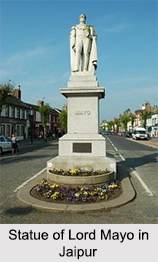
A statue of Lord Mayo was unearthed at Jaipur in India in 2007. Earlier, the statue had been installed inside the premises of Mayo Hospital which is currently known as Mahilya Hospital in Jaipur. The statue is 9 foot tall made up of iron weighing around 3 tons It was built by the Maharaja Ram Singh Ji of Jaipur. It was a tribute to him after the assassination. R.Monti and J. Forsyth. In order to prevent the statue from vandalism, it was buried inside the premises of Albert Hall Museum in Jaipur. After a time span of six decades the statue got unearthed by the Jaipur Mayo Alumni Chapter on 29th May in 2007 to the Mayo College where it is installed at present.