 The Singh Sabha intended to restore Sikhism to its past purity by publishing historical religious books, magazines and journals, to propagate knowledge using Punjabi, to return Sikh apostates to their original faith, and to involve highly placed Englishmen in the educational programme of the Sikhs. After the Nirankari and Namdhari movements of 19th Century, a fresh century was about to be started with a new movement called Singh Sabha. Nirankari and Namdhari movements could not encourage the Sikh people to a considerate point and because of the limited scope and schismatic character they acquired. Once Sardar Harbans Singh said that the Singh Sabha that followed them, had a much deeper effect and it influenced the entire Sikh Community and reoriented its attitude and spirit. Ever since the emergence of the Gurus nothing so important event had taken the effort to nurture the consciousness of the Sikhs. The Singh Sabha by leavening the intellectual and cultural processes brought a new way of outlook to the personal life of the community and thus its heritage. Starting in the seventies of the last century, it marked a turning point in the history of the Sikhs. The Singh Sabha touched Sikhism to its very roots, and revived the religion once again. The incentive it provided has shaped the Sikhs` attitude and ambition for more than past one hundred years.
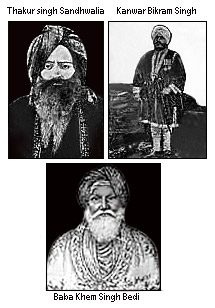
The people who helped to establish the Singh Sabha were Kanwar Bikram Singh of Kapurthala, Sir Khem Singh Bedi, Giani Gian Singh and Thakur Singh Sandhawalia. Sandhawalia became its president and Giani Gian Singh its secretary, when it was formed. An Executive Committee consisting of the president and secretary plus a few members directed the Singh Sabha. As the Sabha expanded, new officers were appointed, a vice-president, assistant secretary, a giant (scholar of the Sikh scriptures), an updeshak or preacher, a treasurer and a librarian. They were elected each year and there was the provision of re-election. Members had to be Sikhs with a strong belief in the teachings of the gurus. The members paid a monthly subscription and were asked to oath themselves to serve the community and to be loyal to Sikhism till death. All the original members were baptized Sikhs, although no obligation for this was written into the constitution of the Sabha. They held a meeting every two weeks and also held anniversary celebrations. They arranged special meetings on festival days or in response to specific challenges by other religious groups. The Sabha soon began to issue records of its decisions and also kept records of its earnings and expenditures, and produced annual reports.
The cause behind the success of the Singh Sabha was the motivation to search for Sikh individuality and self-assertion that we are not just another part of Hinduism. Earlier, Hindu philosophers thought Sikhs to be another sect of Hinduism and 2500 years ago, same thing was applicable for Buddhism. In those days, Buddha was believed to be as the re-embodiment of Vishnu by Brahmins, thus ending Buddhism in India. Singh Sabha remembered this and started their campaign of development for pastoral Khalsa that eventually came under the direct threat of Christian Missionaries, Muslim Maulalivis and Arya Samajis. Khalsa`s ethical force and dynamic energy was rediscovered and Singh Sabha was inspired by its history and tradition with clear and self-judicious eye.
Everything that went against Gurus teaching was discarded. Rites and customs were regarded as regular and steady with Sikh principles and traditions were established. For some, legal sanction was kept secured through government rule. With this came the restructuring of Sikh Shrines. Later in 1920`s Sikh Historic Shrines like Golden Temple, Nankana Sahib, TarnTaran Sahib, Punja Sahib and others were freed from the hold of traditional Mahants. These mahants used to practice rites and ritual conflicting with Sikhism, such as not letting people of "lower caste" enter the Gurdwaras, publicly smoking, idol worshipping of various Gods and Goddesses, and holding Shraddhas and other rituals that were strictly forbidden by the Sikh Gurus.
This period of the Singh Sabhas also witnessed the modern development and emergence of new cultural and political aspirations. The Sikhs properly achieved higher level of literacy. Famous Khalsa College at Amritsar and hundreds of Khalsa Schools were established all across Punjab. Many Sikhs went outside India at this period and settled at Malaysia, Canada, U.K, Africa and USA.
The first anniversary of the Lahore Singh Sabha was on April 22, 1905. Singh Sabha movement not only reformed the Sikh institutions of the customs and rites like casteism but also ensured that in future, these rituals would not come back into the society.
The Singh Sabha was an idiom of the impulse of the Sikh community to clear itself of the base adulterations and accretions, which were draining away its energy, and to revive the foundations of its actual inspiration. Unlike other Indian reform movements of the period that were the creation of the privileged class, the Singh Sabha was a mass expansion.
The Singh Sabha represented the leaders of the Sikh community. It was united by members of the landed gentry, the aristocracy, and by various types of temple servants. The Sabha prepared a calendar that had listed the correct dates of the births and deaths of the ten gurus. They embarked on the creation of an ultimate text of the Dassam Granth; however, this task proved so difficult that a separate organization, the Gurmat Granth Pracharak Sabha was also founded to complete it. The Singh Sabha published numerous tracts and books and in 1894 organized the Khalsa Tract Society to make the Punjabis popular, the Gurmukhi script, and to issue monthly publishing on the Sikh religion. Soon the Singh Sabha of Amritsar was followed by new organizations that also proved to be competitors for leadership within the Sikh community.