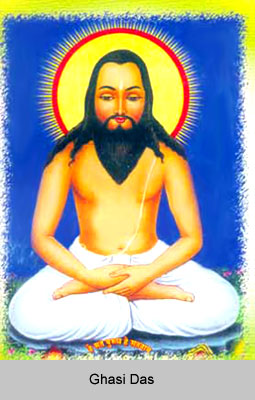
 Ghasi Das founded a socio-religious movement in Chhattisgarh and called it the Satnamis. He was born in the year 1756 in a dalit family in village Girodhpuri of Raipur District (presently in Chhattisgarh) and died in 1836. He severely disliked the cruel behavior to his brotherhood and he kept on searching for the right answers. Ghasi Das, who was seeking the right path or solution, decided to go to Puri. During the 1820s, Ghasi Das and his brother set out on a pilgrimage to the Vaishnava temple of Puri in Orissa. It is said that on his way at Sarangarh, Ghasi Das attained true knowledge. Thus, he declared `satnam` and returned to his village.
After returning from Puri, Ghasi Das deserted his normal life and became a religious austere. He retired to the forest for contemplation and periodically reappeared in the locality to help those individuals who sought spiritual inspiration and moral aid. Gradually his reputation grew and he had a group of disciples. Most of his followers were from the backward community of the society. From a very early age, Ghasi Das rejected social discrimination and tried to sort out the troubles faced by the backward community for finding solutions. And for this purpose, Ghasi Das travelled expansively in the undivided state of Madhya Pradesh.
The religious career of Ghasi Das gradually moved to a new stage when he withdrew to the forest for six months and then returned to preach a new religious doctrine. Ghasi Das asked his followers to discard idol worship and all that was demanding. He believed that all men were equal, thus stood against the system of caste. Ghasi Das also asked for restructuring of nutritional practices. Beyond the issue of diet and basic belief, Ghasi Das taught his disciples to withdraw themselves from using cattle for ploughing after midday. Until his death, the Satnamis primarily focused on improving the status of the backward community through adjustments.
Ghasi Das instigated a socio-religious order that discarded and helped in demolishing the hierarchical caste system from the society. This new order initiated by Ghasi Das through Satnamis principles treated all people as equal. Satnami principles state that `there is only one God`, which is described as formless and infinite. Ghasi Das was of the view that the measures to eradicate social injustice and disparity would stay insufficient and unfinished without the proper transformation of the individuals. Balak Das, Ghasi Das`s eldest son, became the successor of the Satnamis. Balak Das was forceful and radical in his attitudes to caste discrimination.
Eventually, the Satnamis were linked to Hindu Bhakti saint, Ramananda. Chhattisgarh was an extension of the Ramanandi movements of the north and the area had been influenced by the teachings of Saint Kabir. Chhattisgarh remained the centre of this movement with forty two per cent of the Satnamis residing in this region. The Satnamis became a permanent subdivision of the Hindus of the Central Provinces of the country. Lawrence Babb conducted field research among the Satnamis in 1966-67 and described them as essentially a single-caste movement with its own hierarchical system of priests, its holy centers and a special calendar of ritual events. As an intermediary socio-religious movement, Satnamis followed the well-established path of Ramanandi Hinduism. The impact of Satnami movement was limited to Chhattisgarh plain. They were an extension of the religious and cultural developments within the Gangetic basin, a dimension that sets these two movements apart from Satya Mahima Dharma of Orissa or the third intermediary movement.
More than a few myths have been built around the teachings of Ghasi Das. These myths are widely accepted by the people.
Ghasi Das
Ghasi Das was the founder of socio-religious Satnami movement. Several beliefs and myths that have been built around Ghasi Das are broadly accepted by his followers.