Architectural Developments of New Delhi during British Rule, British India - Informative & researched article on Architectural Developments of New Delhi during British Rule, British India
  Indianetzone: Largest Free Encyclopedia of India with thousand of articles History of India


in  
Art & Culture | Entertainment | Health | Reference | Sports | Society | Travel
Forum  | Free E-magazine
History of India : Sources of History of India l Ancient History of India l Medieval History of India l Modern History of India l Indian Historical Dynasties l Indian Battles l Sepoy Mutiny 1857 l Indian Rulers l History of India l Indian Freedom Struggle l Indian Governor- Generals l British Indian Acts l Post Independence India l Iron Age in India
Home > Reference > History of India > Modern History of India > British Empire in India > Art and Architecture during British Rule in India > Architectural Developments of New Delhi during British Rule
Architectural Developments of New Delhi during British Rule, British India
Architectural developments of New Delhi during British rule redefined enormity, with colossal architectures being erect.

Lord-HardingeArchitectural developments of New Delhi during British rule was the most remarkable that had ever happened prior to Indian independence. With an imperial announcement by the English Crown, New Delhi witnessed the rise of architectural wonders, overshadowing many in the street corners. The desolated grounds and vast tracts were taken as planned lands for construction, under the Viceroy-General`s approval. Several English architects worked day and night, resisting every argument to make New Delhi the perfect capital city.

At the Delhi Durbar of December 1911, King George V announced the transfer of India`s capital from Calcutta to Delhi. In consequence, a site for the capital required selection; architects had to be chosen to design and to oversee construction of a series of buildings.

Within the period of December 1911 to February 1912, the choice of architectural style for the new capital immediately emerged as a point of contention. On December 22, 1911 Ernest B. Havell (1861-1934), retired Principal of the Calcutta School of Art, began to promote the use of an Indie-style in a letter to The Times. He called for the use of Indian craftsmen applying Indian arts and science. Later on February 6, 1911 a group of prominent English artists, scholars and politicians presented a petition to the India Office calling for the use of traditional Indian craftsmanship. This group represented a coalition of interest in Indo-Saracenic architectural style and in the Indian arts and crafts movement.

On 13th March 1912, the British Government announced the membership of the Delhi Town Planning Commission. It included: Edwin Lutyens (1869-1944), Henry Vaughn Lanchester (1863-1953), Ernest B. Havell (1859-1937) and J. A. Brodie (1858-1934). Their charge embraced recommending a site for New Delhi and drawing a city plan. It was evident that architectural developments of New Delhi under British rulers had begun to take shape of a serious official affair.

On 2 May, on behalf of the Town Planning Commission, Lutyens indicated the selection of a site for New Delhi, slightly south of the present Delhi. This concept became formalised in the Commission` report of June 13 to the Government of India. The Commission evaluated the southern site as cheaper, healthier and possessed greater room for growth. The Viceroy, Lord Hardinge (1858-1944), similarly recommended this site on March 7, 1913 and Lord Crewe (1858-1945), Secretary of State for India, gave final approval.

On 1 October, Lord Hardinge named Malcolm Hailey (1872-1969) as Commissioner of Delhi and President of the Imperial Delhi Committee. Geoffrey de Montmorency (1876-1955) was later named Secretary to the Committee.

Within the period of 1913 to 1916, the Raisina Hill Controversy came up as a serious issue in the path of architectural developments of New Delhi under British dominion. As early as 1913, Lord Hardinge acknowledged that Raisina Hill would block observation of the Viceroy`s House for a part of the approach along the processional route. A perspective drawn early in 1913 misleadingly showed both of the Secretariats and the Viceroy`s House in their entirety. In June 1914, Lutyens filed a signed plan with the Imperial Delhi Committee affirming the grade of the approach to the Viceroy`s House and fixed the error forever. Only in January 1916 did Lutyens perceive the diminished view of Viceroy`s House. He was to fight fruitlessly the issue for the next six years.

On 29th January 1913, an agreement evolved that Luytens would have principal responsibility for the layout of New Delhi and the design of the Viceroy`s House. A second architect, Herbe Baker (1862-1946) would be responsible for designing the two secretariat buildings. The architect, Sir Swinton Jacob (1841-1917) took employment as a consultant, but retired in August 1913. On May 8, a despatch from the Viceroy to the Secretary of State for India formalised the selection of the architects, their remuneration and general instructions.

By the time of January 1913, Lutyens had essentially settled on a European classical style for the Viceroy`s House. His initial drawings called for a huge dome and many columns and subordinated Indie-forms, such as the Chajja, Chattris, a cobra fountain and the use of trabeated arches at the kitchen entrance. On completion, the Viceroy`s House displayed a 600-foot frontage, measured 180 feet to the top of its dome and covered four and a half acres. Lutyens used a combination of blood-red Dholpur sandstone mixed with contrasting cream-coloured stone for its exterior surface. He completed construction of the Viceroy`s House in 1929.

In February of the same year, the Government of India assigned to William Henry Nicholls the responsibility for designing buildings in New Delhi not assigned to Lutyens or Baker. Later he would be named the Architectural Member of the Imperial Delhi Committee. Owing to the national capital being shifted from Calcutta to Delhi, it was evident that the Britons were putting in every effort to develop New Delhi into an architectural wonder.

The First World War of 1914-1918 imposed serious delays on the re-construction of New Delhi. Some supplies soared up greatly in price due to their inflation, others requiring import were simply not available. The skilled workforce ebbed away to 8000, or only one-third of their original number.

In the winter months of 1919-1920, a new Capital Committee replaced the Imperial Delhi Committee. Its Membership now included the Secretary for Mibllc Works and an officer from the Financial department. Additional powers were granted to the Chief Commissioner of Delhi; collectively these changes increased the efficiency of the construction process.
Edwin-Lutyens
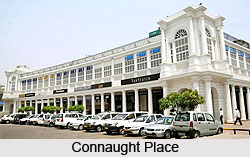
Within the years of 1919 to 1935, Robert Tor Russell (188-1972), Chief Architect to the Government of India, executed designs for a number of supplementary buildings required in the new capital. They included: Connaught Place which was a shopping centre, two legislators, the mansion of the Army`s Commander-in-Chief, other official housing, hospitals, bungalows, police stations and post offices. Russell`s style was essentially Classical.

On 12th February 1921, the Duke of Connaught (1863-1938) laid the foundation stone for the Indian Legislative Chambers in New Delhi. Architectural developments of New Delhi had taken up pace by this time, with the city gradually turning into a marvel under British rulers.

In the time period within 1927 to 1935, on behalf of the religious needs of the new capital, the Anglican Church of the Redemption was constructed. H. A. N. Medd (1892-1977) drew its designs and it was given a distinguished location on the axis of the Jaipur Column at the request of Lord Irwin. Some of it architectural aspects resembled those of Palladio`s H Redentore in Venice.

In 1927, in the design of the two identical Secretariat blocs located on either side of King`s Way, Baker combined elements of English classicism with Indian architectural features. The latter included the overhanging stone Chujja, the canopied Chattri and the marble Jaali. These Indian architectural aspects pretty much duplicated those Lutyens had used at the Government House. In addition Baker used the Nashlman, or recessed porch. In general, these Indian architectural features represented the means of dealing with India`s sun and monsoon rains.

In the same year, planning for the Capital grounds called for the inclusion of eight-acre lots on which the Indian princes could build their palaces. Lutyens produced the designs for the New Delhi palaces of the Nizam of Hyderabad and the Gaekar of Baroda and were completed by 1931.
Lord-Irwin
In January, Lord Irwin (1881-1959) officially opened the Council House, in which the Chamber of Princes, Imperial Legislative Assembly and Council of State resided. The structure possessed a circular Colosseum design which emanated from Lutyens` thinking.

In the period of 1928 to 1930, Arthur G. Shoosmith (1888-1974) designed the Garrison Church of St. Martin. Massive, simple in design and almost severe, it was constructed entirely in brick. As time passed, critics acknowledged it as one of the great pieces of architecture in the twentieth century.

Architectural developments of New Delhi under British rule was perhaps the most astounding, with splendid edifices coming up as planned, every other day. If one leaves aside the cruelty of the ruthless rule of Britishers on India, these instances of architectural masterpieces elevate the English to a respectable level. The early 20th century in Indian Independence history was the most eventful, as this was a period of contrast when activities of sociality like these occurred as differentiated with killings and butchery.

Within the years of 1930 to 1934, H. A. N. Medd also designed the Roman Catholic Cathedral of the Sacred Heart. His plans possessed the influence of the sixteenth century church in Rome, the Gesu.

In 1931, Australia, Canada, New Zealand and South Africa donated four columns to architecturally develop New Delhi, known as the Ashokan columns, representing each of the Dominions. Each column was topped by a bronze ship in connotation of the maritime nature and power of the British Empire.

In the same year, at the east end of King`s Way, Lutyens designed the All-India War Memorial Arch. Standing one hundred and thirty-nine feet in height, it commemorated the dead of the First World War and the Third Afghan War. This war memorial is hugely popular today as the India Gate. Additionally, Lutyens drew up the plans for the King George V Memorial, which stood five hundred feet to the east of the War Memorial Arch. It was completed in 1936.

Within the fortnight of 4th to 15th February 1931, celebrations centred on the opening of the Lady Hardinge Serai, a series of formal dinners and informal parties, an investure ceremony, unveiling the Ashokan columns from the four Dominions, a commemoration ceremony at the Indian War Memorial Arch and the consecration of the Church of the Redemption. Lord Irwin led the various events which were marred somewhat by concerns over expenses and possibility of Indian violence.

The Oriental Delhi of the Mughals was given a whole fresh Western look in New Delhi, when the British took up the task of developing the city architecturally. Within a period spanning from 1912-1935, New Delhi was rebuilt and reconstructed by Britons, as one witnessed the erection of churches, official buildings, war memorials and ballroom halls. In times of terrible blood and violence, New Delhi stood apart in its architectures, some even commemorating Indian soldiers.

(Last Updated on : 7/02/2012)
  More Articles in Art and Architecture during British Rule in India
 
Architecture During Early British rule Architectural Developments during 19th Century Architectural Developments of Bombay during British Rule
Architectural Developments of Calcutta during British Rule Architectural Developments of Madras during British Rule Architectural Developments of New Delhi during British Rule
Early British Architectural Design    
Recently Updated Articles in History of India
  • Indian Art and Craft during British Rule
    Indian art and craftwork during British rule comprised intricate and patterned works, owing to its surging popularity.
  •  
  • Indian Films during the British Regime
    Indian films during British regime was not much widespread in its acceptability, owing to serious independence issues.
  •  
     
  • Development of Education during British Rule
    Development of education under British rule was huge, with the educated graph climbing to the top.
  •  
  • Sanghamitta
    Sanghamitta is a princess and the daughter of the Emperor of Ashoka.
  •  
  • Developments in Medicine
    Developments in Medicine in British India was perfectly all-round, with British employing every method to look.
  •  
    E-mail this Article | Post a Comment
    RSS Feeds
    Forum
    Forum on History of India

    Free E-magazine
    Subscribe to Free
    E-Magazine on Indian Crafts
     
     
    Architectural Developments of New Delhi during British Rule, British India - Informative & researched article on Architectural Developments of New Delhi during British Rule, British India
    Sitemap
    Contact Us   |   RSS Feeds
    Copyright © 2008 Jupiter Infomedia Pvt. Ltd. All rights reserved including the right to reproduce the contents in whole or in part in any form or medium without the express written permission of Jupiter Infomedia Pvt. Ltd.