Dams in Madhya Pradesh is constructed over several rivers which include the River Chambal, Son, Narmada, Barna, etc. The dams constructed in this Indian state with the aim of providing water for the irrigation of agricultural lands. These also serve as the major source of drinking water and for the generation of hydro electric power. Various dams are there in the state of Madhya Pradesh which help in the irrigation and also serve as some of the most beautiful tourist destinations. The dams help in boosting the agricultural economy of the state of Madhya Pradesh to a large extent.

One of the most prominent dams in the state of
Madhya Pradesh is the Bansagar or Ban Sagar. It is a multipurpose river valley project, built on the River Son. The dam is situated in
Ganga River Basin in Madhya Pradesh. The main purpose for the construction of this dam was to improve both hydroelectric power generation and irrigation. The Bansagar Dam is erected at village called Deolond in the district of Shahdol. The dam is situated at a distance of about 51.4 kilometers from Rewa. The project has been named as `Bansagar` after the renowned Sanskrit scholar of the 7th century, Bana Bhatt. This project was first visualized by the Central Water Commission New Delhi as the `Dimba Project` in the year 1956. The dam was firstly planned to be constructed at the confluence of Banas and Sone River close to the Shikarganj town, about 30 kilometers down the present site of the dam. However, the site of the dam was shifted to the present site at Deolond. The Governments of Madhya Pradesh,
Bihar and
Uttar Pradesh decided upon an agreement in the year 1973 for the building of the Dam, according to which the states resolved to share the expenditure in the ratio of 2:1:1. 4-maf of water has to be shared by the states in the same ratio. The construction of this dam was initiated in the year 1978 at the predetermined cost of Rs. 91.31 crores. The final anticipated cost in the year 1998 was Rs. 1054.96 crores.
The primary benefit of the Bansagar Dam is concerned to the purpose of irrigation only. The water sharing from Bansagar Dam is as under Madhya Pradesh, Bihar and Uttar Pradesh. Bansagar dam provides irrigation facility over an area of 2,490 km² in the state of Madhya Pradesh, 1,500 km² and in the state of Uttar Pradesh and 940 km² in the state of Bihar. The Bansagar Dam provides power generation of 425 MW in Madhya Pradesh state. The Bansagar Canal Project was initiated in the year 1978 and the same got completed in the year 2008. The Canal Systems, which are under construction to utilize water from the Bansagar Reservoir, shall be started shortly.
One of the major dams in the Madhya Pradesh state is the Bargi Dam. This is the first dam of its kind which was constructed over the River Narmada. The Bargi Dam is located in close proximity to the Bijora Village, around 40 kilometers southwest of the city of
Jabalpur. The construction work of the Bargi Dam was initiated in the year 1974 and the construction of this small dam got completed in the year 1990, when the dam was filled to its complete capacity. This dam is one of the major sources of water in the region and it also uses its water for the generation of Hydro electric power. The site of the dam is opened for visitors round the year till late evening. The fishing community settled around the dam has formed a fishing co-operative society for proper income. The scenic Temar falls located close to the site of this dam forms one of the major attractions of the area.
The plan to construct a chain of thirty major dams on the
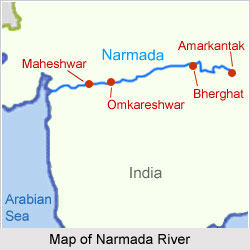
Narmada River in Madhya Pradesh was steadily in progress, and the Bargi Dam is one of the first completed Dams from the list. River Narmada is the largest river in the state of Madhya Pradesh and it flows towards the west ultimately emptying its water into the
Arabian Sea. The total length of the River Narmada flowing in the state of Madhya Pradesh is around 1072 kilometers and the Bargi Dam controls this portion of the water of River Narmada. The proposal of building the Bargi Dam was decided by the Central Water and Power Commission in the year 1968 in order to enhance irrigation in 2,980 square kilometers and hydropower generation capacity of 105 MW. After few years from the initiation of the dam construction, the Bargi diversion scheme was designed in order to increase the total irrigation potential to 4,370 square kilometers. The height of Bargi Dam is 69 meters and its length is 5.4 kilometers. The adjacent lake of the Bargi Dam is about 75 kilometers in length and 4.5 kilometers in width, covering an area of 267.97 km². The Bargi Dam mainly serves the districts of Jabalpur, Seoni and Mandla and the water supplied is upto FRL of 422.76 m.

The River Barna is a tributary of the River Narmada, flowing in the district of Raisen in Madhya Pradesh. Barna Dam was constructed over the Barna River. The dam is constructed at a height of about 48 meters and it acts as the main source of irrigation in Bari and other nearby villages.
Bhopal Airport and the Pipariya railway station are the nearest points of communication in order to reach the Barna Dam site. Another notable dam in the state of Madhya Pradesh is the Gandhi Sagar Dam. The
Chambal River impounds in the Gandhi Sagar Reservoir. The Gandhi Sagar dam serves Gandhi Nagar, Mandsaur District and Madhya Pradesh. The Water Resources Department of the state of Madhya Pradesh maintains the Gandhi Sagar Dam. The construction of this dam got initiated in the year 1954 and the same was fully completed in the year 1970. The Gandhi Sagar Dam is 513 metres in length and the height of this dam is 62.20 metres. The Gandhi Sagar dam is probably the first of the four dams constructed on the River Chambal. This high masonry gravity dam has a live storage capacity of 6,920 Mm³ and a catchment area of 22,584 km². The hydro electric power station includes five generating units of each having a capacity of 23 MW. The water released after power generation is used for irrigation via Kota Barrage.
The Narmada Dam Project is a project which is concerned with the construction of a chain of large hydroelectric dams on the River Narmada in India. Another prominent dam in Madhya Pradesh is the Rajghat Dam, which stands on the
Betwa River. This dam is situated at a distance of about 22 kilometers from Lalitpur. Rajghat Dam is an inter-state Dam project of the collaborated team of the Government of Uttar Pradesh and Madhya Pradesh. The project includes the construction of 43.80 meters high and 562.50 m long stonework dam across the River Betwa flanked by an earthen dam with a maximum height of 29.5 meters and a total length of 10.79 km. The project was designed in such a way that it will provide irrigation to 1,210 square kilometres of agricultural land in the states of Madhya Pradesh and 1,380 square kilometres of agricultural land in the state of Uttar Pradesh. The usable capacity of the powerhouse is about 45 MW. The benefits and costs of this project are to be shared by both the states of Uttar Pradesh and Madhya Pradesh equally. Matatila Dam project, Parichha Weirs and Dhukwan are the existing projects on the downstream. It is for this reason the Rajghat Dam project shall serve as parent storage for irrigation requirements in the states of Uttar Pradesh and Madhya Pradesh through a cascade of water falls and other hydraulic structures in the downstream of River Betwa.
Tawa Reservoir is situated in the district of Hoshangabad in the state of Madhya Pradesh. It is a large reservoir on the
Tawa River in the central part of India. This reservoir was created only after the building of the Tawa Dam, which began in the year 1958 and the construction work was completed in the year 1978. At the time of the construction of the Tawa reservoir, almost forty-four villages were submerged. Tawa Reservoir is nestled between the western boundary of Satpura National Park and Bori Wildlife Sanctuary. The catchment area of Tawa Reservoir is 5982.9 km² and surface area is 225 km². Water Resources Department of Madhya Pradesh bears the responsibility to maintain the Tawa Reservoir. The reservoir is almost 57.91 metres high and 1,815 metres long.
Indirasagar Project is famously known as the ISP. It is a multipurpose key project of the Madhya Pradesh state constructed over the River Narmada at the district of Narmadanagar. Dams and reservoirs in Madhya Pradesh, thus, help in the irrigation of large patches of land in the state and they also cater to the drinking water requirements of the locality. Several dams constructed in this state have different utilities. They also help in the generation of hydro electricity. The picturesque location of some of the major dams in Madhya Pradesh and the famous attractions situated close to them, serve as some of the favorable tourist destinations in the state.