About Aravidu Dynasty
 Aravidu Dynasty was the fourth and last Hindu dynasty which ruled Vijayanagar Empire in South India.
Founder of Aravidu Dynasty
The founder of Aravidu Dynasty was Tirumala, whose brother Rama Raya had been the masterful regent of the last ruler of the previous dynasty. Rama Raya`s death at the Battle of Rakasa-Tangadi (also known as the Battle of Talikota) in the year 1565 led to the subsequent destruction of Vijayanagar Empire, which ruled the South India in the midst of Dark Age, by the combined forces of the Muslim states of Bijapur. The main rulers of Aravidu dynasty were as follows:
Rama Raya (1542-1565 CE)
Rama Raya, (1542-1565 CE) commonly known as "Aliya" Rama Raya, was the progenitor of the "Aravidu" dynasty of Vijayanagar Empire.
Tirumala Deva Raya (1565-1572 CE)
Tirumala Deva Raya (1565-1572 CE) was perhaps the original Coronated King of the Vijayanagara Empire from the Aravidu Dynasty.
Sriranga Deva Raya I (1572-1586 CE)
Sriranga I also known as Sriranga Deva Raya, (1572-1586 CE) was the king of Vijayanagara empire, from 1572-1586. He conceded the restitution of the Vijayanagara empire, but his reign was stained with repeated attacks and loss of territories from his Muslim neighbours.
Sriranga II (1614-1614 CE)
Sriranga II also known as Sriranga Chika Raya (1614-1614 CE), was nominated in 1614 by King Venkata II to ascend him as king of the Vijayanagara Empire in Southern India.
Rama Deva Raya (1617-1632 CE)
Rama Deva Raya, also known as Vira Rama Deva Raya (1617-1632 CE), succeeded the throne following a ghastly war in 1617 as the King of Vijayanagara Empire. In 1614 his father,Sriranga II the preceding King and his family were gruesomely murdered by rival factions headed by Jagga Raya, who was one of their kins. Rama Deva himself was smuggled out of the prison by Yachama Nayudu, a faithful commander of earlier king Venkata II. The defeated Jagga Raya sought harbour in the jungle but sprung up and sought aid from the Nayaks of Gingee and Madurai, both willing to set out of the Vijayanagara bond, to assail Yachama Nayudu and Rama Deva. Yachama Nayudu and Ramadeva sought support from the Tanjore Nayaks, who still treated the Vijaynagar as their authority.
Venkata III (1632-1642)
Venkata III also known as Peda Venkata Raya, the grandson of Aliya Rama Raya became the King of Vijayanagara Empire from 1632-1642.
Sriranga III (1642-1652 CE)
Sriranga III 1642-1652 CE was the ultimate ruler of the Vijayanagar Empire, who came to power in 1642.
Capture by Timma Raja
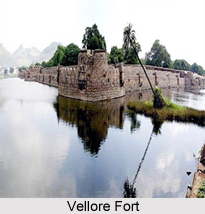
Venkata III`s paternal uncle, Timma Raja, another brother of Sriranga II, considered himself to be a better claim, detained the government at Vellore Fort, persuading Venkata III to remain in his native place Anekonda. The Nayaks of Gingee, Tanjore and Madurai declared support for Venkata III, while Timma Raja got from none and was looked upon as a usurper. Timma Raja however made lot of trouble and civil strife continued until his death in 1635.Initially he was winning, until the King Peda Venkata (Venkata III)`s nephew,Sriranga III took to the field and beat Timma Raja with help from the Dutch in Pulicat,compelling him to accept Venkata III`s claim. Timma Raja was allowed some territories under his control, but stirred up trouble the second time, only to be slain by the Nayak of Gingee in 1635. Peace was finally restored and Peda Venkata Raya or Venkata III returned to Vellore to take charge.
Madras Land Grant
On 22 August 1639 Francis Day of the British East India Company attained a miniature strip of Land in the Coramandal Coast from in Chandragiri. The region was under by the Damerla Venkatapathy, Nayak of Vandavasi. It is the place to build a factory and warehouse for their trading activities.
Trouble from Southern Nayaks
In the year 1647 the Nayaks of Tanjore and Madurai, resulting out of some complications endeavoured to seize Venkata III, and assailed Vellore but were overpowered and peace was patched up.
 Insurgence of Sriranga III
The Kings loyal nephew, Sriranga III for certain reasons turned against the King in 1638 and engineered an invasion from Bijapur.The Bijapur - Sriranga III combine initially attacked Bangalore making the King Venkata III buy peace after an expensive deal.In 1641 the same combine launched another attack and were just 12 miles to Vellore Fort, but Southern Nayaks attacked their camp with backing.
Golkonda Forces and the Kings of Aravidu Dynasty
In the following year 1641, the Golkonda Sultan witnessing the disarray sent a huge force along the East Coast. The Golkonda army after facing a stiff confrontation near Madras by Venkata III`s army backed by Gingee Nayaks and Darmala Venkatapati,the chieftain of Madras and Poonamalee advanced towards Vellore Fort. But Venkata III, now badly under threat from all sides retreated to the Jungles of Chittoor and died October 1642. Venkata III did not have any heirs and was instantly succeeded by his deceitful nephew Sriranga III, who came to Vellore Fort after deserting the Bijapur camp.
Ruler of Aravidu Dynasty
 Aravidu dynasty , the fourth and last to hold sway over the Vijayanagara Empire, is often not counted as a ruling dynasty of that empire, for reasons delineated below. Rama Raya patronised the Sanskrit scholar Rama Amatya. Aliya" Rama Raya and his brother Aliya Tirumala Raya were sons-in-law of the great Vijayanagara emperor Krishna Deva Raya. The word "Aliya" means "son-in-law" in the Kannada language. Along with another brother Venkatadri, the Aravidu brothers rose to prominence during the rule of Krishnadevaraya.
Rama Raya was a successful army general, able administerator and tactful diplomat who conducted many victorious campaigns during the rule of Krishnadevaraya. After the demise of his illustrious father-in-law, Rama Raya, as a member of the family, began to wield great influence over the affairs of the state. Krishna Deva Raya was succeeded in 1529 by his younger brother Achyuta Raya, upon whose demise in 1542, the throne devolved upon his nephew Sadashiva Raya, then a minor. Rama Raya appointed himself regent during the minority of Sadashiva Raya. After Sadashiva Raya came of age to rule, Rama Raya kept him a virtual prisoner. During this time he turned into a virtual ruler having confined Sadashiva Raya. Rama Raya removed many loyal servants of the kingdom and replaced them with officers who were loyal to him. He also appointed two Muslim commanders, the Gilani brothers who were earlier in the service of the Sultan Adil Shah as commanders in his army, a mistake that would cost the empire the final Battle of Talikota.
Sultanate Affairs: During his reign, the Deccan Sultanates were continually occupied in internal conflicts and requested Rama Raya on more than one occasion to act as a mediator, enabling Rama Raya to push north of Krishna River and expand his domains utilizing the disunity of the Deccan Sultans. He also suppressed revolts of the chieftens of Travancore and Chandragiri. Some scholars have criticised Rama Raya for interfering in the affairs of the Sultans too much, but scholars like Dr. P.B. Desai have ably defended his political affairs indicating that Rama Raya did whatever he could to increase the prestige and importance of the Vijayanagar empire, ensuring no single Sultanate would rise above the others in power hence preventing a difficult situation for Vijayanagar empire. In fact Rama Raya had interfered in Sultanate affairs only upon the insistence of one Sultan or the other, just the way the Sultans had acted as parelys between Rama Raya and Achyuta Raya in earlier years.
When the Nizam of Ahmednagar and Qutbshah of Golconda sought Rama Raya`s help against Bijapur, Rama Raya secured the Raichur doab for his benefactors. Later in 1549 when the Adilshah of Bijapur and Baridshah of Bidar declared war on Nizamshah of Ahmednagar, Ramaraya fought on behalf of the Ahamednagar ruler and secured the fort of Kalyana. In 1557 Ramaraya allied himself with Ali Adilshah of Bijapur and Baridshah of Bidar when the Sultan of Bijapur invaded Ahmednagar. The combined armies of the three kingdoms defeated the partnership between Nizamshah of Ahmednagar and the Qutbshah of Golconda. This situation of Vijayanagar ruler constantly changing sides to improve its own position made the Sultanates form an alliance. Intermarraige between Sultanate families helped solve internal differences between Muslim rulers. This consolidation of Muslim power in the northern Deccan resulted eventually in the Battle of Talikota.
Battle of Talikota: Rama Raya continued to be devoted to the legitimate dynasty until finally extinguished by war. In 1565, it was Rama Raya, as the finest general of the Vijayanagar army, who led the defense against the invading army of Deccan Sultans (i.e. Husain Nizam Shah, Ali Adil Shah and Ibrahim Qutb Shah) in the battle of Talikota. This battle which seemed an easy triumph for the large Vijayanagar army was a disaster following the revelation capture and death of Aliya Rama Raya who led the forces, a blow from which it never recovered. The city of Vijayanagara was thoroughly sacked by the invaders and the inhabitants were massacred. The royal family was largely exterminated. Vijayanagara, once a city of fabled splendour, the seat of a vast empire, became a desolate ruin, now known by the name of a hallowed inner suburb within it, Hampi.
Architecture of Aravidu Dynasty
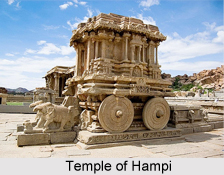
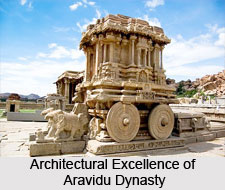 Vijayanagara architecture is a vivacious amalgamation of the Chalukya, Hoysala, Pandya and Chola styles, phrases that flourished in previous centuries.Its stylistic trademark is the ornate pillared Kalyanamantapa (marriage hall), Vasanthamantapa (open pillared halls) and the Rayagopura (tower). Artisans used the locally accessible hard granite considering its resilience as the kingdom was under unvarying hazard of incursion. While the empire`s monuments are fanned out over the entire Southern India, nothing surpasses the vast al fresco theatre of monuments at its capital at Vijayanagara, a UNESCO World Heritage Site.
In the 14th century the kings sustained the construction of Vesara or Deccan style monuments but later incorporated Dravidic-style gopurams to convene their ritualistic needs. The Prasanna Virupaksha temple (underground temple) of Bukka Raya I and the Hazare Rama temple of Deva Raya I are examples of Deccan architecture. The varied and intricate ornamentation of the pillars is a mark of their work. At Hampi, though the Vitthala shrine is the finest illustration of pillared Kalyanamantapa style while the Hazara Ramaswamy temple is a self-effacing but perfectly finished example. A visible aspect of their style is their return to the simplistic and serene art developed by the Chalukya dynasty. A magnificent example of Vijayanagara art, the Vitthala temple, took numerous decades to absolute during the supremacy of the Tuluva kings. 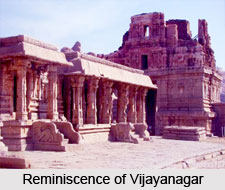
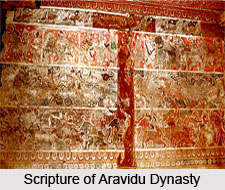
An additional constituent of the Vijayanagara style is the carving of large monoliths such as the Sasivekalu (mustard) Ganesha and Kadalekalu (Ground nut) Ganesha at Hampi, the Gomateshwara statues in Karkala and Venur, and the Nandi bull in Lepakshi. The Vijayanagara temples of Bhatkal, Kanakagiri, Sringeri and other towns of coastal Karnataka, also Tadpatri, Lepakshi, Ahobilam, Tirupati and Srikalahasti in Andhra Pradesh, and Vellore, Kumbakonam, Kanchi and Srirangam in Tamil Nadu are instances of this style. Vijayanagara art comprises of wall-paintings such as Dasavathara (ten avatars of Vishnu) and Girijakalyana (marriage of Goddess Parvati) in the Virupaksha temple at Hampi, the Shivapurana paintings (tales of Shiva) at the Virabhadra temple at Lepakshi, and those at the Jain basadi (temple) and the Kamaskshi and Varadaraja temple at Kanchi.
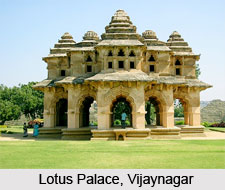
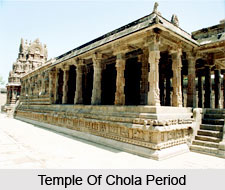 A characteristic of Vijayanagara architecture exhibiting the multi-ethnicity of the great conurbation is the occurrence of several secular structures bearing Islamic features.While political history concentrates on the ongoing conflict amid the Vijayanagara Empire and the Deccan Sultanates, the architectural record reflects a more creative interaction. There are several arches, domes and vaults that show these influences. The concentration of structures like pavilions, stables and towers suggests they were for use by royalty.
The decorative details of these structures may have been absorbed into Vijayanagara architecture during the early 15th century, corresponding with the rule of Deva Raya II and I. These kings are identified to have employed scores of Muslims in their army and court, a number of whom may have been Muslim architects. This harmonious barter of architectural ideas must have happened during rare periods of peace between the Hindu and Muslim kingdoms. The "Great Platform" (Mahanavmi dibba) encompasses relief carvings in which the figures seem to have the facial features of central Asian Turks who were known to have been engaged as royal attendants.
Literature of Aravidu Dynasty
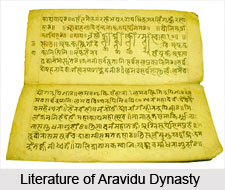 During the reign of the Vijayanagar Empire, poets, scholars and philosophers inscribed in Sanskrit and the regional languages, Kannada, Telugu and Tamil and enclosed such subjects as religion, biography, Prabhanda (fiction), music, grammar, poetry and medicine. The Telugu language became a popular literary medium, reaching its peak under the patronage of Krishnadevaraya.
Most Sanskrit works were commentaries either on the Vedas or on the Ramayana and Mahabharata epics, printed by well known figures such as Sayana and Vidyaranya that extolled the superiority of the Advaita philosophy over other rival Hindu philosophies. Other writers were famous Dvaita saints of the Udupi order such as Jayatirtha (earning the title Tikacharya for his polemicial writings), Vyasatirtha who wrote rebuttals to the Advaita philosophy and of the conclusions of earlier logicians, and Vadirajatirtha and Sripadaraya both of whom criticised the beliefs of Adi Sankara. Apart from these saints, noted Sanskrit scholars adorned the courts of the Vijayanagara kings and their feudatory chiefdoms. Numerous kings of the dynasty were themselves litterateurs and authored classics such as King Krishnadevaraya`s Jambavati Kalyana, a poetic and dramatically skillful work.
The era`s Kannada poets and scholars shaped significant writings supporting the Vaishnava Bhakti movement heralded by the Haridasas (devotees of Vishnu), Brahminical and Virashaiva (Lingayatism) literature. The Haridasa poets celebrated their devotion through songs called Devaranama (lyrical poems) in the ragale metre. Their inspirations were the teachings of Madhvacharya and Vyasatirtha. Purandaradasa and Kanakadasa are considered the foremost among many Dasas (devotees) by virtue of their immense contribution. Kumara Vyasa, the most prominent of Brahmin scholars wrote Gudugina Bharata, a translation of the epic Mahabharata. This work marks a transition of Kannada literature from old Kannada to modern Kannada. Chamarasa was a famous Virashaiva scholar and poet who had many debates with Vaishnava scholars in the court of Devaraya II. His Prabhulinga Lile, later deciphered into Telugu and Tamil, was a eulogy of Saint Allama Prabhu (the saint was considered an incarnation of Lord Ganapathi while Parvathi took the form of a princess of Banavasi).
At this peak of Telugu literature, the most famous writing in the Prabhanda style was Manucharitamu. King Krishnadevaraya was an accomplished Telugu scholar and wrote the celebrated Amuktamalyada. In his court were the eight famous scholars regarded as the pillars (Astadiggajas) of the literary assembly, the most famous being Allasani Peddana honoured with the title Andhrakavitapitamaha (father of Telugu poetry) and Tenali Ramakrishna, Krishnadevaraya`s court jester who authored several acclaimed works. This was the age of Srinatha, the utmost of all Telugu poets in legend, who wrote books like Marutratcharitamu and Salivahana-sapta-sati. King Devaraya II patronized him and his stature was equivalent to the most significant ministers in the court.
Though a great deal of the Tamil literature from this period came from Tamil speaking regions ruled by the feudatory Pandya who gave particular attention on the cultivation of Tamil literature, some poets were patronised by the Vijayanagara kings. Svarupananda Desikar wrote an anthology of 2824 verses, Sivaprakasap-perundirattu, on the Advaita philosophy. His pupil the ascetic, Tattuvarayar, wrote a shorter anthology, Kurundirattu, that contained about half the number of verses. Krishnadevaraya patronised the Tamil Vaishnava poet Haridasa whose Irusamaya Vilakkam was an exposition of the two Hindu systems, Vaishnava and Shaiva, with a preference for the former. Notable amid secular writings on music and medicine were Vidyaranya`s Sangitsara, Praudha Raya`s Ratiratnapradipika, Sayana`s Ayurveda Sudhanidhi and Lakshmana Pandita`s Vaidyarajavallabham.
Administartion of Aravidu Dynasty
 The monarchs of the Vijayanagara empire sustained the smooth functioning governmental methods developed by their precursors, the Hoysala, Kakatiya and Pandya kingdoms, to govern their territories and made changes only where necessary. The King was the eventual power, backed by a cabinet of ministers (Pradhana) headed by the prime minister (Mahapradhana). Further important titles recorded in inscriptions were the chief secretary (Karyakartha or Rayaswami) and the imperial officers (Adhikari). All high-ranking ministers and officers were obligatory to pursuemilitary training.
A secretariat in close proximity to the king`s palace employed scribes and officers to maintain records made official by using a wax seal imprinted with the ring of the king. At the lower administrative levels, wealthy feudal landlords (Goudas) supervised accountants (Karanikas or Karnam) and guards (Kavalu). The palace administration was divided into 72 departments (Niyogas), each having several female attendants chosen for their youth and beauty (some imported or captured in victorious battles) who were trained to handle minor administrative matters and to serve men of nobility as courtesans or concubines.
The empire was separated into five main provinces (Rajya), each under a commander (Dandanayaka or Dandanatha) and headed by a governor, habitually from the royal family, who used the native language for administrative purposes. A Rajya was divided into regions (Vishaya Vente or Kottam), and further divided into counties (Sime or Nadu) themselves subdivided into municipalities (Kampana or Sthala). Hereditary families ruled their respective territories and paid tribute to the empire while some areas, such as Keladi and Madurai, came under the direct supervision of a commander.
 On the battlefields, the king`s commanders led the troops. The empire`s war strategy rarely involved massive invasions; more often it employed small-scale methods such as attacking and destroying individual forts. The empire was among the first in India to use long-range artillery commonly manned by foreign gunners. Army troops were of two types: The king`s private army unswervingly recruited by the empire and the feudal army under each feudatory. King Krishnadevaraya`s personal army consisted of 100,000 infantry, 20,000 cavalrymen and over 900 elephants.
This number was only a part of the army numbering over 1.1 million soldiers, a figure that varied as an army of two million has also been recorded along with the existence of a navy as evidenced by the use of the term Navigadaprabhu (commander of the navy). The army recruited from all classes of society (sustained by the compilation of additional feudal tributes from feudatory rulers), and consisted of archers and musketeers wearing quilted tunics, shield men with swords and poi nards in their girdles, and soldiers carrying shields so larges that no armor was necessary. The horses and elephants were fully armored and the elephants had knives fastened to their tusks to do maximum damage in battle.
The capital city was completely dependent on the water supply systems constructed to channel and store water, and guarantees a steady supply throughout the year. The remains of these hydraulic systems have given historians a picture of the prevailing surface water distribution methods in use at that time in South India`s semiarid regions.[37] Contemporary inscriptions and notes of foreign travelers describe how labourers constructed huge tanks. 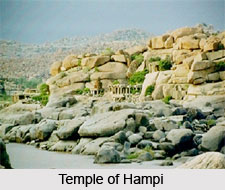 Excavations have revealed the remains of a well-connected water distribution system accessible exclusively within the majestic inclusion and the large temple complexes (suggesting it was for the exclusive use of royalty, and for special ceremonies) with sophisticated channels using gravity and siphons to transport water through pipelines.
The only structures akin to public waterworks are the remains of large water tanks that collected the seasonal monsoon water and then dried up in summer except for the few fed by springs. In the fertile agricultural areas near the Tungabhadra River, canals were dug to guide the river water into irrigation tanks. These canals had sluices that were opened and closed to control the water flow. In other areas the administration encouraged the digging of wells monitored by administrative authorities. Large tanks in the capital city were constructed with royal patronage while wealthy individuals; in order to attain social and religious merit funded smaller tanks.
Economy of Aravidu Dynasty
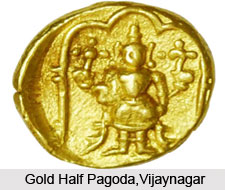
 The empire`s economy was largely dependent on agriculture. Corn (jowar), cotton and pulse legumes grew in semi arid regions, while sugarcane, rice and wheat thrived in rainy areas. Betel leaves, areca (for chewing), and coconut were the chief cash crops, and large-scale cotton production supplied the weaving centers of the empire`s vibrant textile industry. Spices such as turmeric, pepper, cardamom and ginger grew in the remote Malnad hill region and were transported to the city for trade. The empire`s capital city was a booming business center that incorporated a mushrooming market in large quantities of precious gems and gold.[40] Prolific temple building provided employment to thousands of masons, sculptors, and other skilled artisans.
Salt production and the manufacture of saltpans were controlled. The production of ghee (clarified butter), which was sold as oil for human consumption and as a fuel for lighting lamps, was profitable. Exports to China deepened and included cotton, spices, jewels, semi-precious stones, ivory, rhino horn, ebony, amber, coral, and aromatic products such as perfumes. Large vessels from China made frequent visits, some captained by the Chinese Admiral Cheng Ho, and brought Chinese products to the empire`s 300 ports, large and small, on the Arabian Sea and the Bay of Bengal. The ports of Mangalore, Honavar, Bhatkal, Barkur, Cochin, Cannanore, Machilipatnam and Dharmadam were the most important.
Ship building prospered and keeled ships of 1000-1200 bahares (burden) was built devoid of decks, sewing the entire hull with ropes rather than binding them with nails. Ships sailed to the Red Sea ports of Aden and Mecca with Vijayanagara goods sold as far away as Venice. The empire`s primary exports were pepper, ginger, cinnamon, cardamom, myrobalan, tamarind timber, anafistula, precious and semi-precious stones, pearls, musk, ambergris, rhubarb, aloe, cotton cloth and porcelain. Cotton yarn was shipped to Burma and indigo to Persia. Cloth printed with coloured patterns crafted by native techniques was exported to Java and the Far East. Golkonda specialized in plain cotton and Pulicat. The foremost imports on the east coast were non-ferrous metals, camphor, porcelain, and silk and luxury goods.
Culture of Aravidu Dynasty
The Hindu caste system was prevalent and rigidly followed, with each caste symbolized by a local body of elders who represented the community. They set the rules and regulations that were implemented with the help of imperial verdict. Untouchability was a fraction of the caste system and these communities were represented by leaders (Kaivadadavaru). Their own group in coastal Karnataka represented the Muslim communities.
Over fifty writings confirming this have been discovered the practice of Sati in the Vijayanagara principality alone. These inscriptions are termed Satikal (Sati stone) or Sati-virakal (Sati hero stone). Satikals commemorated the death of a woman by entering into fire after the death of her husband while Sati-virakals were made for a woman who performed Sati after her husband`s heroic death.
The socio-religious movements of the previous centuries, such as Lingayitism, offered impetus for lithe social customs to which women were expected to abide. By this time South Indian women had crossed most barriers and were actively involved in matters hitherto considered the monopoly of men, such as administration, business and trade and involvement in the fine arts. Tirumalamba Devi who wrote Varadambika Parinayam and Gangadevi who wrote Madhuravijayam were among the notable women poets of the era. Early Telugu women poets like Tallapaka Timmakka and Atukuri Molla became popular during this period. The court of the Nayaks of Tanjore is known to have patronised several women poets. The Devadasi system existed, as well as legalised prostitution relegated to a few streets in each city.
Physical exercises were popular with men and wrestling was an important male preoccupation for sport and entertainment. Even women wrestlers are mentioned in records. Gymnasiums have been discovered inside royal quarters and records speak of regular physical training for commanders and their armies during peace time. Royal palaces and market places had special arenas where royalty and common people alike amused themselves by watching matches such as cock fights, ram fights and wrestling between women. Excavations within the Vijayanagara city limits have revealed the existence of various types of community-based activities in the form of engravings on boulders, rock platforms and temple floors, implying these were places of casual social interaction. Some of these games are in use today and others are yet to be identified.
Although the empire was constructed to shelter Hindu dharma from the attack of the Mughal Empire and the Deccan sultanates, the Vijayanagara kings were forbearing of every religions and sects as writings by foreign visitors show. The kings used titles such as Gobrahamana Pratipalanacharya ("protector of cows") and Hindurayasuratrana ("upholder of Hindu faith") that testified to their intention of protecting Hinduism. The Empire`s founders Harihara I and Bukka Raya I were devout Shaivans (worshippers of Shiva), but made grants to the Vaishnava order of Sringeri with Vidyaranya as their patron saint, and designated Varaha (the boar, an avatar of Vishnu) as their emblem. The later Saluva and Tuluva kings were Vaishnava by faith, but worshipped at the feet of Lord Virupaksha (Shiva) at Hampi as well as Lord Venkateshwara (Vishnu) at Tirupati. A Sanskrit work, Jambavati Kalyanam by King Krishnadevaraya, called Lord Virupaksha Karnata Rajya Raksha Mani ("protective jewel of Karnata Empire"). The kings patronized the saints of the dvaita order (philosophy of dualism) of Madhvacharya at Udupi.
The Bhakti (devotional) movement was vigorous during this time, and implicated renowned Haridasas (devotee saints) of that time. Like the Virashaiva movement of the 12th century, this movement presented another strong current of devotion, pervading the lives of millions. The haridasas represented two groups, the Vyasakuta and Dasakuta, the former being required to be proficient in the Vedas, Upanishads and other Darshanas, while the Dasakuta merely conveyed the message of Madhvacharya through the Kannada language to the people in the form of devotional songs (Devaranamas and Kirthanas).
The philosophy of Madhvacharya was spread by eminent disciples such as Naraharitirtha, Jayatirtha, Vyasatirtha, Sripadaraya, Vadirajatirtha and others. Vyasatirtha was the guru (teacher) of Vadirajatirtha, Purandaradasa (Father of Carnatic music), Kanakadasa and King Krishnadevaraya who considered the saint his Kuladevata (family deity) and honoured him in many of his writings. During this time, another great composer of early carnatic music, Annamacharya composed hundreds of Kirthanas in Telugu at Tirupati in present day Andhra Pradesh.