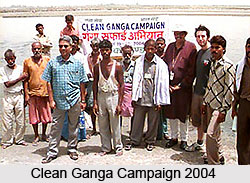
 The Clean Ganga Campaign was started to keep the legendary river pollution free, however with time many more awareness campaigns have come up to get associated with it. Sankat Mochan Foundation or the SMF is a charitable organization devoted to cleaning and protecting the sacred Ganges river in India. The Sankat Mochan Foundation was established in 1982 as a non-profit, non-political organization under the "Societies Act" of the Government of India. Veer Bhadra Mishra started this act. The vision of Sankat Mochan Foundation is to restore the Ganges by alleviating its fast deteriorating environmental conditions, promote education and health care programs for the less privileged and maintain and encourage the age-old cultural traditions of Varanasi, in tune with its current environmental needs. The SMF runs the Swatcha Ganga (Clean Ganges) program and thus it is sometimes referred to as "Swatcha Ganga".
The Government of India launched the Ganga Action Plan in 1986. Unfortunately, it has not achieved any success in spite of expenditure of over five billion rupees. The government has declared that the schemes under the Ganga Action Plan have been successful, but real measurements and scientific data narrate a different story. The failure of the GAP is clearly evident but proper, corrective action is missing. The higher the Biochemical Oxygen Demand, the higher is the pollution.
Professor William J. Oswald and his co-workers at the University of California, Berkeley, have developed the SMF AIWPS Solution. Advanced Integrated Wastewater Pond Systems (AIWPS) are potentially practicable for application in the developing world. Each AIWPS facility designs and incorporates a series of low-cost ponds or earthwork reactors. A typical AIWPS facility comprises a minimum of four ponds in the series, namely the Advanced Facultative Ponds (AFP), Secondary Facultative Ponds or Algal High Rate Ponds (HRP), Algae Settling Ponds (ASP), Maturation Ponds.
 These systems are made in a way that store sewage for 45 days, using bacteria and algae to eradicate waste and purify the water.
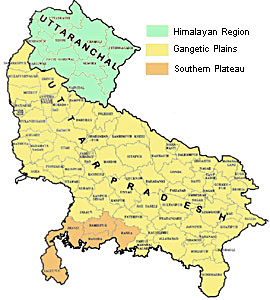
The greatest advantage of this system is that it is a low cost and highly efficient and effective mode of treating sewage, with almost no power necessity, and it is well suited for a tropical region like the Gangetic Plains. Sankat Mochan Foundation, working alongside Oswald Green LLC, had planned this system for treating the sewage water that is being let in to Ganga near the area of Varanasi. Though this solution was collectively accepted by Varanasi Nagar Nigam or the Varanasi Local Government Body, Municipal Corporation, depending on the facts that this solution is more inexpensive, greater in technology and requires very little preservation, it has been hindered by the indifference shown by the central and state government bureaucracy.
US President Bill Clinton praised the Swatcha Ganga Campaign in his speech at Agra in India. The 3-year project "Addressing Ganga`s Pollution at Varanasi with change in social habits and use through awareness, mobilization and information dissemination" was successfully launched with support from SIDA, Sweden. The Active Collaboration established between cleanup campaigners of the "River Thames" in London and the Civil Society Partnership Program (CSPP) of Ganga in India was launched together by the SMF. The Asia Foundation`s "Asia Environmental Program", San Francisco, United States, actively supported this launching.
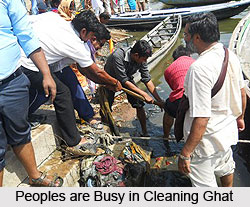
"Adopt a Ghat" program brought the schools and other local institutions together to save the world famous historical Ghats at the Ganga`s bank to maintain their cleanliness schemes with support from SIDA. In the year 2003, SMF and Oz-GREEN, Australia in cooperation organized the International Students Congress, in which participants from Australia, Bangladesh and many schools from Indian cities attended and decided their action plan for pollution reduction of rivers, especially Ganges.
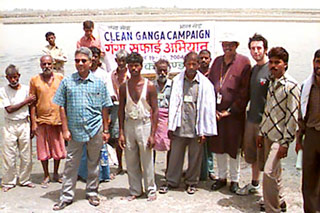 In the year 2004, "Clean Ganga - Clean Ghat" is a collaborative exhibition project implemented with support of British High Commission, New Delhi, under the SIDA project "Clean Ganga Conclave" at Tulsighat, under the CSPP Clean Ganga Day organized at New Delhi. In 2005, SMF & Oz-GREEN organized 3rd International Students Congress MoU, who signed between Times Foundation, K.K. Jajodia Foundation and Art of Living Foundation for the Holy Ganga Initiative Students from Australia and Sweden took part in World Environment Day celebration Clean Ganga Day organized in New Delhi MoU signed with Oxfam Svaraj for cleaning the River Ganga water front and ghats of Varanasi.