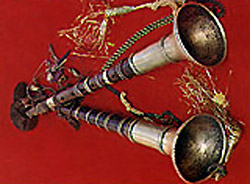
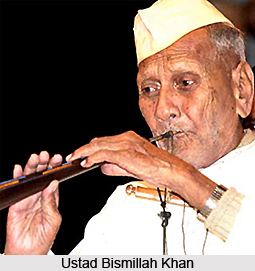
 Ustad Bismillah Khan was a motivated and extremely determined person since childhood. He was born into a family of shehnai players and his visit to his uncle`s home in Varanasi changed his life forever. He was enamoured by the way his uncle, Ali Baksh use to play the shehnai with such smoothness and passion. Bismillah soon became a disciple of Ali Baksh and this is where his historical journey with this slender, winged instrument began. Several aspects of the old-world charm impressed upon Bismillah, like the glittering nocturnal life of the narrow by-lanes of Beneras where thumri singers used to belch out their very best, or the subtleties of the shehnai he had picked up from his grandfather. Name and fame started pouring in from very early age, and the world witnessed a prodigious man with his magic with every raaga he performed. Each of his renditions was exceptional to the previous, and the audience were enraptured each time they saw his precision, his profoundness and his technique.
Early Life of Ustad Bismillah Khan
Bismillah Khan was born on 21st March 1916 into a family of shehnai players in a tiny princely state of Dumraon in Bihar. His parents named him Kamaruddin Khan; later he changed his name to Bismillah Khan. His father was a shehnai player in the service of the Dumraon court, while his grandfather had been a celebrated shehnai player during his own time. When he was about three, during the time of Id ul Zuha, his mother took him and his brother Shamsuddin to Beneras to visit their uncles, `Vilayattu` Hussain, the older one and Ali Baksh, the younger one. They were soon to become his gurus. Ali Baksh was the official shehnai player at the Kashi Vishwanath temple in Beneras, where he was required to play all day.
Bismillah, who idolized his younger mamu (uncle), followed him like a shadow to the temple and would fervently listen to him play the various raagas associated with the times of the day. After playing at the Kashi Vishwanath temple, Ali Baksh would go to the Balaji temple in Balaji Ghat and seat himself in one of the rooms in the temple and immerse himself for hours in riyaz - a fact that let a deep and enduring in the young mind of Bismillah. He right away requested his uncle since when would they commence their music sessions, and Ali Baksh promptly replied from that very moment. Despite Bismillah`s father wishes to study hard and join a profession, he could not be deterred from his aim to practice shehnai under his uncle. Ali Baksh, thus taught him every nuance of a raaga essential to master this slender instrument, which was extremely tough to tackle in the beginning for Bismillah. He was also taught vocal music and was encouraged to assimilate its appealing lilt into the art of playing. About this time, Bismillah visited his family home on Dumraon and picked up many playing tips from his grandfather - primarily the need to blow the pipe with greater force and vitality, as also the craft of sustaining his musical notes.
Life in Music for Ustad Bismillah Khan
On his return, he also learnt the intricacies of rhythm and taan-kari from his older uncle, Vilayattu Khan. He soon got back to his riyaz sessions at Balaji temple. However, he also had picked up some indirect tutelage from the then golden age of Beneras thumri and the excellence in singing and infinite varieties of melody that streamed in the night air and the throbbing passion and ardour in the voices of the mellowed thumri singers. This was to haunt Bismillah throughout the rest of his life. It was through this mechanism that he was able to assimilate the finer aspects of the Poorab-ang thumri in his own art. Besides thumri, he also picked up the exquisite folk melodies of several parts of Uttar Pradesh, like kajri, sawani and chaithi.
Bismillah Khan made his first public recital in 1930, at the Allahabad Music Conference, when he had turned 14. He was to make his first appearance in the presence of Ali Baksh. The greatest singers and the finest connoisseurs were to be the audience. None less than Ustad Faiyaz Khan came up to Ali Baksh and paid glowing compliments about his nephew`s music. Bismillah`s music had certainly come of age, and what happened to both the artist and the instrument from this point of time on is history. His beloved guru and uncle, Ali Baksh passed away a decade or so after Bismillah ascended the ladder of fame. After his uncle`s demise, he used to play with his brother Shamsuddin until the latter`s unfortunate death. His beloved brother`s death shattered him so much that he kept away from music, blunted as he was by this personal tragedy. But, with time Bismillah came back to the bosom of music.
Slowly fame came his way. Concerts, commercial recordings and radio programmes all brought him ample recognition and money started to pour in. He exhilarated audiences at the Edinburgh International Festival and the Commonwealth Arts Festival in Liverpool in the 1960s with the joyous magic of his shehnai.
Ustad Bismillah Khan`s Rise to Fame
Bismillah Khan`s music and art are no longer the coveted property of Beneras, but of an entire nation and people. Following the substantial changes and modifications he brought about in the shehnai repertoire, few had the courage to dismiss the instrument as one fit only for festive occasions. Following periods of demanding experimentation, he incorporated a whole range of skills and techniques, typical of stringed instruments, besides integrating the graceful glides and movement`s characteristic of vocal music into his art. One of the chief reasons for Bismillah`s popularity is the marvellous tonal quality his instrument emits. He eliminated the shrill tone that the instrument is prone to through his superbly controlled blowing techniques. Though even a veteran player as himself could get a span of only two octaves from the instrument, Bismillah makes up for this shortcoming with immense melodic variety, such that listeners do not feel the deficiency at all. His enviable breath control accounts for his ability to linger on and caress notes with tender emotion. His manner of playing while giving the impression of being leisurely and laidback is, in reality, extremely organized. The concise alaaps, the bhava-laden raagavistaar in vilambit, the gracefully sensuous meends, the various sparkling gamaks, and piercing taans are beautifully organized and set within the Gestalt pattern of the raaga. The sense of structure and proportion were always central to his aesthetics.
Numerous Records by Ustad Bismillah Khan
The numerous recordings in the market testify to his popularity among a very wide range of listeners. His renditions of most major and popular raagas like Bhairav, Lalit, Jaunpuri, Gujari Todi, Brindavani Sarang, Multani, Madhuvanti, Shyam Kalyan, Shankara and Malkauns are gems of precision, as they are of his unfailing instinct of tunefulness. The clear-cut manner in which he evokes the raagabhaava of these raagas would have even a seasoned musician in awe. The stirring poignancy, typical of his pipe and his style comes through in his Bageshri. The appealing tone captures the viraha or the sense of parting and separation, typical of the late night raaga. All lovers of Bismillah Khan`s shehnai will treasure the volumes of his radio recordings brought out by T-Series. His Allaiya Bilawal, Brindavani Sarang, Bihag and Jaijaiwanti are memorable for several exquisite reasons. Bismillah Khan is at his expressive best when he plays light classical forms like thumris, kajris and dhuns. His sure sense of melody, earthy vitality, zest and playful element, all manifest themselves when he renders them with effortless ease.
Awards and Recognitions by Ustad Bismillah Khan
Awards
* Bharat Ratna (2001)
* Fellow of Sangeet Natak Akademi (1994).
* Talar Mausiquee from Republic of Iran (1992).
* Padma Vibhushan (1980)
* Padma Bhushan (1968)
* Padma Shri (1961)
* Sangeet Natak Akademi Award (1956)
* Tansen Award by Govt. of Madhya Pradesh.
* Three medals in All India Music Conference, Calcutta (1937)
* "Best Performer" in All India Music Conference, Allahabad (1930)
Recognitions by Ustad Bismillah Khan
Bismillah Khan had honorary doctorates from
* Banaras Hindu University, Varanasi
* Visva Bharati University, Santiniketan
Others Awards include
* Was invited by the then Prime Minister of India Pandit Jawaharlal Nehru to play shehnai on the first Independence Day (August 15, 1947) in Delhi`s Red Fort.
* Participated in World Exposition in Montreal
* Participated in Cannes Art Festival
* Participated in Osaka Trade Fair
* His 80th birthday was celebrated by World Music Institute in New York
Death of Ustad Bismillah Khan
Bismillah Khan on August 17, 2006, fell ill and admitted to the Heritage Hospital, Varanasi for treatment. He died after four days on August 21, 2006 due to a cardiac arrest. He is survived by five sons, three daughters and a large number of grandchildren and great-grandchildren