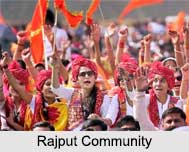
 Rajput Community is the representative of the old warrior or Kshatriya class of India. Rajputs are considered as the second of the four castes of Hinduism. There are over 200 million Rajputs in India. Rajasthan is their original home, but they are also settled in other parts of the country like Jammu and Kashmir, Himachal Pradesh, Haryana, Madhya Pradesh, Uttar Pradesh, Bihar, Odisha, Gujarat, Maharashtra and Andhra Pradesh. Some people of West Bengal and Assam also claim Rajput descent.
Origin of Rajput Community
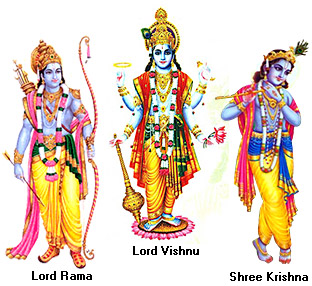
Rajputs claim to be the descendants of the Kshatriyas who were originally Aryans. They are considered "dwija" (twice born) and are entitled to wear the sacred thread. Thakur is the common title of Rajput. There are 36 Rajput clans tracing their mythical descent from the sun, the moon and the sacred fire, known as the Suryavanshi, Chandravanshi and Agnivanshi respectively. It is believed that they were made from the arms of Lord Brahma.
Etymology of Rajput Community
"Rajputra" is a Sanskrit word and is found in several ancient texts, like Vedas, Ramayana and Mahabharata. This term was used by ancient Sanskrit grammarian Panini in 4th century BCE. In the past, the word "Kshatriya" was commonly used for Vedic community consisting of rulers and warriors. The word "Rajputra" was used for differentiating Kshatriyas from royal warriors. The word Rajput literally means "son of a king". Eventually, the term Rajputra was shortened to Rajput and slowly it became a caste in India.
History of Rajput Community
 Bravery, chivalry, loyalty, beauty, feuds, wars - all these abound in the history of the Rajputs. Rajput community rose to fame between 9th and 11th centuries. It is said that the Rajputs ruled over 400 of approximate 600 princely states at the time of independence of the country in 1947.
The history of Rajputs is dotted with tales of bravery and compassion. There was a tradition in many Rajput states of having at least one Muslim amongst their social chiefs. Hakim Khan Sur was one of the prominent generals in Maharana Pratap Singh`s army, who fought the battle of Haldi Ghati.
Society and Religion of Rajput Community
The Rajput values honour more than anything else in life. Women are given a respectable position in society. They are given education and in the past they even were taught martial art for self protection. Rajput women are known to be very brave. This warrior clan is quite religious minded. They have full faith in Mother Goddesses. Temples are scattered in the regions where they are settled. Festivals, such as, Shivaratri, Dussehra and Diwali are quite popular with the Rajput community. In Rajput community, marriage within the same clan is not allowed.
Profession of Rajput Community
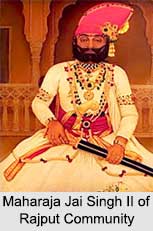
The Rajputs considered war and governance as the highest arts of all, but among them have been poets, scientists, musicians and architects. The Rajput noble"s court was a centre for the cultivation of the fine arts and even some sciences. The Jantar Mantar observatory at New Delhi was the creation of a Rajput prince, Maharaja Jai Singh II (1699-1744). He himself was a great astronomer and also built similar observatories at Varanasi, Ujjain, Udaipur, Rajasthan and Mathura. Beautiful paintings, acclaimed as exquisite pieces of art, have been produced by Rajput artists in certain distinctive styles.
Many Rajputs are engaged in agriculture today and serve in the armed forces and the police as well. A minority is engaged as clerks and in the professions though some have occupied senior positions in the services. Honesty and honour were and still are the building stones for the Rajput community.